Mississippi Math A3.N.5
The Standard
Extend the meaning of exponents to include rational numbers.
2025 Mississippi College- and Career-Readiness Standards for Mathematics
Teacher's field guide
What This Standard Means
What Students Need to Do
- Students use roots to make sense of fractional exponents. They rewrite 27^(2/3) as the square of the cube root of 27, then find its value. They use reciprocals when the exponent is negative.
What Mastery Looks Like
- A student can explain why 16^(1/2) equals 4, since 4 squared is 16. They can find 8^(-2/3) = 1/4 and recognize that (-16)^(1/2) is not a real number.
Common Misconceptions
- Students may divide by the denominator of a fractional exponent instead of taking a root. They may think a negative exponent makes the answer negative. Some assume the square root of a negative number is real.
How to Assess It
- On an exit ticket, ask students to find 27^(2/3) and 16^(-1/2). Have them show the root and, where needed, the reciprocal.
Lesson moves
Ways to Teach It
Give each pair 16 square tiles. Have them build a square, count its side length in tiles, and label it 16^(1/2).
Ask: Why is 27^(2/3) equal to 9, not 18? Have partners write a two-step explanation.
Have students match cards showing 16^(3/4), 27^(2/3), and 8^(-2/3) to separate cards with root forms and values.
A cube-shaped box has a volume of 64 cubic centimeters. Have students find its edge length using 64^(1/3), then check by cubing.
Free download
Printable A3.N.5 Worksheet
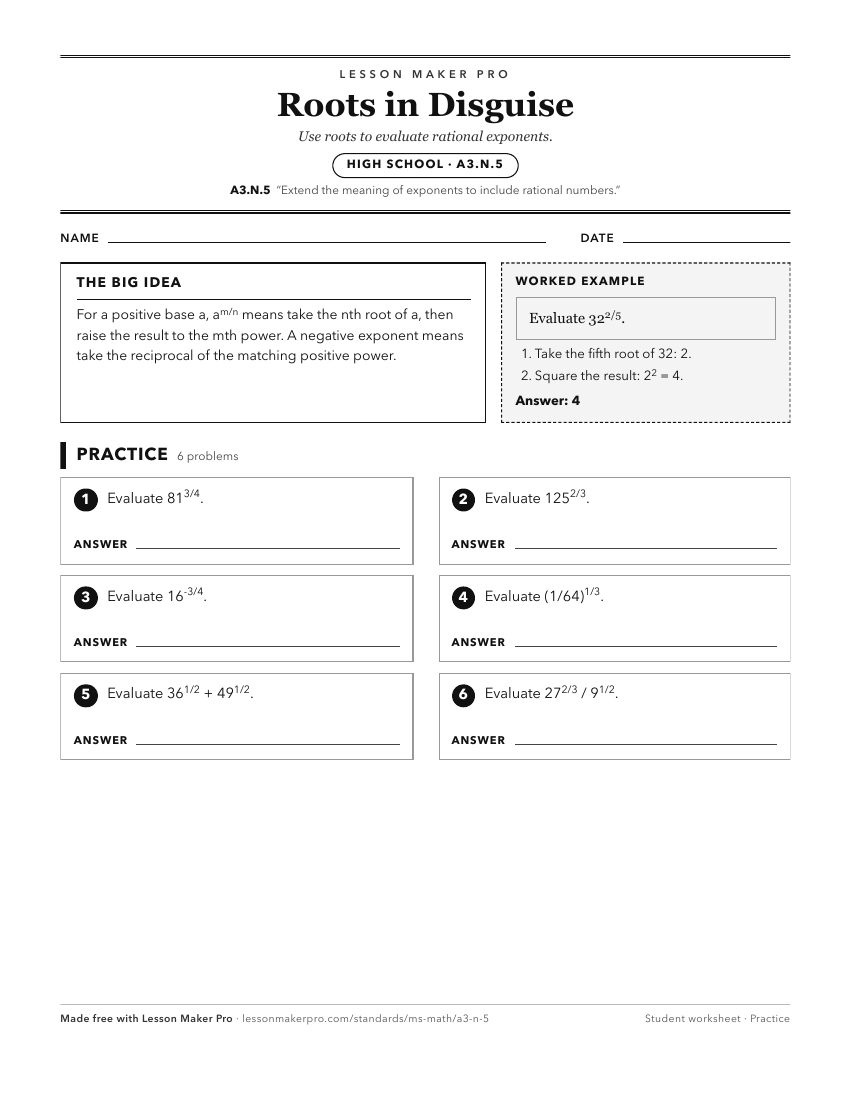
A ready-to-print activity worksheet aligned to A3.N.5, with an answer key for the teacher on its own page. No account needed.
PDF, US Letter, prints cleanly in black and white.
Download the worksheetKeep exploring
Related Standards
Turn this exact standard into a lesson
Grade, subject, topic, and the complete standard are prefilled. Create one free, no account needed.
Also for this standard:Make a WorksheetMake a QuizMake a Sub Lesson