Mississippi Math A3.N.3
The Standard
Calculate limits based on convergent and divergent series.
2025 Mississippi College- and Career-Readiness Standards for Mathematics
Teacher's field guide
What This Standard Means
What Students Need to Do
- Students find the partial sums of a series and decide whether they approach a finite number. For a geometric series, they use the first term and common ratio to calculate that limit when one exists.
What Mastery Looks Like
- Given 3 + 1.5 + 0.75 + ..., a student finds a limit of 6. Given 1 - 1 + 1 - 1 + ..., they show that the partial sums alternate between 1 and 0, so no limit exists.
Common Misconceptions
- Some students think terms shrinking to zero guarantee a finite sum, but 1 + 1/2 + 1/3 + ... keeps growing. Others use the infinite geometric sum formula when the common ratio is 1 or -1.
How to Assess It
- Exit ticket: Find the limit of the partial sums for 4 + 2 + 1 + ... and 2 - 2 + 2 - 2 + .... Show the first four partial sums for each and explain your answers.
Lesson moves
Ways to Teach It
Cut paper strips 1, 1/2, 1/4, and 1/8 unit long; lay them end to end and predict the total length after infinitely many strips.
Ask students to explain why 1 + 1/2 + 1/4 + ... approaches 2 while 1 + 2 + 4 + ... does not.
Give pairs three series cards: 3 + 1.5 + 0.75 + ..., 2 + 2 + 2 + ..., and 5 - 5 + 5 - .... Have them sort by whether the partial sums have a finite limit.
A ball drops 1 meter and bounces to half its previous height each time; have students calculate its total travel distance.
Free download
Printable A3.N.3 Worksheet
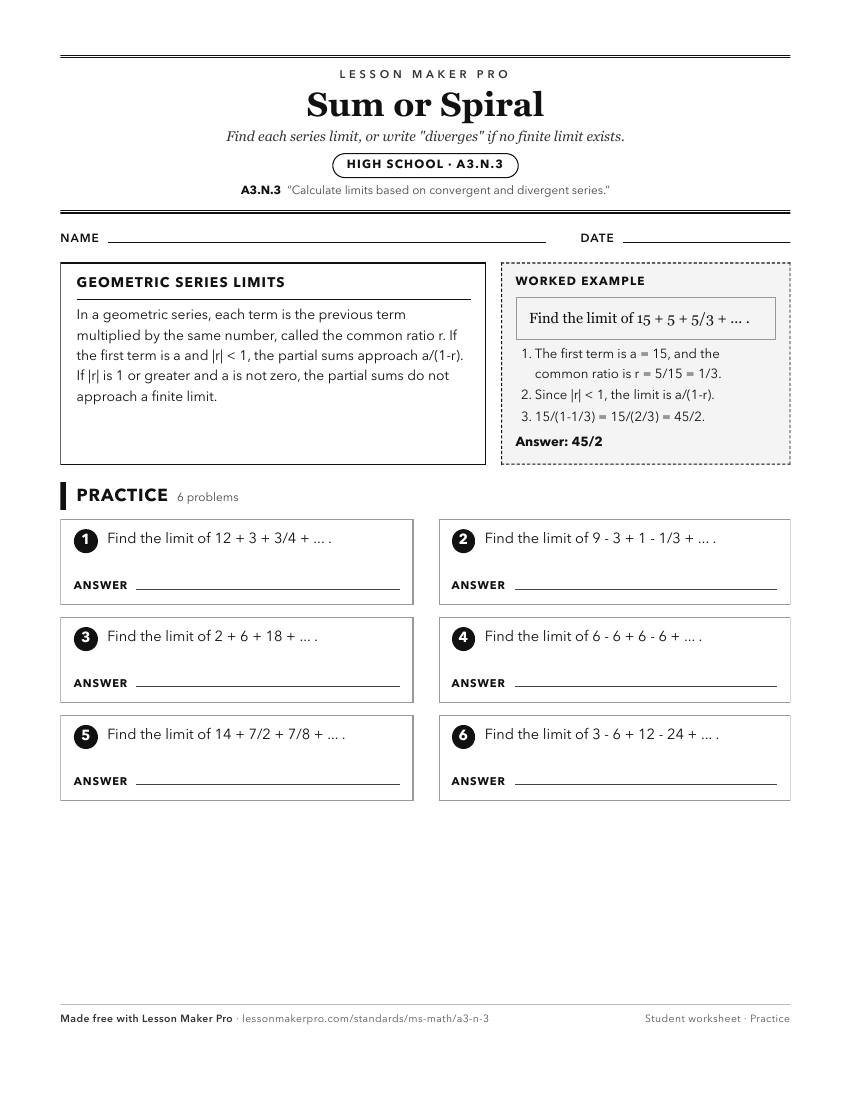
A ready-to-print activity worksheet aligned to A3.N.3, with an answer key for the teacher on its own page. No account needed.
PDF, US Letter, prints cleanly in black and white.
Download the worksheetKeep exploring
Related Standards
Turn this exact standard into a lesson
Grade, subject, topic, and the complete standard are prefilled. Create one free, no account needed.
Also for this standard:Make a WorksheetMake a QuizMake a Sub Lesson