Mississippi Math 6.NS.9
Standard Cluster
Apply and extend previous understandings of addition and subtraction to add and subtract integers; represent addition and subtraction on a horizontal or vertical number line diagram. a. Describe situations in which opposite quantities combine to make 0. For example, a hydrogen atom has 0 charge because its two constituents are oppositely charged. b. Understand p + q as the number located a distance |q| from p, in the positive or negative direction depending on whether q is positive or negative. Show that a number and its opposite have a sum of 0 (are additive inverses). Interpret sums of integers by describing real-world contexts. c. Understand subtraction of integers as adding the additive inverse, p – q = p + (– q). Show that the distance between two integers on the number line is the absolute value of their difference, and apply this principle in real-world contexts. d. Apply properties of operations as strategies to add and subtract integers.
2025 Mississippi College- and Career-Readiness Standards for Mathematics · Apply and Extend Previous Understandings of Numbers to the System of Rational Numbers
Cluster contents
Standards in This Cluster
6.NS.9 is a cluster heading. These are the individual standards under it.
- 6.NS.9a
Describe situations in which opposite quantities combine to make 0. For example, a hydrogen atom has 0 charge because its two constituents are oppositely charge...
- 6.NS.9b
Understand p + q as the number located a distance |q| from p, in the positive or negative direction depending on whether q is positive or negative. Show that a ...
- 6.NS.9c
Understand subtraction of integers as adding the additive inverse, p – q = p + (– q). Show that the distance between two integers on the number line is the abso...
- 6.NS.9d
Apply properties of operations as strategies to add and subtract integers.
Teacher's field guide
What This Cluster Means
What Students Need to Do
- Students use number lines to add and subtract positive and negative integers. They rewrite subtraction as addition of the opposite and show why opposite numbers add to zero. They find the distance between two integers and explain what an integer sum means in a real situation.
What Mastery Looks Like
- A student can show 3 - (-5) as 3 + 5 and move eight units right on a number line. They can pair -4 and 4 to make zero when adding -4 + 7 + 4. They can find the distance from -3 to 5 as 8 units.
Common Misconceptions
- Students may move left when subtracting a negative number. Some think -6 + 6 equals 12 because they ignore the signs. Others report a negative distance, such as -8 units from -3 to 5.
How to Assess It
- Exit ticket: Start at -3 on a number line, add 5, then subtract -2; draw each move, write the final value, and state its distance from -3.
Lesson moves
Ways to Teach It
Tape a number line on the floor; have students start at -2, add 5, then subtract -3 by walking right.
Ask, “Why does -6 + 6 equal 0, but -6 - 6 does not?” Have partners sketch and explain.
Give pairs cards labeled -4, 4, and 7; have them rearrange the numbers to make a zero pair and name the addition property used.
Post morning and evening temperatures of -5°C and 3°C; have students draw both readings and find the temperature change.
Free download
Printable 6.NS.9 Worksheet
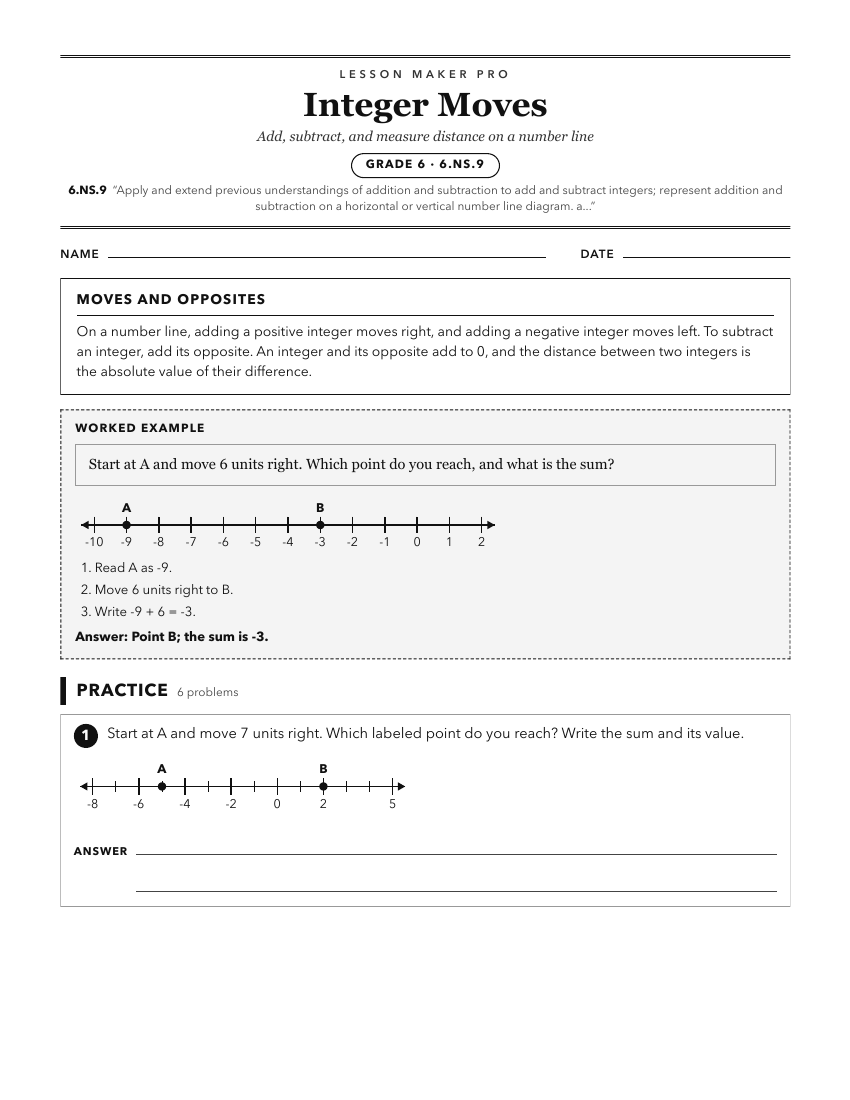
A ready-to-print activity worksheet aligned to 6.NS.9, with an answer key for the teacher on its own page. No account needed.
PDF, US Letter, prints cleanly in black and white.
Download the worksheetTurn this cluster into a lesson
Grade, subject, topic, and the complete cluster are prefilled. Create one free, no account needed.
Also for this cluster:Make a WorksheetMake a QuizMake a Sub Lesson