Maryland Math G.GPE.D.12
The Standard
Graph polar equations by hand and using technology.
Maryland College and Career Ready Standards for Mathematics (2025) · Polar Equations.
Teacher's field guide
What This Standard Means
What Students Need to Do
- Students make a table of angles and radii for a polar equation, then plot the points on a polar grid. They sketch the curve and check its shape with a graphing tool.
What Mastery Looks Like
- A student plots points for r=2cos θ, placing negative radii on the opposite ray. Their hand sketch matches the graphing tool, and they can explain the curve's symmetry.
Common Misconceptions
- Students may place a negative radius on the named ray instead of the opposite ray. They may treat θ as an x-coordinate or leave the graphing tool in degree mode when using radians.
How to Assess It
- Exit ticket: For r=2cos θ, find and plot the points at θ=0, π/2, π, and 3π/2. Explain where the point at θ=π goes when r=-2.
Lesson moves
Ways to Teach It
Tape a polar grid to the floor, then use string to mark points for r=2+2cos θ at 45-degree steps.
Ask partners: Why does r=2cos θ at θ=π land at (2,0)? Have them explain with a sketch.
Give pairs angle cards for r=3sin(2θ); have them race to plot the points, then check the rose in Desmos.
Show a cardioid microphone pickup pattern, then have students compare its outline to a graph of r=2+2cos θ.
Free download
Printable G.GPE.D.12 Worksheet
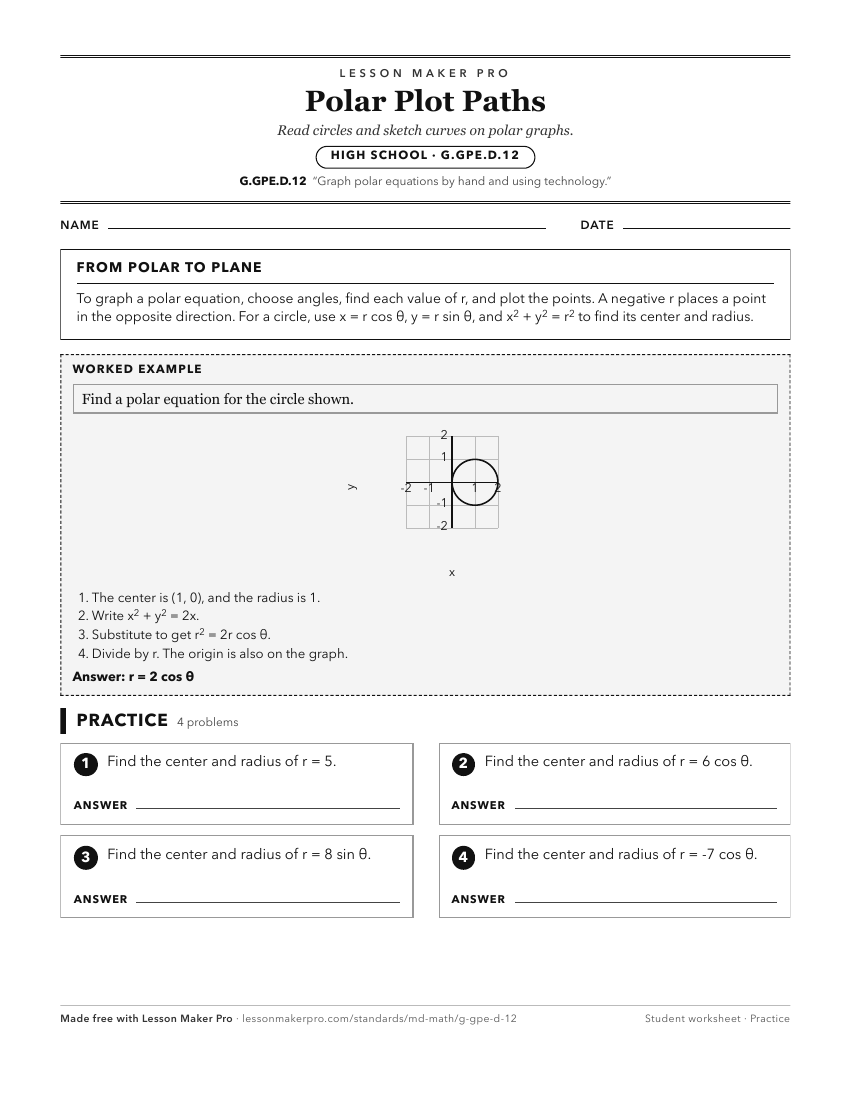
A ready-to-print activity worksheet aligned to G.GPE.D.12, with an answer key for the teacher on its own page. No account needed.
PDF, US Letter, prints cleanly in black and white.
Download the worksheetKeep exploring
Related Standards
Turn this exact standard into a lesson
Grade, subject, topic, and the complete standard are prefilled. Create one free, no account needed.
Also for this standard:Make a WorksheetMake a QuizMake a Sub Lesson