Maryland Math G.GPE.C.8
The Standard
Understand the relationship between polar coordinates and Cartesian coordinates.
Maryland College and Career Ready Standards for Mathematics (2025) · Polar Coordinates.
Teacher's field guide
What This Standard Means
What Students Need to Do
- Students plot a point using its distance from the origin and an angle measured from the positive x-axis. They convert between that description and x-y coordinates using right triangles, sine, and cosine.
What Mastery Looks Like
- Given (4, 150°), a student plots the point in quadrant II and finds its x-y coordinates, (−2√3, 2). Given (−3, 3), they find a distance of 3√2 and an angle of 135°.
Common Misconceptions
- Students may measure the angle clockwise or start from the positive y-axis. They may treat the distance as the x-coordinate or choose an angle without checking the quadrant.
How to Assess It
- Exit ticket: Plot the point (4, 150°) and give its x-y coordinates. Show how you found them.
Lesson moves
Ways to Teach It
Give pairs a protractor, ruler, and coordinate grid; have them plot (5, 120°) and measure its x and y coordinates.
Ask, "How can (3, 0°) and (3, 360°) name the same point?" Have students sketch and explain.
Make matching cards for (2√2, 45°), (2, 2), and a sketch; have teams assemble matching sets.
Show a radar target 10 km away at 30° counterclockwise from east; students calculate its east and north distances.
Free download
Printable G.GPE.C.8 Worksheet
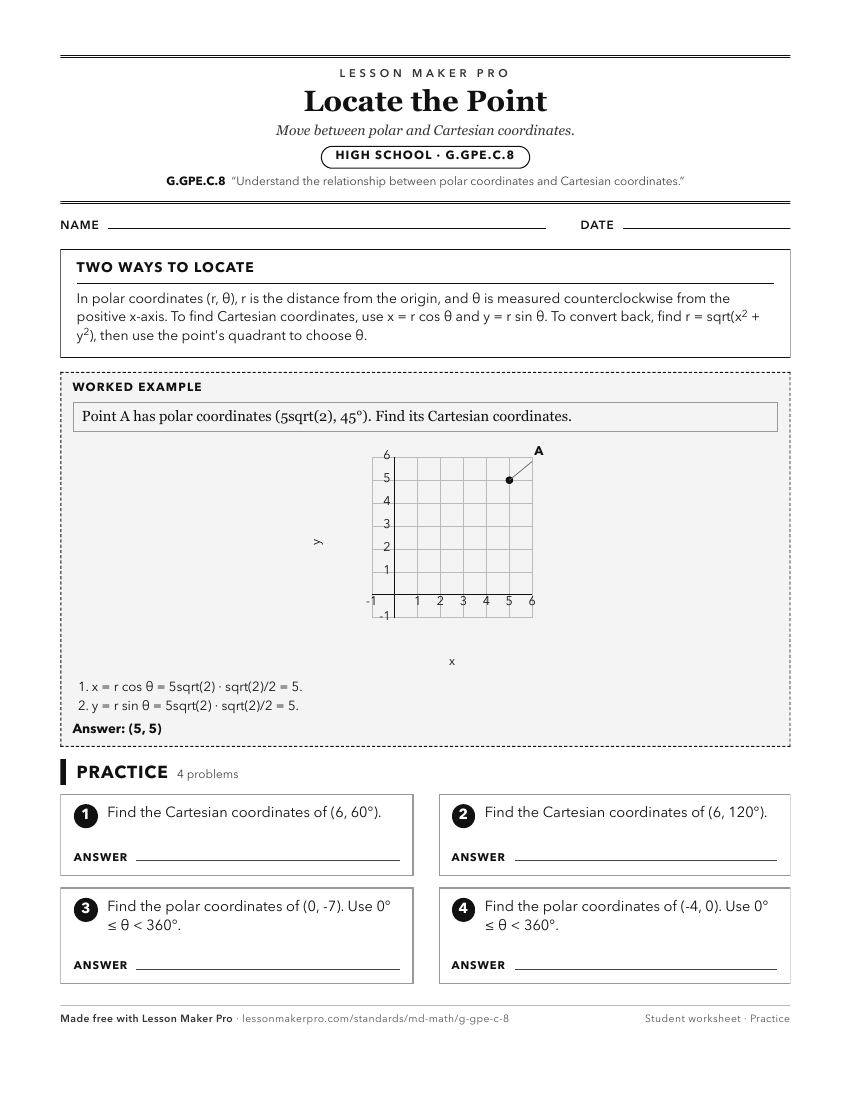
A ready-to-print activity worksheet aligned to G.GPE.C.8, with an answer key for the teacher on its own page. No account needed.
PDF, US Letter, prints cleanly in black and white.
Download the worksheetKeep exploring
Related Standards
Turn this exact standard into a lesson
Grade, subject, topic, and the complete standard are prefilled. Create one free, no account needed.
Also for this standard:Make a WorksheetMake a QuizMake a Sub Lesson