Maryland Math 8.NOS.B.5.a
The Standard
- 8.NOS.B.5
- Apply scientific notation to represent and compare very large and very small quantities in context, and use technology to compute with numbers in scientific notation.
Express numbers as a single digit times an integer power of 10 to estimate and compare magnitudes.
Maryland College and Career Ready Standards for Mathematics (2025) · REASON WITH EXPONENTS TO EXPRESS AND INTERPRET QUANTITIES.
Teacher's field guide
What This Standard Means
What Students Need to Do
- Students round numbers to one nonzero digit and write each estimate as that digit times a power of 10. They use the estimates to compare large numbers and numbers smaller than one.
What Mastery Looks Like
- A student estimates 0.0048 as 5 × 10^-3 and 0.00062 as 6 × 10^-4. They can explain why the first is about eight times as large.
Common Misconceptions
- Students may think a negative exponent makes the number negative. Some reverse the order of 10^-3 and 10^-4, or write 43 × 10^5 instead of using a single digit.
How to Assess It
- Exit ticket: Estimate 0.0072 and 0.00093 as a single digit times a power of 10. Circle the larger number and estimate how many times larger it is.
Lesson moves
Ways to Teach It
Give pairs decimal number cards to place on a tape number line marked with powers of 10.
Ask students to explain in writing why 6 × 10^-3 is about eight times 8 × 10^-4.
Play estimate match: students flip decimal cards and power-of-10 cards, then keep pairs that agree to one nonzero digit.
Compare a city population of 3,000,000 with a stadium capacity of 40,000, and estimate how many stadiums would hold the city.
Free download
Printable 8.NOS.B.5.a Worksheet
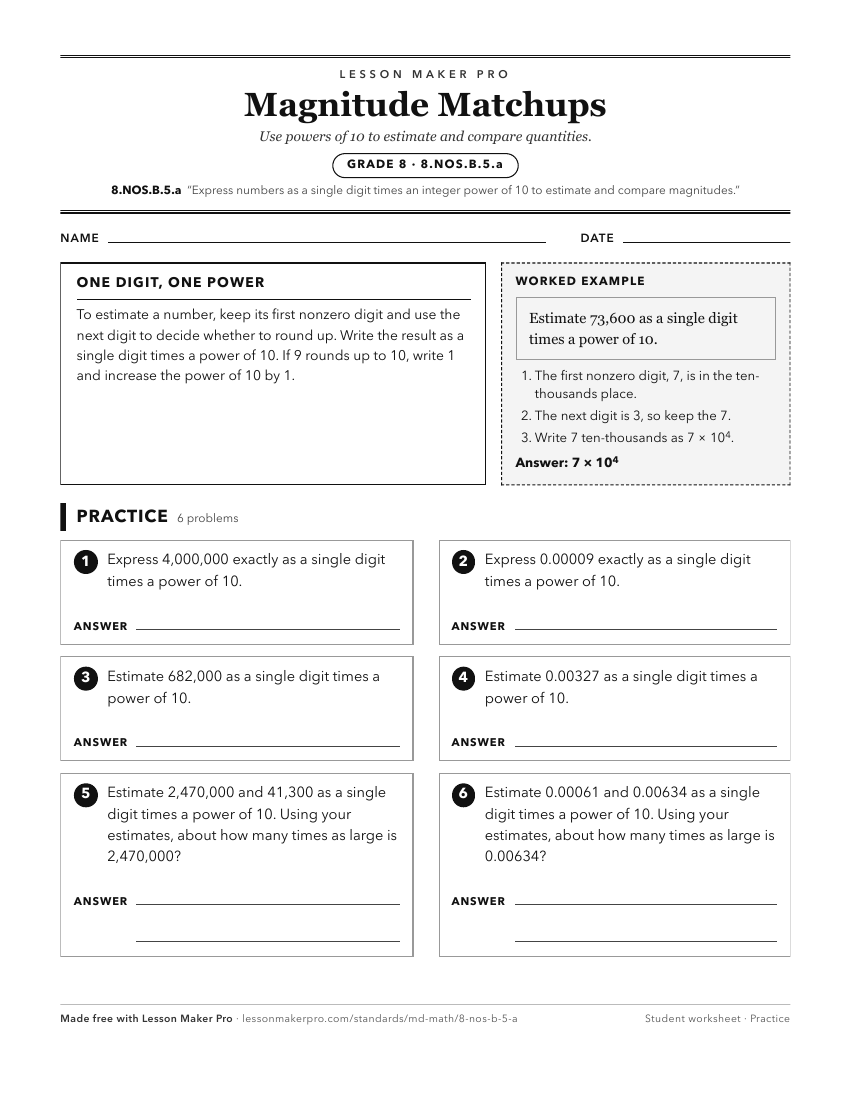
A ready-to-print activity worksheet aligned to 8.NOS.B.5.a, with an answer key for the teacher on its own page. No account needed.
PDF, US Letter, prints cleanly in black and white.
Download the worksheetKeep exploring
Related Standards
- 8.NOS.B.5
Apply scientific notation to represent and compare very large and very small quantities in context, and use technology to compute with numbers in scientific not...
- 4.NOS.B.5
Multiply a whole number of up to four digits by a one-digit whole number, and multiply two two-digit numbers.
- 4.NOS.B.4
Extend place value understanding and basic facts to multiply a multi-digit whole number by a multiple of ten.
Turn this exact standard into a lesson
Grade, subject, topic, and the complete standard are prefilled. Create one free, no account needed.
Also for this standard:Make a WorksheetMake a QuizMake a Sub Lesson