Maryland Math 7.NOS.A.2
Standard Cluster
Multiply and divide rational numbers using multiple strategies and representations. Model multiplication of rational numbers using number lines, arrays, or area models to show how properties of operations (e.g., the distributive property) lead to rules for signed number multiplication, including (−1) × (−1) = 1. Interpret quotients of rational numbers in context and represent division of signed numbers in different forms, such as −(p/q) = (−p)/q = p/(−q) when the divisor is not zero. Use properties of operations to multiply and divide rational numbers flexibly and efficiently. Analyze the decimal representation of a quotient resulting from dividing rational numbers to determine whether it terminates or repeats and use this pattern to explain why all rational numbers have decimal forms that either terminate or repeat. Model and solve multistep contextual problems involving multiplication and division of rational numbers, using efficient and flexible strategies.
Maryland College and Career Ready Standards for Mathematics (2025) · USE STRUCTURE AND REPRESENTATIONS TO REASON WITH RATIONAL NUMBERS.
Cluster contents
Standards in This Cluster
7.NOS.A.2 is a cluster heading. These are the individual standards under it.
- 7.NOS.A.2.a
Model multiplication of rational numbers using number lines, arrays, or area models to show how properties of operations (e.g., the distributive property) lead ...
- 7.NOS.A.2.b
Interpret quotients of rational numbers in context and represent division of signed numbers in different forms, such as −(p/q) = (−p)/q = p/(−q) when the diviso...
- 7.NOS.A.2.c
Use properties of operations to multiply and divide rational numbers flexibly and efficiently.
- 7.NOS.A.2.d
Analyze the decimal representation of a quotient resulting from dividing rational numbers to determine whether it terminates or repeats and use this pattern to ...
- 7.NOS.A.2.e
Model and solve multistep contextual problems involving multiplication and division of rational numbers, using efficient and flexible strategies.
Teacher's field guide
What This Cluster Means
What Students Need to Do
- Students use models and properties to multiply signed numbers and explain the sign of a product. They divide signed fractions, interpret negative quotients, and solve multistep problems. They track remainders to explain why a rational decimal stops or repeats.
What Mastery Looks Like
- Students use 0 = (-1) × (1 + (-1)) to show why (-1) × (-1) = 1. They solve a multistep problem and show that -(3/4), (-3)/4, and 3/(-4) have the same value. They explain that division reaches a remainder of zero or repeats a remainder, so a rational decimal terminates or repeats.
Common Misconceptions
- Students may know that two negatives make a positive but cannot explain why. Some put a negative sign on both the numerator and denominator and expect a negative quotient. Others assume a long decimal is irrational without checking whether its digits repeat.
How to Assess It
- Exit ticket: Calculate (-3/4) ÷ (1/2), write the quotient with its negative sign in two positions, and state whether its decimal terminates.
Lesson moves
Ways to Teach It
Build three zero pairs with red negative and blue positive counters, then remove the red counters to model (-1) × (-3).
Ask students to expand 0 = (-1) × (1 + (-1)) and explain what (-1) × (-1) must equal.
Play a remainder race: divide 1 by 6 and 3 by 8, record each remainder, and explain why one decimal repeats.
A diver descends 2.5 meters per minute for 4 minutes, then rises 6 meters over 3 minutes; find the final depth and rising rate.
Free download
Printable 7.NOS.A.2 Worksheet
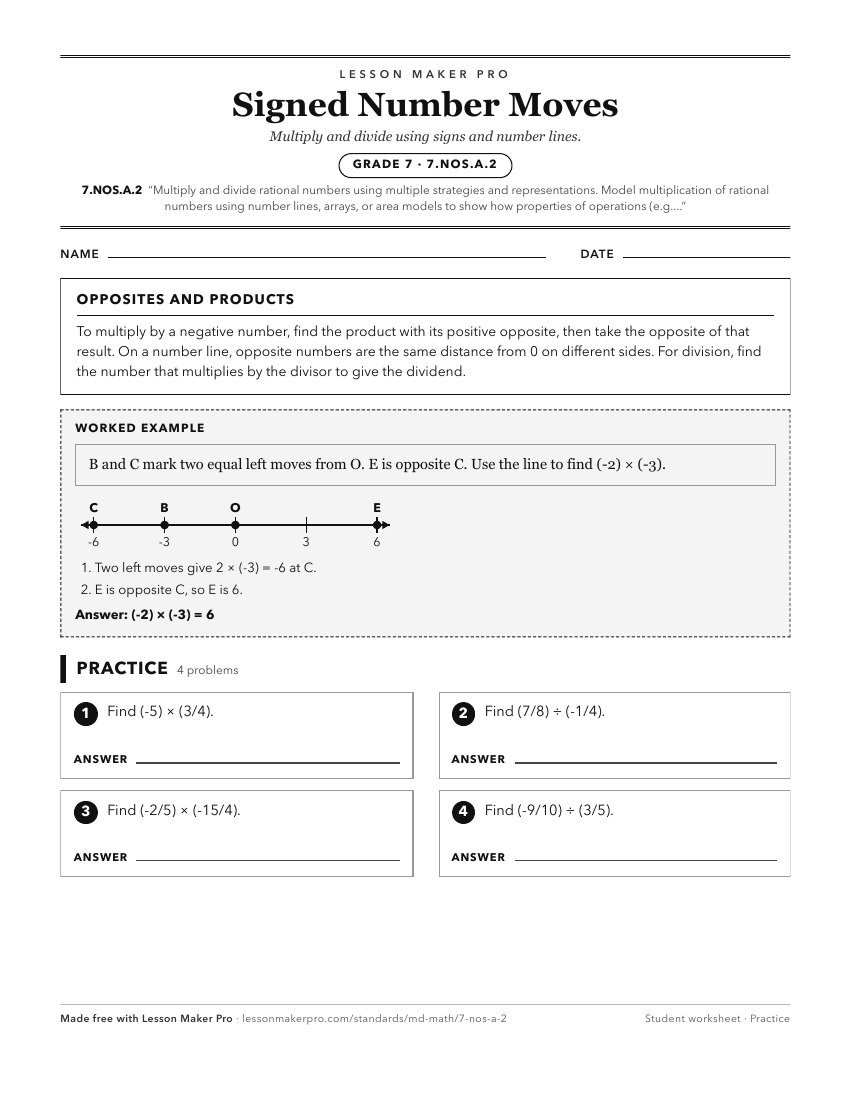
A ready-to-print activity worksheet aligned to 7.NOS.A.2, with an answer key for the teacher on its own page. No account needed.
PDF, US Letter, prints cleanly in black and white.
Download the worksheetKeep exploring
Related Standards
Turn this cluster into a lesson
Grade, subject, topic, and the complete cluster are prefilled. Create one free, no account needed.
Also for this cluster:Make a WorksheetMake a QuizMake a Sub Lesson