Maryland Math 7.GR.B.4
Standard Cluster
Solve mathematical problems with and without context involving area, surface area, and volume of two- and three-dimensional objects. Solve problems involving area, surface area, and volume of polygonal figures and polyhedral solids, including triangles, quadrilaterals, other polygons, cubes, right prisms, and pyramids—figures defined by edges and flat faces. Solve problems involving volume of curved-surface solids, including cones, cylinders, and spheres—figures without edges. Interpret and justify solutions in context by comparing different geometric representations, estimating or checking for reasonableness, and explaining how the result applies to the context.
Maryland College and Career Ready Standards for Mathematics (2025) · REASON WITH AND ABOUT GEOMETRIC FORMULAS TO SOLVE PROBLEMS AND JUSTIFY SOLUTIONS IN CONTEXT.
Cluster contents
Standards in This Cluster
7.GR.B.4 is a cluster heading. These are the individual standards under it.
- 7.GR.B.4.a
Solve problems involving area, surface area, and volume of polygonal figures and polyhedral solids, including triangles, quadrilaterals, other polygons, cubes, ...
- 7.GR.B.4.b
Solve problems involving volume of curved-surface solids, including cones, cylinders, and spheres—figures without edges.
- 7.GR.B.4.c
Interpret and justify solutions in context by comparing different geometric representations, estimating or checking for reasonableness, and explaining how the r...
Teacher's field guide
What This Cluster Means
What Students Need to Do
- Students find polygon areas by splitting shapes into familiar parts. They calculate surface area of cubes, prisms, and pyramids, and volume of those solids plus cylinders, cones, and spheres. They choose units and check whether answers fit the situation.
What Mastery Looks Like
- A student can find the area of an L-shaped floor by two methods and get the same result. They can add face areas on a prism or pyramid net and find the volume of a cone, cylinder, or sphere. They label square and cubic units correctly and check their answers against the object's size.
Common Misconceptions
- Students sometimes add side lengths when asked for area or leave out faces hidden in a drawing when finding surface area. They may use the diameter as the radius in a volume formula. They may also use square units for volume or assume a cone holds as much as a cylinder with the same base and height.
How to Assess It
- Exit ticket: A closed box measures 4 cm by 3 cm by 2 cm. Sketch its faces, find its surface area and volume, then explain why the answers use different units.
Lesson moves
Ways to Teach It
Cut and fold paper nets of a cube and a square pyramid, then measure the faces and calculate each total surface area.
Compare an L-shaped floor split into rectangles with one found by subtracting a cutout; write why both area methods match.
Give pairs dimension cards for prisms, pyramids, cylinders, cones, and spheres; have them match each with its volume formula and calculate.
Measure a cylindrical storage jar and calculate its volume; pour in water from a marked measuring cup to check your estimate.
Free download
Printable 7.GR.B.4 Worksheet
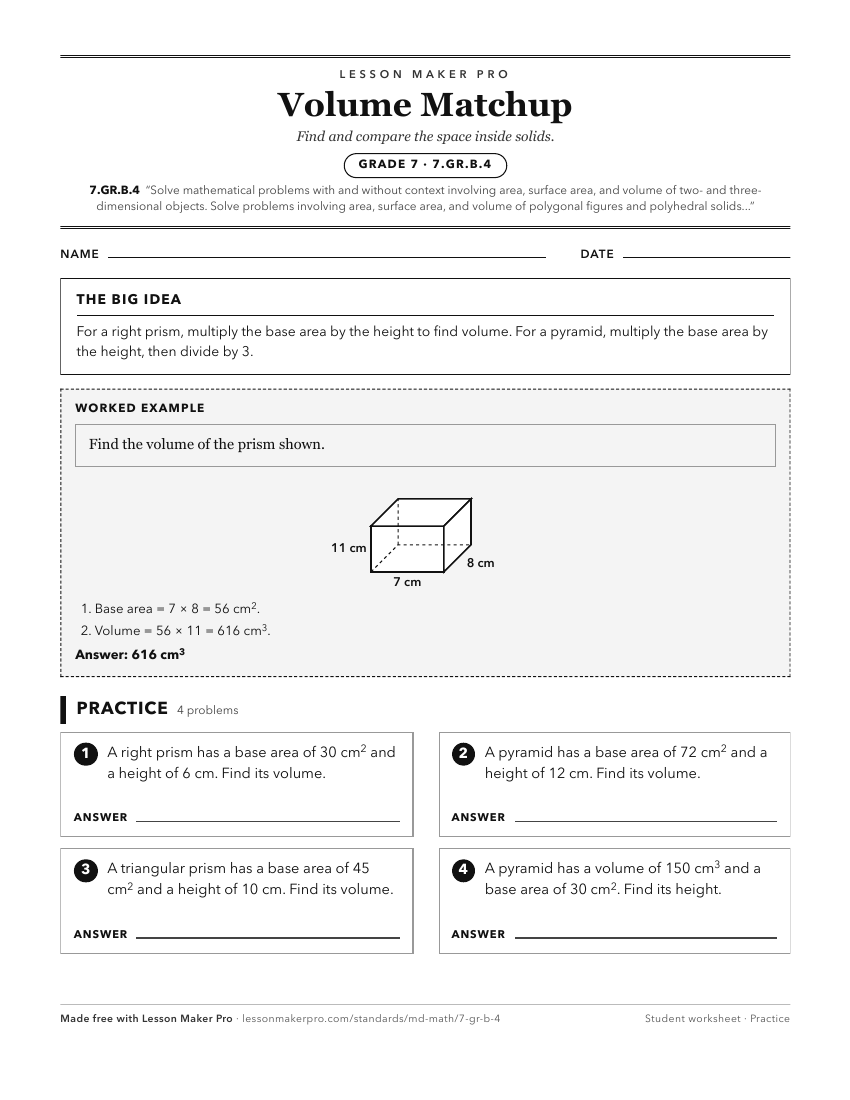
A ready-to-print activity worksheet aligned to 7.GR.B.4, with an answer key for the teacher on its own page. No account needed.
PDF, US Letter, prints cleanly in black and white.
Download the worksheetKeep exploring
Related Standards
Turn this cluster into a lesson
Grade, subject, topic, and the complete cluster are prefilled. Create one free, no account needed.
Also for this cluster:Make a WorksheetMake a QuizMake a Sub Lesson