Maryland Math 5.GR.C.5
Standard Cluster
Relate volume to the operations of multiplication and addition and solve problems in context. Find the volume of a right rectangular prism with whole-number side lengths by filling it with unit cubes in layers and show that the volume is the same as would be found by multiplying the edge lengths, or by multiplying the height by the area of the base. Represent products of three whole numbers as volumes, (e.g., to represent the associative property of multiplication). Apply the formulas V = (l)(w)(h) and V = (B)(h) for rectangular prisms to find volumes of right rectangular prisms with whole-number edge lengths to solve problems in the context. Determine the volumes of composite figures by decomposing them into non-overlapping right rectangular prisms and adding their volumes together to solve problems in context
Maryland College and Career Ready Standards for Mathematics (2025) · UNDERSTAND CONCEPTS OF VOLUME AND RELATE VOLUME TO MULTIPLICATION.
Cluster contents
Standards in This Cluster
5.GR.C.5 is a cluster heading. These are the individual standards under it.
- 5.GR.C.5.a
Find the volume of a right rectangular prism with whole-number side lengths by filling it with unit cubes in layers and show that the volume is the same as woul...
- 5.GR.C.5.b
Apply the formulas V = (l)(w)(h) and V = (B)(h) for rectangular prisms to find volumes of right rectangular prisms with whole-number edge lengths to solve probl...
- 5.GR.C.5.c
Determine the volumes of composite figures by decomposing them into non-overlapping right rectangular prisms and adding their volumes together to solve problems...
Teacher's field guide
What This Cluster Means
What Students Need to Do
- Students build rectangular prisms with unit cubes and count the cubes in layers. They use multiplication to find a prism’s volume in cubic units. For joined solids, they find the volume of each non-overlapping block and add.
What Mastery Looks Like
- A student can show that a 4 by 3 by 2 prism has two layers of 12 cubes, or 24 cubic units. They can regroup the three factors and get the same volume. They can split a joined solid into prisms, calculate each volume, and add without counting any space twice.
Common Misconceptions
- Students may count only the cubes they can see. Some add the edge lengths instead of multiplying them, or label volume in square units. When splitting a joined solid, they may count the same space twice.
How to Assess It
- Exit ticket: A 4 by 3 by 2 block has a 2 by 3 by 1 block stacked on top. Find the total volume, show two multiplication expressions, and label the units.
Lesson moves
Ways to Teach It
Build a 3 by 4 by 2 prism with unit cubes, then count one layer and use it to find the total.
Sketch a 3 by 4 by 2 prism and explain why (3 × 4) × 2 and 3 × (4 × 2) match.
Play volume match with cards showing prism sketches, dimension triples, and cubic-unit totals; students match three cards and check their calculations.
Tape whole-number centimeter dimension labels onto two stacked cardboard boxes, then calculate their combined volume in cubic centimeters.
Free download
Printable 5.GR.C.5 Worksheet
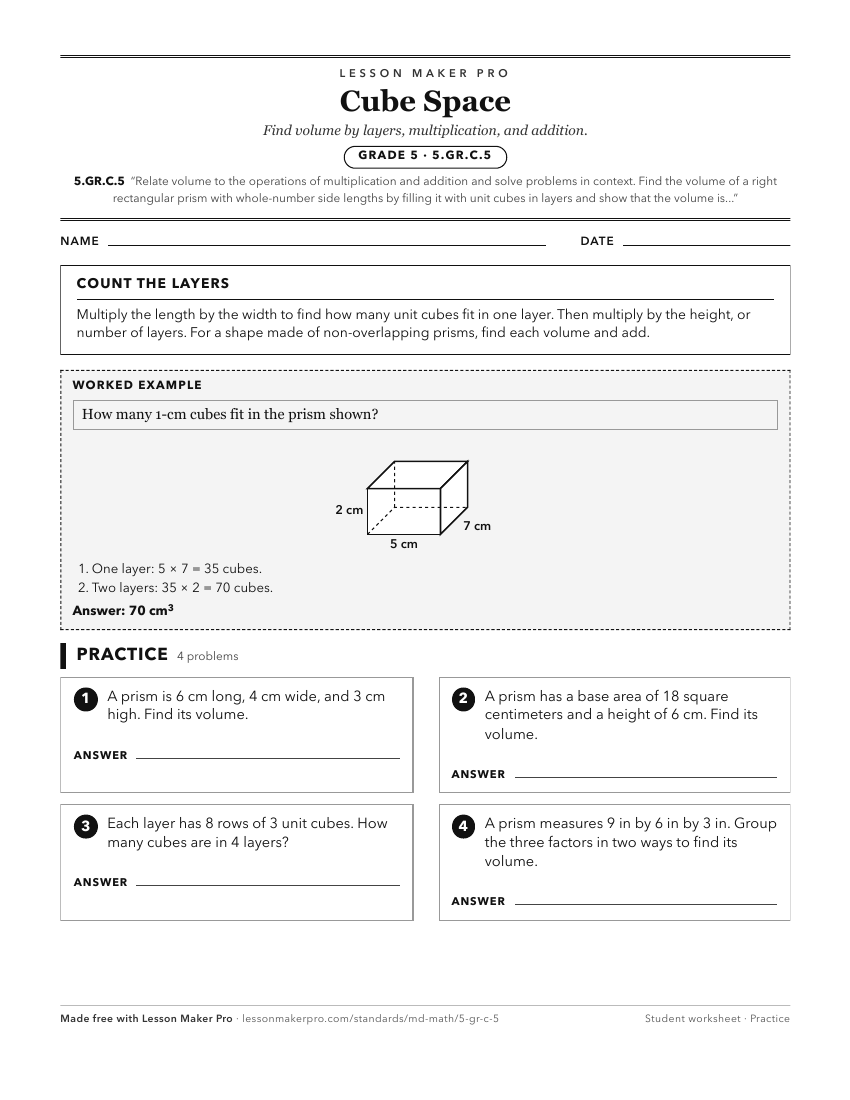
A ready-to-print activity worksheet aligned to 5.GR.C.5, with an answer key for the teacher on its own page. No account needed.
PDF, US Letter, prints cleanly in black and white.
Download the worksheetKeep exploring
Related Standards
- 4.GR.A.2
Use the four operations to solve problems in context involving distances, intervals of time, liquid volumes, masses of objects, and money, including problems in...
- 5.NOS.B.7.d
Use properties of operations and/or the inverse relationship between multiplication and division to multiply and divide.
Turn this cluster into a lesson
Grade, subject, topic, and the complete cluster are prefilled. Create one free, no account needed.
Also for this cluster:Make a WorksheetMake a QuizMake a Sub Lesson