Maryland Math 5.NOS.C.8
Standard Cluster
Add and subtract fractions with unlike denominators. Estimate sums and differences by reasoning about benchmark numbers and assess reasonableness of answers (e.g., 2/3 + 3/4 will be more than 1 because both fractions are greater than 1/2). Apply and extend whole number addition and subtraction strategies (e.g. counting on, making a whole, partial sums, compensation, properties of operations, the inverse relationship between addition and subtraction) to add and subtract fractions. Use equivalent fractions to produce an equivalent sum or difference of fractions with like denominators (e.g. 2/3 + 5/4 = 8/12 + 15/12 = 23/12. In general, a/b + c/d = (ad + bc)/bd).
Maryland College and Career Ready Standards for Mathematics (2025) · USE EQUIVALENT FRACTIONS AS A STRATEGY TO ADD AND SUBTRACT FRACTIONS.
Cluster contents
Standards in This Cluster
5.NOS.C.8 is a cluster heading. These are the individual standards under it.
- 5.NOS.C.8.a
Estimate sums and differences by reasoning about benchmark numbers and assess reasonableness of answers (e.g., 2/3 + 3/4 will be more than 1 because both fracti...
- 5.NOS.C.8.b
Apply and extend whole number addition and subtraction strategies (e.g. counting on, making a whole, partial sums, compensation, properties of operations, the i...
- 5.NOS.C.8.c
Use equivalent fractions to produce an equivalent sum or difference of fractions with like denominators (e.g. 2/3 + 5/4 = 8/12 + 15/12 = 23/12. In general, a/b ...
Teacher's field guide
What This Cluster Means
What Students Need to Do
- Students rename fractions with like denominators, then add or subtract the numerators. They estimate with 0, 1/2, and 1 to check their answers. They also try making a whole or counting on when it makes the work easier.
What Mastery Looks Like
- A student predicts that 2/3 + 3/4 is greater than 1, then rewrites it as 8/12 + 9/12 and gets 17/12. For 5/6 minus 1/4, they get 7/12 and explain why that is close to 1/2.
Common Misconceptions
- Students may add the denominators and write 2/3 + 3/4 as 5/7. Others change a denominator without changing the numerator, so the fraction no longer has the same value. Some accept a sum above 2 even though both starting fractions are less than 1.
How to Assess It
- Exit ticket: Estimate 2/3 + 1/4 and 5/6 minus 1/3 using 0, 1/2, or 1. Then solve both by renaming fractions and check whether your answers fit your estimates.
Lesson moves
Ways to Teach It
Give pairs fraction strips for 2/3 and 3/4; have them build twelfths, add, and check whether the sum exceeds 1.
Ask, 'Is 5/6 minus 1/4 closer to 0, 1/2, or 1? How do you know before calculating?'
Play a card match game with 3/4 + 1/2, 3/4 + 2/4, and 1 1/4; students match the equal values.
A runner jogs 3/4 mile, then 2/3 mile; students estimate and calculate the total distance.
Free download
Printable 5.NOS.C.8 Worksheet
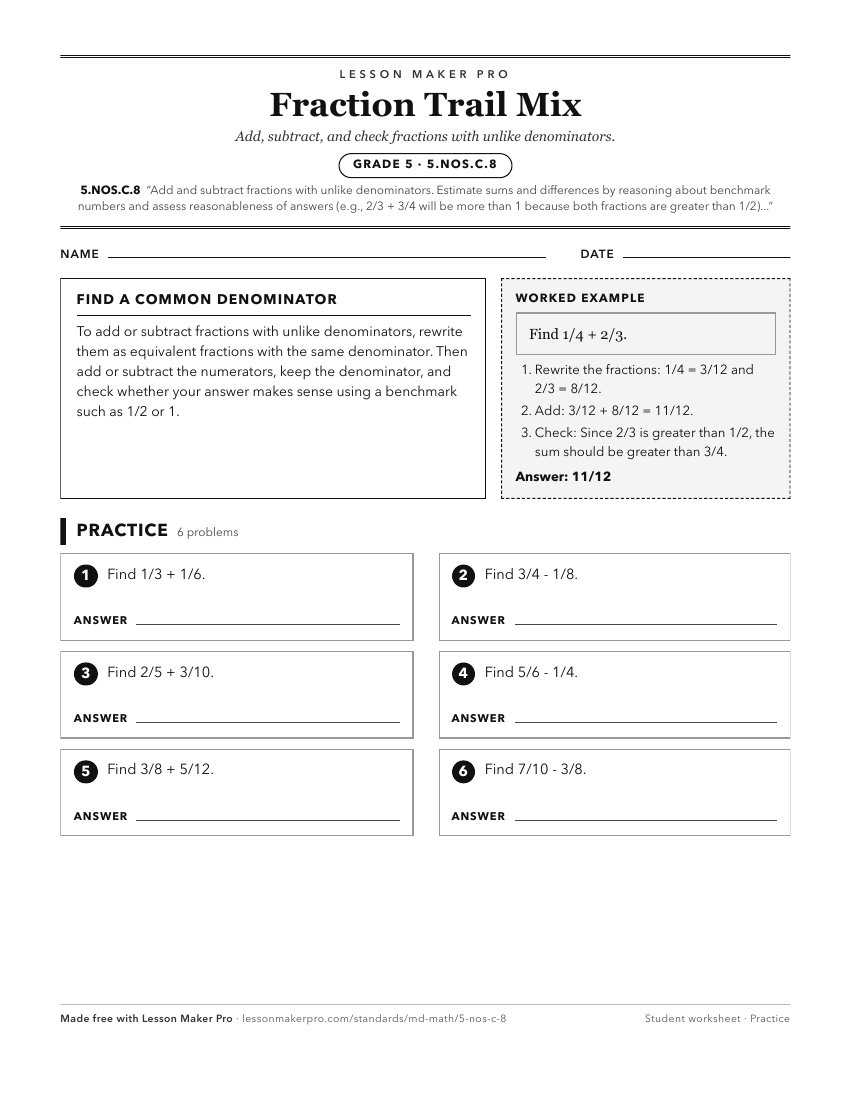
A ready-to-print activity worksheet aligned to 5.NOS.C.8, with an answer key for the teacher on its own page. No account needed.
PDF, US Letter, prints cleanly in black and white.
Download the worksheetKeep exploring
Related Standards
- 4.NOS.E.12.d
Solve problems in context involving addition and subtraction of fractions using visual fraction models and equations to represent the problem.
- 5.NOS.C.9
Solve problems in context involving addition and subtraction of fractions referring to the same whole, including cases of unlike denominators using visual fract...
- 4.NOS.E.12
Apply and extend previous understanding of addition and subtraction of whole numbers to add and subtract fractions with like denominators.
- 7.NOS.A.1
Add and subtract rational numbers using multiple strategies and representations.
Turn this cluster into a lesson
Grade, subject, topic, and the complete cluster are prefilled. Create one free, no account needed.
Also for this cluster:Make a WorksheetMake a QuizMake a Sub Lesson