Maryland Math 4.NOS.E.12
Standard Cluster
Apply and extend previous understanding of addition and subtraction of whole numbers to add and subtract fractions with like denominators. Understand addition and subtraction of fractions as joining and separating parts referring to the same whole. Estimate sums and differences by reasoning about benchmark numbers and assess reasonableness of answers (e.g., 3/4 + 3/4 will be greater than 1 because both fractions are greater than 1/2). Apply and extend whole number addition and subtraction strategies (e.g. counting on, making a whole, partial sums, compensation, properties of operations, the inverse relationship between addition and subtraction) to add and subtract fractions. Solve problems in context involving addition and subtraction of fractions using visual fraction models and equations to represent the problem.
Maryland College and Career Ready Standards for Mathematics (2025) · BUILD FRACTIONS FROM UNIT FRACTIONS BY APPLYING AND EXTENDING PREVIOUS UNDERSTANDINGS OF OPERATIONS ON WHOLE NUMBERS.
Cluster contents
Standards in This Cluster
4.NOS.E.12 is a cluster heading. These are the individual standards under it.
- 4.NOS.E.12.b
Estimate sums and differences by reasoning about benchmark numbers and assess reasonableness of answers (e.g., 3/4 + 3/4 will be greater than 1 because both fra...
- 4.NOS.E.12.c
Apply and extend whole number addition and subtraction strategies (e.g. counting on, making a whole, partial sums, compensation, properties of operations, the i...
- 4.NOS.E.12.d
Solve problems in context involving addition and subtraction of fractions using visual fraction models and equations to represent the problem.
Teacher's field guide
What This Cluster Means
What Students Need to Do
- Students join or remove equal-size parts from wholes of the same size. They use drawings and equations to solve fraction word problems. They compare answers with 1/2 and 1 to see if they make sense.
What Mastery Looks Like
- A student draws equal-size wholes and writes an equation that matches a word problem. They can count on or make a whole to find the answer. They can explain why 3/4 + 3/4 must be greater than 1.
Common Misconceptions
- Students may add denominators and write 3/4 + 2/4 = 5/8. They may draw wholes of different sizes, then count the pieces as equal. They may reject 6/4 because it is greater than 1.
How to Assess It
- Exit ticket: Two batches of cookies each need 3/4 cup of oats. Draw a model, write an equation for the total, and use 1/2 to explain why the answer makes sense.
Lesson moves
Ways to Teach It
Give pairs equal-length fraction strips to join 3/4 and 2/4, make one whole, and label the leftover 1/4.
Ask, 'Will 3/4 + 3/4 be more than 1? Explain using 1/2, then show how you make a whole.'
Put eighths on cards; pairs draw two, add them, and check their answers with fraction strips.
Give students a ribbon problem: A 7/8-meter ribbon loses 3/8 meter. Have them sketch the ribbon and find the length left.
Free download
Printable 4.NOS.E.12 Worksheet
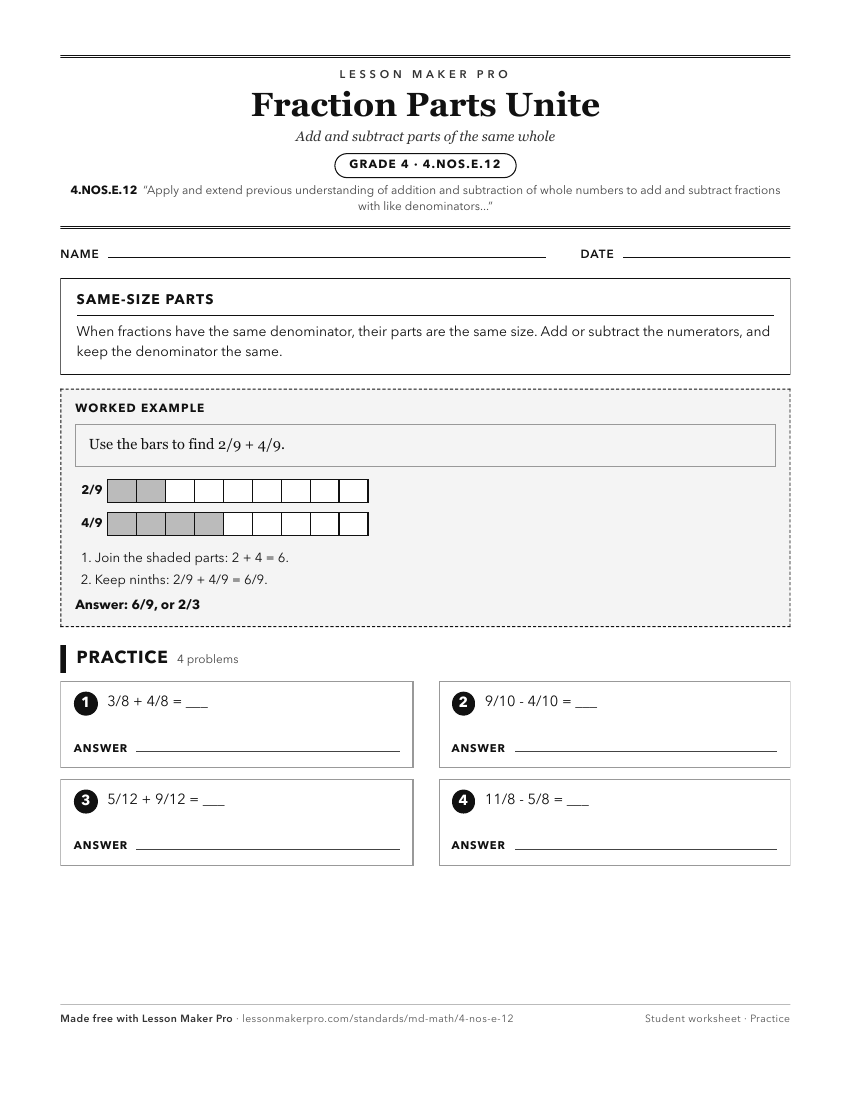
A ready-to-print activity worksheet aligned to 4.NOS.E.12, with an answer key for the teacher on its own page. No account needed.
PDF, US Letter, prints cleanly in black and white.
Download the worksheetKeep exploring
Related Standards
- 5.NOS.D.12
Apply and extend previous understandings of multiplication to multiply a fraction by a fraction.
- 5.NOS.B.6
Apply and extend previous understanding of addition and subtraction of whole numbers to add and subtract decimals to hundredths.
- 5.NOS.C.8.b
Apply and extend whole number addition and subtraction strategies (e.g. counting on, making a whole, partial sums, compensation, properties of operations, the i...
Turn this cluster into a lesson
Grade, subject, topic, and the complete cluster are prefilled. Create one free, no account needed.
Also for this cluster:Make a WorksheetMake a QuizMake a Sub Lesson