Maryland Math 4.NOS.C.7
Standard Cluster
Recall or quickly derive multiplication and division facts within 100 (e.g., factors less than or equal to 10 and quotients less than are equal to 10). Skip count (2s, 5s, 10s) and apply properties of operations (0s, 1s) to derive foundational facts. Derive unknown facts from known facts using double facts (e.g., to solve 4 × 3, double 3 to get 6 and double 6 to get 12) to multiply and divide. Use properties of operations (e.g., to solve 8 × 7, think of (5 × 7 + (3 × 7)) to multiply. Use the inverse relationship between multiplication and division (e.g., think of 4 × ? = 28 to solve 28 ÷ 4 = ?) to multiply and divide.
Maryland College and Career Ready Standards for Mathematics (2025) · GAIN FAMILIARITY WITH FACTORS AND MULTIPLES.
Cluster contents
Standards in This Cluster
4.NOS.C.7 is a cluster heading. These are the individual standards under it.
- 4.NOS.C.7.a
Skip count (2s, 5s, 10s) and apply properties of operations (0s, 1s) to derive foundational facts.
- 4.NOS.C.7.b
Derive unknown facts from known facts using double facts (e.g., to solve 4 × 3, double 3 to get 6 and double 6 to get 12) to multiply and divide.
- 4.NOS.C.7.c
Use properties of operations (e.g., to solve 8 × 7, think of (5 × 7 + (3 × 7)) to multiply.
- 4.NOS.C.7.d
Use the inverse relationship between multiplication and division (e.g., think of 4 × ? = 28 to solve 28 ÷ 4 = ?) to multiply and divide.
Teacher's field guide
What This Cluster Means
What Students Need to Do
- Students answer multiplication facts with factors up to 10 and related division facts. They use skip counting, doubles, split facts, and multiplication to work out facts they do not recall yet.
What Mastery Looks Like
- A student can quickly find 8 × 7 by adding 5 × 7 and 3 × 7. They can find 56 ÷ 8 by asking what number times 8 makes 56.
Common Misconceptions
- Students may say 0 × 7 = 7 or 7 × 1 = 8. When splitting 8 × 7, they may write 5 × 7 + 3 and forget to multiply the 3 by 7.
How to Assess It
- Exit ticket: Find 8 × 7 by splitting 8 into 5 and 3. Then find 56 ÷ 8 using a related multiplication fact.
Lesson moves
Ways to Teach It
Build an 8-by-7 array with counters, split it into 5-by-7 and 3-by-7 sections, and write the matching equation.
Ask, “If you know 4 × 3 = 12, how can doubling help you find 8 × 3?”
Play fact-family match: pair cards such as 6 × 7 = 42 and 42 ÷ 6 = 7.
Place 48 pencils into 8 cups and ask students to find pencils per cup using 8 × ? = 48.
Free download
Printable 4.NOS.C.7 Worksheet
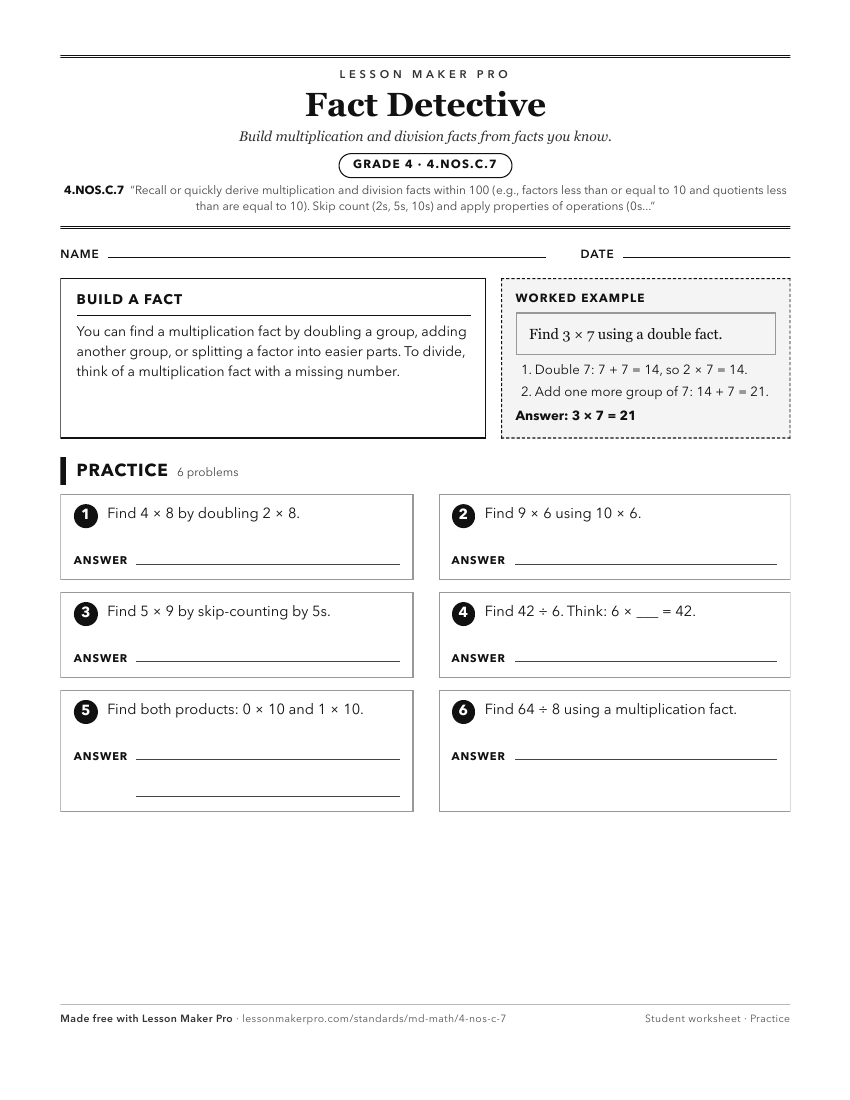
A ready-to-print activity worksheet aligned to 4.NOS.C.7, with an answer key for the teacher on its own page. No account needed.
PDF, US Letter, prints cleanly in black and white.
Download the worksheetKeep exploring
Related Standards
- 2.NOS.B.6
Recall or quickly derive addition and subtraction facts within 20.
- 6.NOS.B.2.b
Use strategies (e.g., partial quotients, inverse relationship between multiplication and division) to divide.
- 3.NOS.E.9
Recall or quickly derive multiplication and division facts within 100 (e.g., factors less than or equal to 10 and quotients less than or equal to 10).
- 1.NOS.D.9
Recall or quickly derive addition and subtraction facts within 20.
Turn this cluster into a lesson
Grade, subject, topic, and the complete cluster are prefilled. Create one free, no account needed.
Also for this cluster:Make a WorksheetMake a QuizMake a Sub Lesson