Maryland Math 3.NOS.B.2
The Standard
Represent and interpret multiplication of two factors (0- 10) as equal groups or as a composed unit that can be repeated/iterated. Explain the relationship between the factors and products.
Maryland College and Career Ready Standards for Mathematics (2025) · REPRESENT AND INTERPRET PROBLEMS INVOLVING MULTIPLICATION AND DIVISION.
Teacher's field guide
What This Standard Means
What Students Need to Do
- Students make equal groups using factors from 0 to 10. They treat each group as a unit, repeat it, and explain what each factor and the product count.
What Mastery Looks Like
- Given 6 bags of 4 marbles, a student draws six groups of four and writes 6 × 4 = 24. They explain that 6 counts bags, 4 counts marbles per bag, and 24 counts all the marbles. They know six empty bags hold zero marbles.
Common Misconceptions
- Students may make uneven groups or add the two factors instead of counting equal groups. Some confuse the number of groups with the size of each group, or think multiplying by zero leaves the other factor unchanged.
How to Assess It
- Ask students to draw 4 groups of 3 dots and write a multiplication equation. Have them label what each factor and the product count.
Lesson moves
Ways to Teach It
Give pairs 24 counters and six paper cups; have them place four counters in each cup and label the group count, group size, and total.
Show 3 plates with 5 crackers each and ask, “What does each number in 3 × 5 = 15 count?”
Play a card match: students pair pictures of equal groups with multiplication equations, then explain what each factor counts.
Show a receipt for 4 packs of 6 pencils; students sketch the packs and find the total number of pencils.
Free download
Printable 3.NOS.B.2 Worksheet
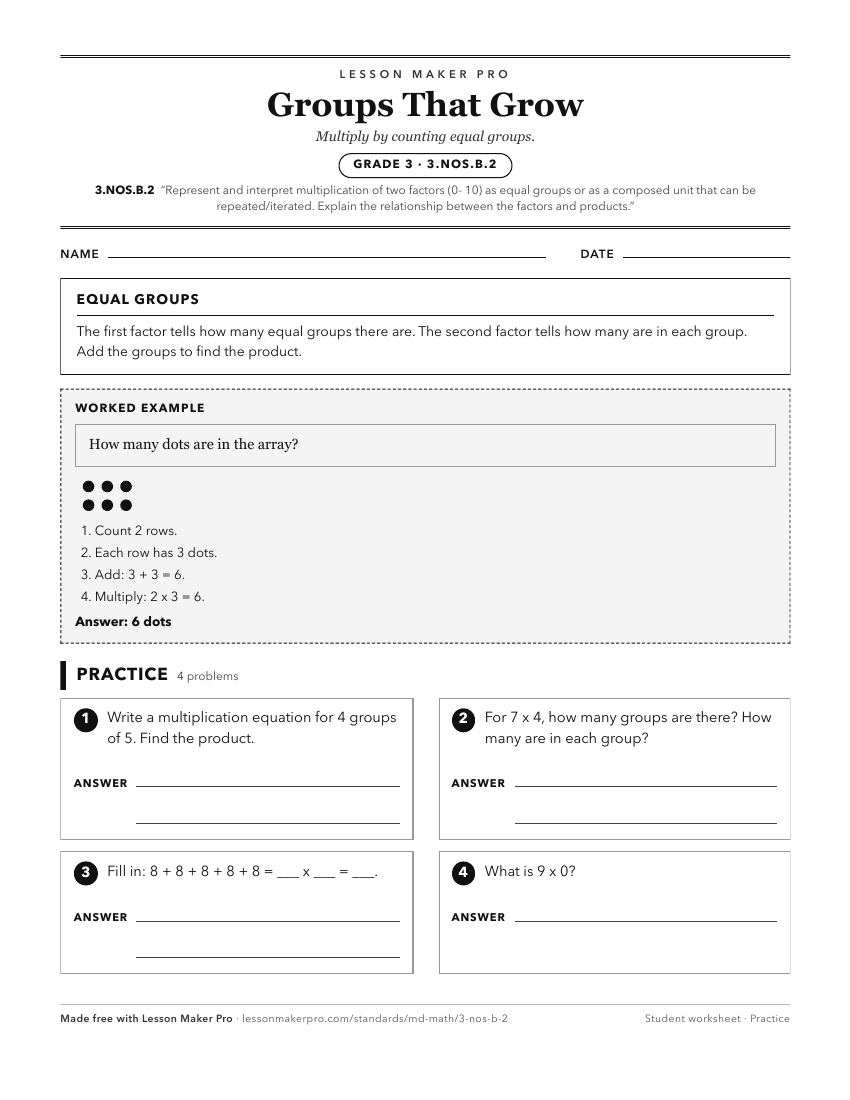
A ready-to-print activity worksheet aligned to 3.NOS.B.2, with an answer key for the teacher on its own page. No account needed.
PDF, US Letter, prints cleanly in black and white.
Download the worksheetKeep exploring
Related Standards
- 4.NOS.C.8.c
Distinguish between factors and multiples and explain how they relate to a given number.
- 6.NOS.B.4
Identify the common factors and multiples of two whole numbers.
- 4.NOS.C.7
Recall or quickly derive multiplication and division facts within 100 (e.g., factors less than or equal to 10 and quotients less than are equal to 10).
- 4.NOS.C.8
Explain and apply concepts of factors, multiples, and prime and composite numbers for whole numbers in the range of 1-100.
Turn this exact standard into a lesson
Grade, subject, topic, and the complete standard are prefilled. Create one free, no account needed.
Also for this standard:Make a WorksheetMake a QuizMake a Sub Lesson