Maryland Math 2.NOS.A.2.b
The Standard
- 2.NOS.A.2
- Count forward and backward within 1000 starting with any number.
Use skip-counting to find the total number of objects arranged in rectangular arrays with up to 5 rows and up to 5 columns.
Maryland College and Career Ready Standards for Mathematics (2025) · UNDERSTAND PLACE VALUE AND REPRESENTATIONS OF NUMBERS.
Teacher's field guide
What This Standard Means
What Students Need to Do
- Students look at equal rows of objects and count by the number in each row. They use that count to find the total without counting every object one at a time.
What Mastery Looks Like
- A student sees four rows of three dots and says, “3, 6, 9, 12.” They can point to each row as they count and say there are 12 dots altogether.
Common Misconceptions
- Some students count the rows but forget that each row has several objects. Others skip-count once for every object instead of once for every row, or lose track of which rows they have counted.
How to Assess It
- Draw four rows of three dots. Ask, “Skip-count to find the total. Write the numbers you say and circle the total.”
Lesson moves
Ways to Teach It
Give pairs 20 counters and a grid with four rows of five spaces; fill each row and skip-count by fives.
Show three rows of four dots and ask, “Why can we count by fours to find the total?”
Use number cards 1 to 5 to pick rows and columns; draw the array, then skip-count to find its total.
Show a photo of four rows of five chairs; have students mark each row and count by fives to find the total.
Free download
Printable 2.NOS.A.2.b Worksheet
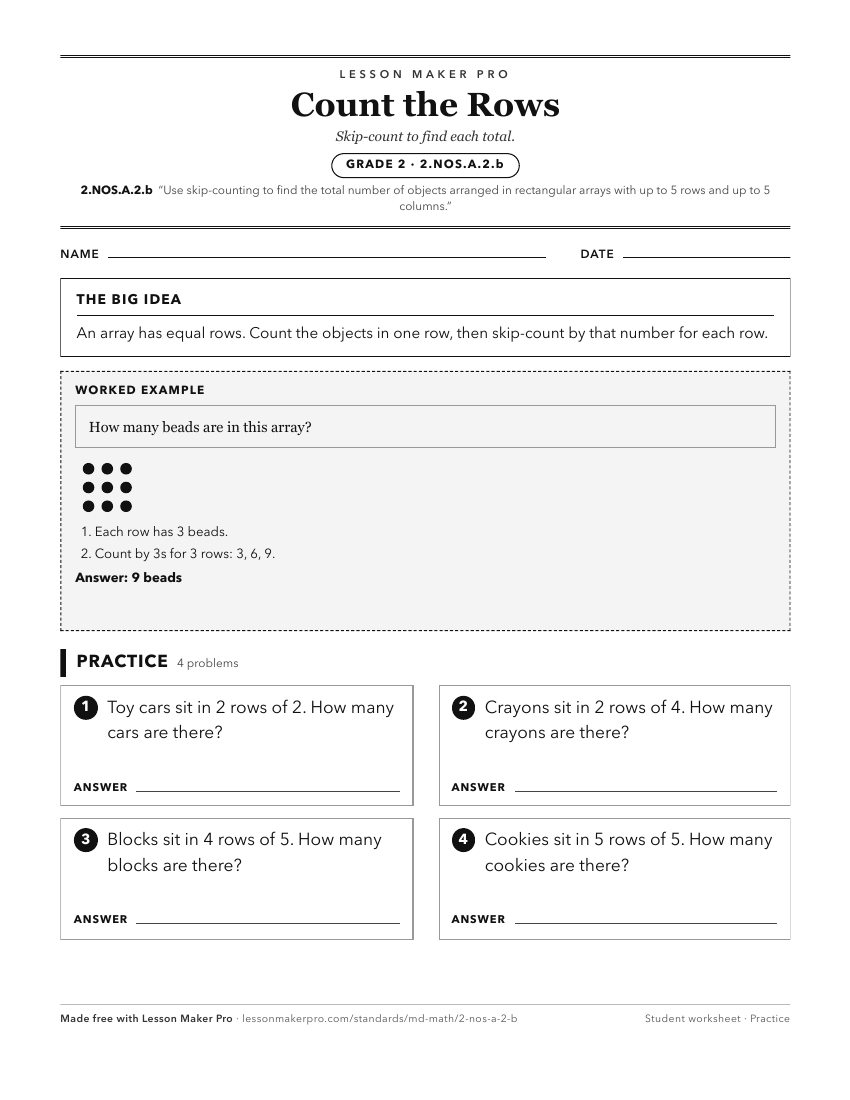
A ready-to-print activity worksheet aligned to 2.NOS.A.2.b, with an answer key for the teacher on its own page. No account needed.
PDF, US Letter, prints cleanly in black and white.
Download the worksheetKeep exploring
Related Standards
- K.NOS.B.8
Recognize the number of objects in a set without counting (subitizing) with both unfamiliar patterns within 6 and familiar patterns within 10.
- K.NOS.A.5
Represent a number of objects with a written numeral within 20 (with 0 representing a count of no objects).
- K.DS.A.1
Organize data by classifying objects into given categories and counting the number of objects in each category (Limit the total in any one category to maximum o...
- K.NOS.B.6
Use the relationship between numbers and quantities within 20 to count objects with one-to-one correspondence (arranged in a line, a rectangular array, a circle...
Turn this exact standard into a lesson
Grade, subject, topic, and the complete standard are prefilled. Create one free, no account needed.
Also for this standard:Make a WorksheetMake a QuizMake a Sub Lesson