Maryland Math K.NOS.B.6
The Standard
Use the relationship between numbers and quantities within 20 to count objects with one-to-one correspondence (arranged in a line, a rectangular array, a circle, or as many as 10 things in scatter configuration) and verbalize that the last number stated is the total when asked “How many?” (cardinality).
Maryland College and Career Ready Standards for Mathematics (2025) · COUNT TO TELL THE NUMBER OF OBJECTS.
Teacher's field guide
What This Standard Means
What Students Need to Do
- Children point to each object and say one number for each. They count up to 20 objects in a line, rectangle, or circle, and up to 10 scattered objects. When asked how many, they give the last number they said.
What Mastery Looks Like
- A child counts every object once, including in a circle where it is easy to lose track of the starting point. They give the total without counting again.
Common Misconceptions
- Children may skip an object or count one twice, especially in a circle or scattered group. Some say the next number when asked how many, rather than using the last number they said.
How to Assess It
- Draw 14 dots in two rows of seven and 8 scattered dots on separate cards. Ask each child to point and count, then answer, “How many?” for each card.
Lesson moves
Ways to Teach It
Give children 12 counters to arrange in a line, then in three rows of four; have them count and name each total.
Place 11 counters in a circle, mark one with a sticky note, and ask, “How did you know when to stop counting?”
Play Count and Cover: scatter up to 10 counters on a mat; partners touch each once, say the total, and check together.
Before snack, set 18 cups in three rows of six; children count them and tell how many classmates can get a cup.
Free download
Printable K.NOS.B.6 Worksheet
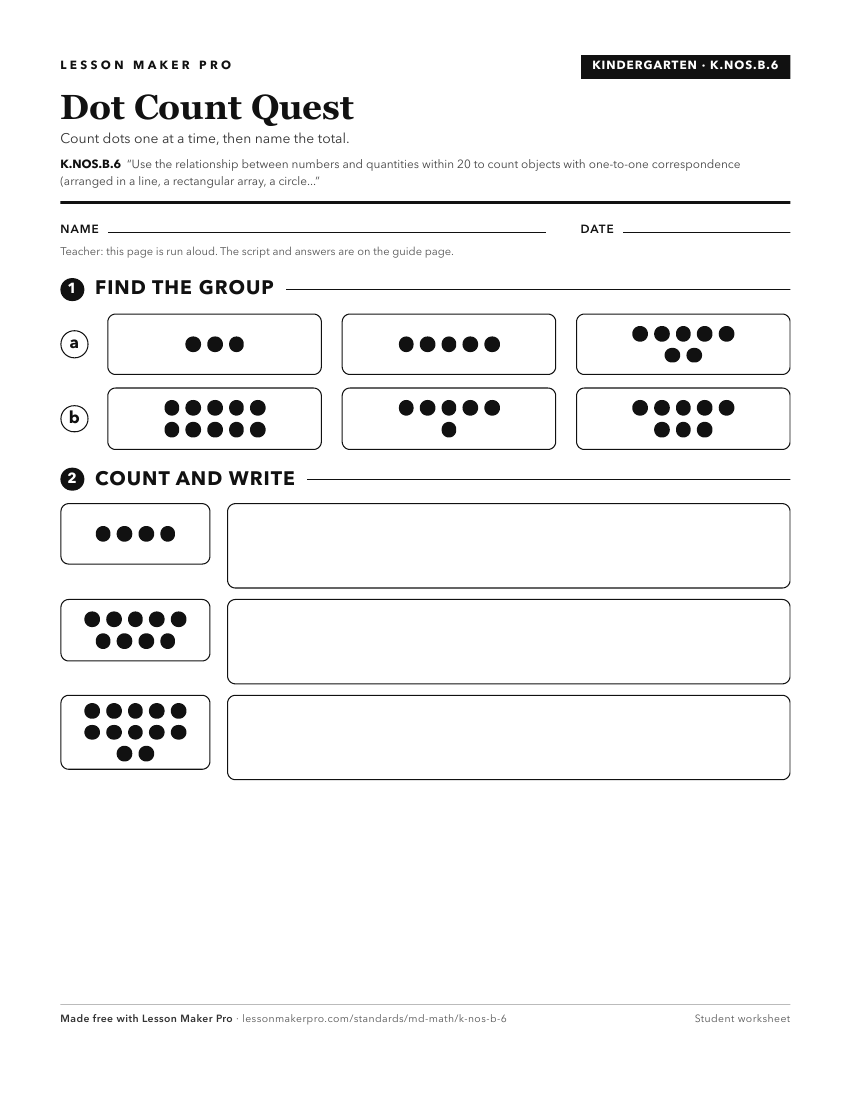
A ready-to-print activity worksheet aligned to K.NOS.B.6, with an answer key for the teacher on its own page. No account needed.
PDF, US Letter, prints cleanly in black and white.
Download the worksheetKeep exploring
Related Standards
- K.NOS.B.8
Recognize the number of objects in a set without counting (subitizing) with both unfamiliar patterns within 6 and familiar patterns within 10.
- K.NOS.A.5
Represent a number of objects with a written numeral within 20 (with 0 representing a count of no objects).
- K.NOS.B.7
When counting objects within 20, recognize that each successive number name refers to a quantity that is one larger.
Turn this exact standard into a lesson
Grade, subject, topic, and the complete standard are prefilled. Create one free, no account needed.
Also for this standard:Make a WorksheetMake a QuizMake a Sub Lesson