Maryland Math 1.NOS.E.10
Standard Cluster
Add within 100 including adding a two-digit number and a one-digit number and adding a two-digit number and a multiple of 10. Understand that when adding two-digit numbers, tens are added to tens, ones are added to ones, and sometimes it is necessary to compose or decompose a ten. Use concrete models and drawings to add. Use counting strategies and strategies based on place value (e.g., partial sums, making tens, etc.) to add. Use properties of operations, and/or the inverse relationship between addition and subtraction to add. Represent and explain the calculation by connecting the strategy used to the meaning of addition.
Maryland College and Career Ready Standards for Mathematics (2025) · USE PLACE VALUE UNDERSTANDING AND PROPERTIES TO ADD AND SUBTRACT.
Cluster contents
Standards in This Cluster
1.NOS.E.10 is a cluster heading. These are the individual standards under it.
- 1.NOS.E.10.a
Use concrete models and drawings to add.
- 1.NOS.E.10.b
Use counting strategies and strategies based on place value (e.g., partial sums, making tens, etc.) to add.
- 1.NOS.E.10.c
Use properties of operations, and/or the inverse relationship between addition and subtraction to add.
- 1.NOS.E.10.d
Represent and explain the calculation by connecting the strategy used to the meaning of addition.
Teacher's field guide
What This Cluster Means
What Students Need to Do
- Students add numbers within 100 using objects, drawings, counting, or place value. They add tens to tens and ones to ones. When the ones reach 10, they make a new ten and explain their work.
What Mastery Looks Like
- A student solves 38 + 7 as 45 and shows the new ten in a drawing. They solve 38 + 20 as 58 and explain why the ones stay at 8. They can check 45 by subtracting 7 to get 38.
Common Misconceptions
- A student may write 27 + 15 as 32 because they drop the new ten made by 7 + 5. Another may treat the 30 in 46 + 30 as 3 ones and write 49.
How to Assess It
- On an exit ticket, ask students to solve 38 + 7 and 38 + 20 with tens-and-ones sketches. Have them circle any new ten and explain which place changed.
Lesson moves
Ways to Teach It
Give pairs 28 and 15 straws in tens bundles and singles; have them combine the straws, bundle ten singles, and record 43.
Write 46 + 20 and 46 + 7 on the board; ask students to draw both and explain why different digits change.
Make cards labeled 18, 27, 36, and 45; partners draw two, add on mini whiteboards, and check with subtraction.
Show a class library shelf with 29 picture books and 14 chapter books; ask students to sketch groups of ten to find the total.
Free download
Printable 1.NOS.E.10 Worksheet
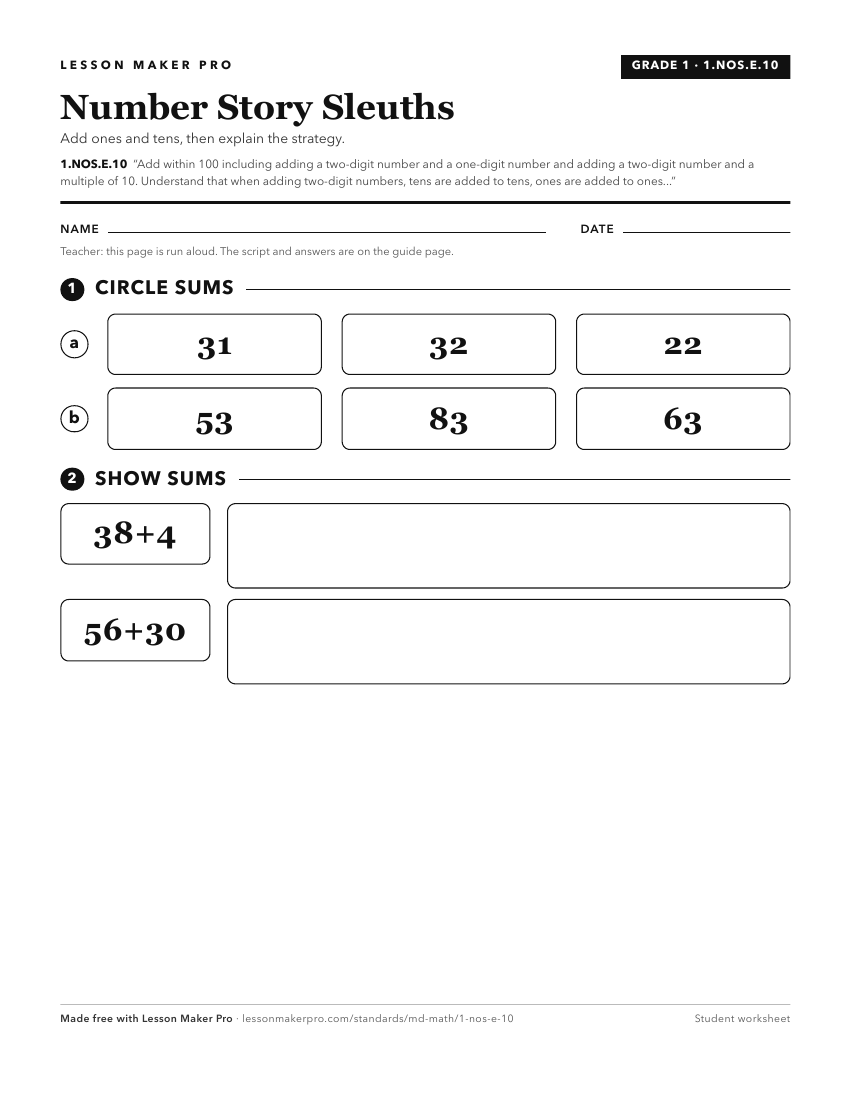
A ready-to-print activity worksheet aligned to 1.NOS.E.10, with an answer key for the teacher on its own page. No account needed.
PDF, US Letter, prints cleanly in black and white.
Download the worksheetKeep exploring
Related Standards
- 2.NOS.C.9
Add and subtract within 1000, recognizing that when adding or subtracting three-digit numbers, one adds or subtracts hundreds and hundreds, tens and tens, ones ...
- 2.NOS.A.1
Use understanding of 100 as a bundle of ten tens, called a “hundred,” and compose and decompose three-digit numbers.
- 2.NOS.A.1.a
Compose and decompose three-digit numbers into hundreds, tens, and ones by using objects, drawings, and/or equations (e.g., 328 = 300 + 20 + 8 or 328 is thirty-...
- 1.NOS.B.3.a
Compose and decompose two-digit numbers into tens and ones using objects or drawings, and equations (e.g., 10 + 4 = 14; 38 = 30 + 8).
Turn this cluster into a lesson
Grade, subject, topic, and the complete cluster are prefilled. Create one free, no account needed.
Also for this cluster:Make a WorksheetMake a QuizMake a Sub Lesson