Maryland Math 1.NOS.E.10.b
The Standard
- 1.NOS.E.10
- Add within 100 including adding a two-digit number and a one-digit number and adding a two-digit number and a multiple of 10. Understand that when adding two-digit numbers, tens are added to tens, ones are added to ones, and sometimes it is necessary to compose or decompose a ten.
Use counting strategies and strategies based on place value (e.g., partial sums, making tens, etc.) to add.
Maryland College and Career Ready Standards for Mathematics (2025) · USE PLACE VALUE UNDERSTANDING AND PROPERTIES TO ADD AND SUBTRACT.
Teacher's field guide
What This Standard Means
What Students Need to Do
- Students add by counting on or breaking numbers into tens and ones. When the ones add up to ten or more, they make a new ten.
What Mastery Looks Like
- For 27 + 15, a student combines 3 tens and 12 ones, then makes 42. They can also start at 27, jump 10 to 37, then count on 5 to reach 42.
Common Misconceptions
- Some students count both numbers from one instead of counting on. Others write 312 for 27 + 15 because they put 3 tens next to 12 ones without making a new ten.
How to Assess It
- Ask students to solve 28 + 14. Have them draw tens and ones or show counting-on jumps, then mark where they made a new ten.
Lesson moves
Ways to Teach It
Build 27 and 15 with connecting cubes, combine the loose cubes, and trade ten loose cubes for a stick of ten.
Write a counting-on path for 28 + 14, then tell a partner where you crossed a ten.
Play Add and Check: draw two cards labeled 10 to 39, add with number-line jumps, and check with tens sticks.
Draw 28 apples and 14 oranges on a store sign, then group them into tens to find the fruit total.
Free download
Printable 1.NOS.E.10.b Worksheet
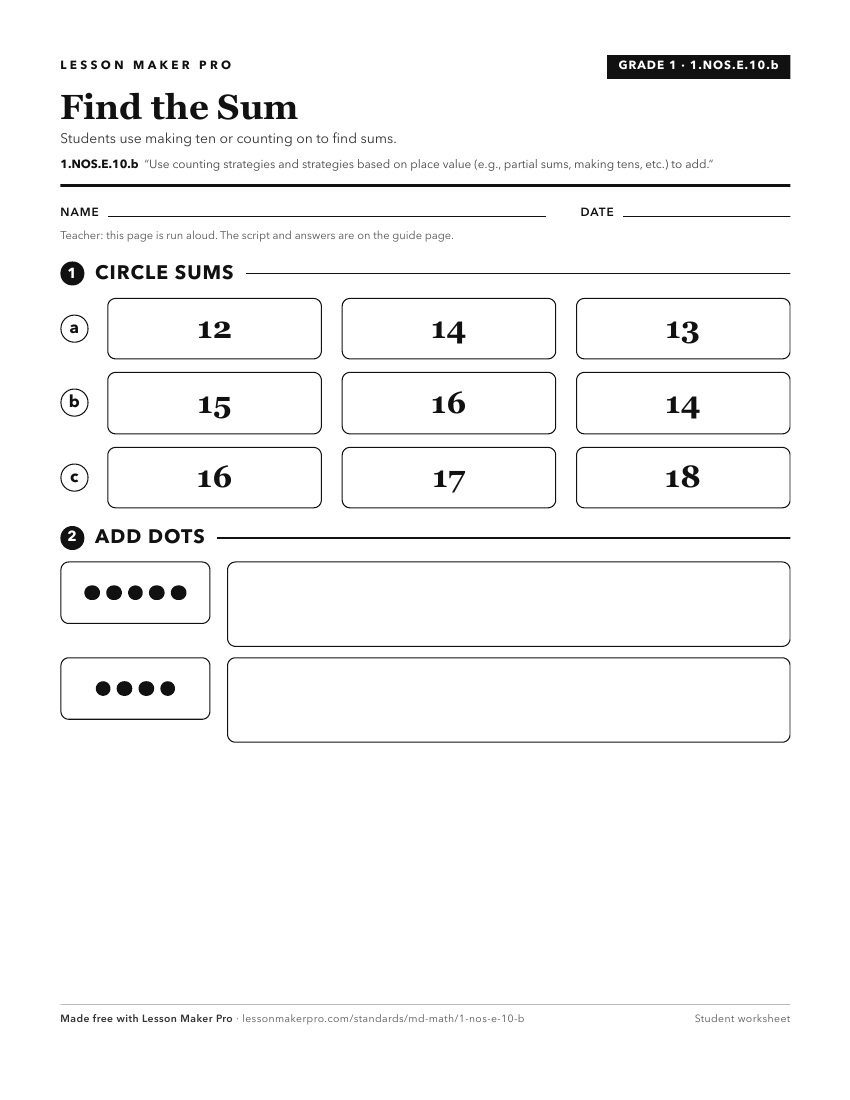
A ready-to-print activity worksheet aligned to 1.NOS.E.10.b, with an answer key for the teacher on its own page. No account needed.
PDF, US Letter, prints cleanly in black and white.
Download the worksheetKeep exploring
Related Standards
- 2.NOS.C.8.a
Use strategies based on counting (e.g., counting on, counting back) and place value (e.g., partial sums, making tens, etc.) to add and subtract.
- 4.NOS.B.5.b
Use strategies based on place value (e.g., partial products) to multiply.
- 2.NOS.B.6.a
Use counting, make ten, and ten more/less, doubling strategies to add and subtract.
- 2.NOS.C.9.b
Use strategies based on place value (counting on, partial sums, making tens, etc.) to add and subtract.
Turn this exact standard into a lesson
Grade, subject, topic, and the complete standard are prefilled. Create one free, no account needed.
Also for this standard:Make a WorksheetMake a QuizMake a Sub Lesson