Kentucky Reading and Writing RI.6.6
The Standard
Determine an author’s perspective and purpose in a text, and explain how it is conveyed in a text.
Kentucky Academic Standards for Reading and Writing (2025) · Craft and Structure
Teacher's field guide
What This Standard Means
What Students Need to Do
- Students work out what a writer thinks about a topic and why the writer wrote the piece. They point to words, facts, or examples that reveal both.
What Mastery Looks Like
- Given an article about school lunch, a student can name the writer’s view and goal separately. They can quote a detail and explain how it supports each answer.
Common Misconceptions
- Students may name the topic as the writer’s purpose, saying “school lunch” instead of “to persuade readers to support a longer lunch period.” They may give their own opinion as the writer’s view or assume a text with facts has no point of view.
How to Assess It
- Put this on an exit ticket: “Our cafeteria throws away hundreds of uneaten apples. A share table could keep good food out of the trash.” Ask, “What does the writer think, what do they want readers to do, and which words show that?”
Lesson moves
Ways to Teach It
Give pairs a school recycling flyer; have them highlight words that show the writer’s view and circle words that show the writer’s goal.
Read a letter asking for longer lunch periods, then ask, “Which sentence best shows what the writer wants, and why?”
Play clue match with three short school lunch excerpts and cards labeled “inform” and “persuade”; students match each card and underline proof.
Compare a grocery store ad for reusable bags with a city recycling flyer; mark phrases that show what each writer wants readers to do.
Free download
Printable RI.6.6 Worksheet
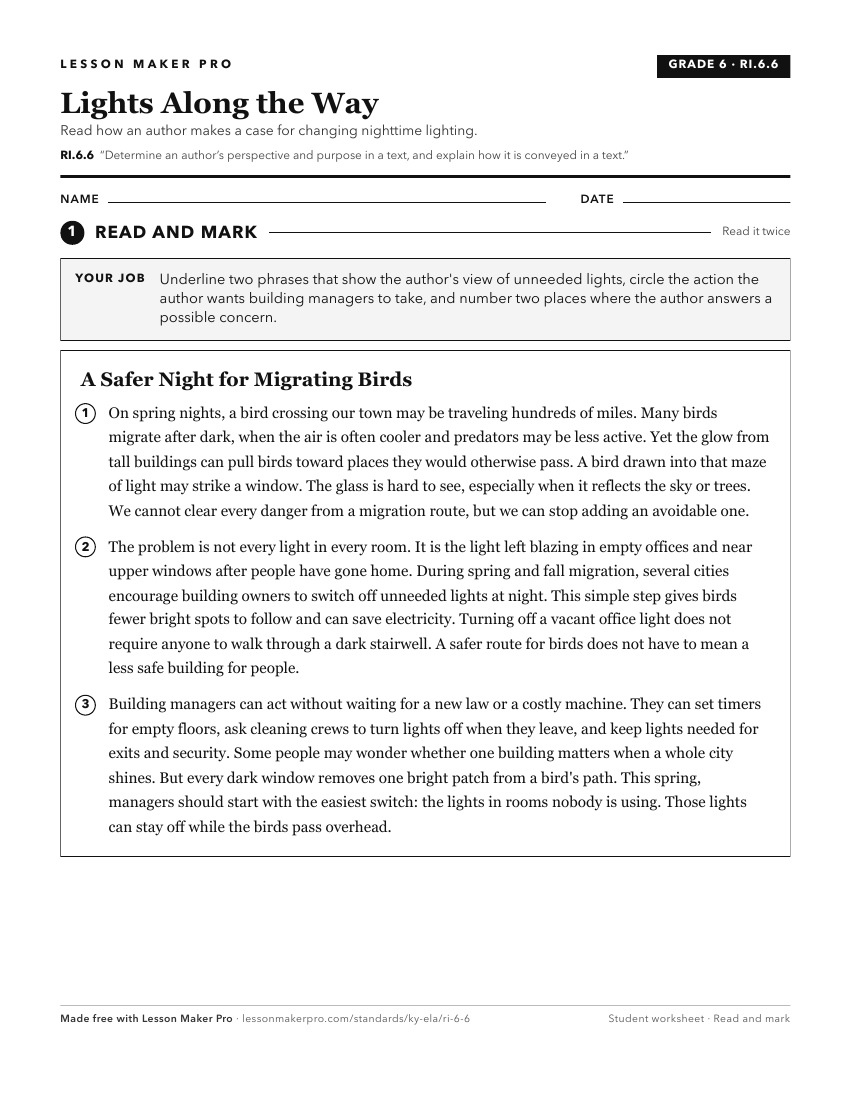
A ready-to-print activity worksheet aligned to RI.6.6, with an answer key for the teacher on its own page. No account needed.
PDF, US Letter, prints cleanly in black and white.
Download the worksheetKeep exploring
Related Standards
- RI.7.6
Determine an author's perspective and purpose in a text, and analyze how the author distinguishes his or her position from that of others.
- RI.3.6
Distinguish their own perspective from that of the author of a text, and describe how various perspectives shape the content and style of a text.
- RI.8.6
Determine an author's perspective and purpose in a text, and analyze how the author acknowledges and responds to conflicting evidence or viewpoints.
- RI.2.6
Identify the main purpose of a text, including what the author wants to answer, explain or describe, and how that purpose shapes the content of the text.
Turn this exact standard into a lesson
Grade, subject, topic, and the complete standard are prefilled. Create one free, no account needed.
Also for this standard:Make a WorksheetMake a QuizMake a Sub Lesson