Kentucky Reading and Writing RF.3.3.b
The Standard
- RF.3.3
- Know and apply grade-level phonics and word analysis skills in decoding and encoding words.
Decode and encode multisyllabic words.
Kentucky Academic Standards for Reading and Writing (2025) · Phonics and Word Recognition
Teacher's field guide
What This Standard Means
What Students Need to Do
- Students break longer words into parts they can read. They put those parts together to say the word, then use the same parts to spell it.
What Mastery Looks Like
- A student reads “fantastic” without skipping the middle syllable. They spell “remember” from dictation and check that every syllable is there.
Common Misconceptions
- Students may guess a word from its first few letters, reading “fantastic” as “fantasy.” They may leave out a syllable or write “baskit” for “basket.”
How to Assess It
- Ask each student to read “fantastic” aloud. Then dictate “remember” and have them write it and mark its syllables.
Lesson moves
Ways to Teach It
Give pairs letter tiles to build “basket” and “fantastic,” then have them rebuild each word from memory.
Ask students to write how they figured out “remember” and which letters helped them read each syllable.
Play a word-building game with cards labeled “fan,” “tas,” “tic,” “bas,” and “ket”; students build, read, and write each word.
Print a lunch menu with “banana,” “pineapple,” and “macaroni”; students read each item, cover it, then write a lunch order.
Free download
Printable RF.3.3.b Worksheet
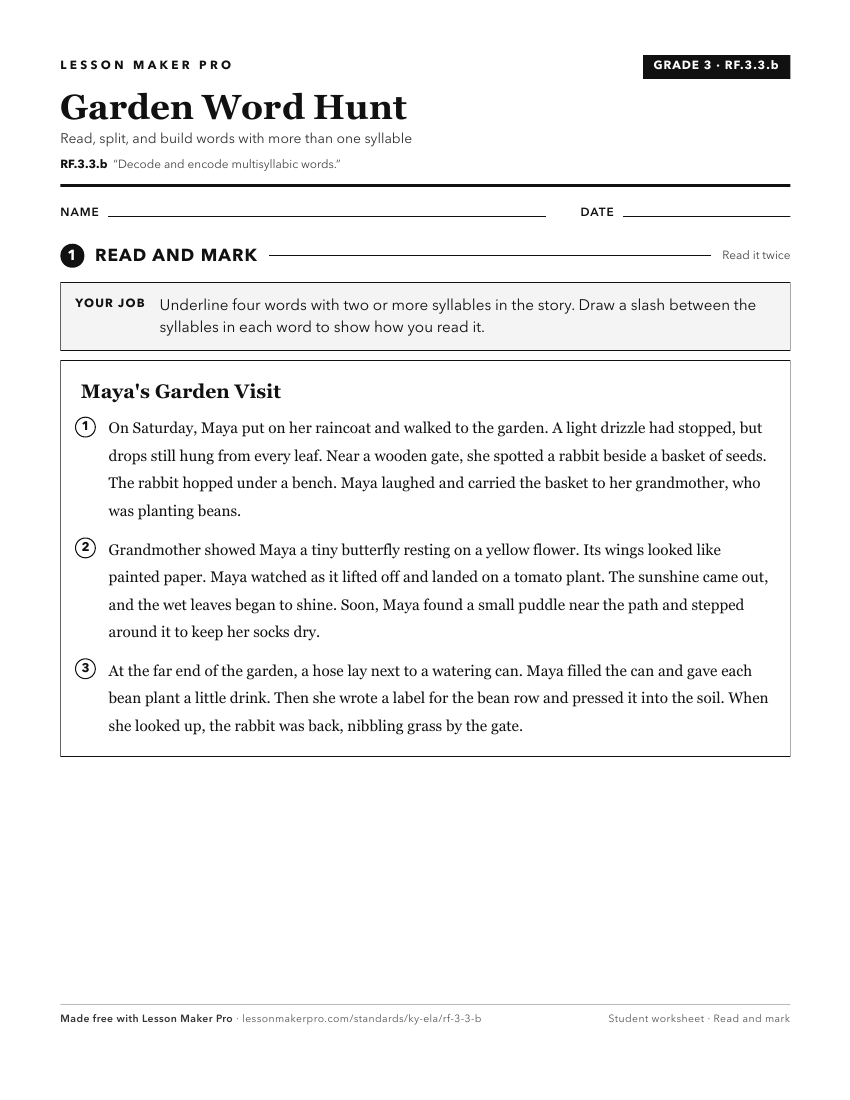
A ready-to-print activity worksheet aligned to RF.3.3.b, with an answer key for the teacher on its own page. No account needed.
PDF, US Letter, prints cleanly in black and white.
Download the worksheetKeep exploring
Related Standards
- RF.5.3.a
Use combined knowledge of all phoneme-grapheme correspondences, syllabication patterns and morphology to accurately decode and encode unfamiliar multisyllabic w...
- RF.1.3.e
With adult support, decode two-syllable words by breaking the words into syllables.
- RF.4.3.a
Use combined knowledge of all phoneme-grapheme correspondences, syllabication patterns and morphology to accurately decode and encode unfamiliar multisyllabic w...
Turn this exact standard into a lesson
Grade, subject, topic, and the complete standard are prefilled. Create one free, no account needed.
Also for this standard:Make a WorksheetMake a QuizMake a Sub Lesson