Kentucky Reading and Writing C.11-12.2
The Standard
Compose informative/explanatory texts to examine and/or convey complex ideas, concepts and information clearly and accurately through the effective selection, organization and analysis of content. Produce clear and coherent writing in which the development, organization and style are appropriate to task, purpose and audience. Introduce a topic; organize complex ideas, concepts and information so that each new element builds on that which precedes it to create a unified whole; include formatting, graphics and multimedia when useful to aiding comprehension. Develop the topic thoroughly by selecting the most significant and relevant facts, extended definitions, concrete details, quotations or other information and examples appropriate to the audience’s knowledge of the topic. Use appropriate and varied transitions and syntax to link the major sections of the text, create cohesion and clarify the relationships among complex ideas and concepts. Use precise language, domain-specific vocabulary and techniques such as metaphor, simile and analogy to manage the complexity of the topic. Establish and maintain a formal style and objective tone while attending to the norms and conventions of the discipline in which they are writing. Provide a concluding statement or section that follows from and supports the information or explanation presented. Develop and strengthen writing as needed by planning, revising, editing, rewriting or trying a new approach, focusing on addressing what is most significant for a specific purpose and audience.
Kentucky Academic Standards for Reading and Writing (2025) · Text Types and Purpose
Teacher's field guide
What This Standard Means
What Students Need to Do
- Students explain a complex topic for a specific reader. They choose accurate details, put ideas in a clear order, and show how those ideas connect. They revise for clarity and a neutral tone.
What Mastery Looks Like
- A student can open with a focused explanation and build each section on what came before. They define unfamiliar terms, use evidence to explain key points, and add a visual only when it helps. Their ending brings the explanation together without adding a new claim.
Common Misconceptions
- Students may list facts in the order they found them instead of grouping related ideas. They may insert a quote without explaining it or add a graphic that only repeats the text. Some think formal writing means using long words rather than precise ones.
How to Assess It
- Exit ticket: Explain to a new resident why heavy rain can flood a paved street. Include two causes, a sentence linking them, and a closing sentence.
Lesson moves
Ways to Teach It
Give pairs cards labeled pavement, soil, runoff, and storm drains; have them arrange a cause-and-effect chain and explain each link.
Ask students to write which cause of street flooding a new resident needs to understand first, using two facts to defend their choice.
Run a revision relay: teams replace vague words in a sample flood paragraph, add a causal transition, and cut a repeated detail.
Have students use a city stormwater FAQ to write a 150-word explanation for residents, with one cited fact and a labeled runoff sketch.
Free download
Printable C.11-12.2 Worksheet
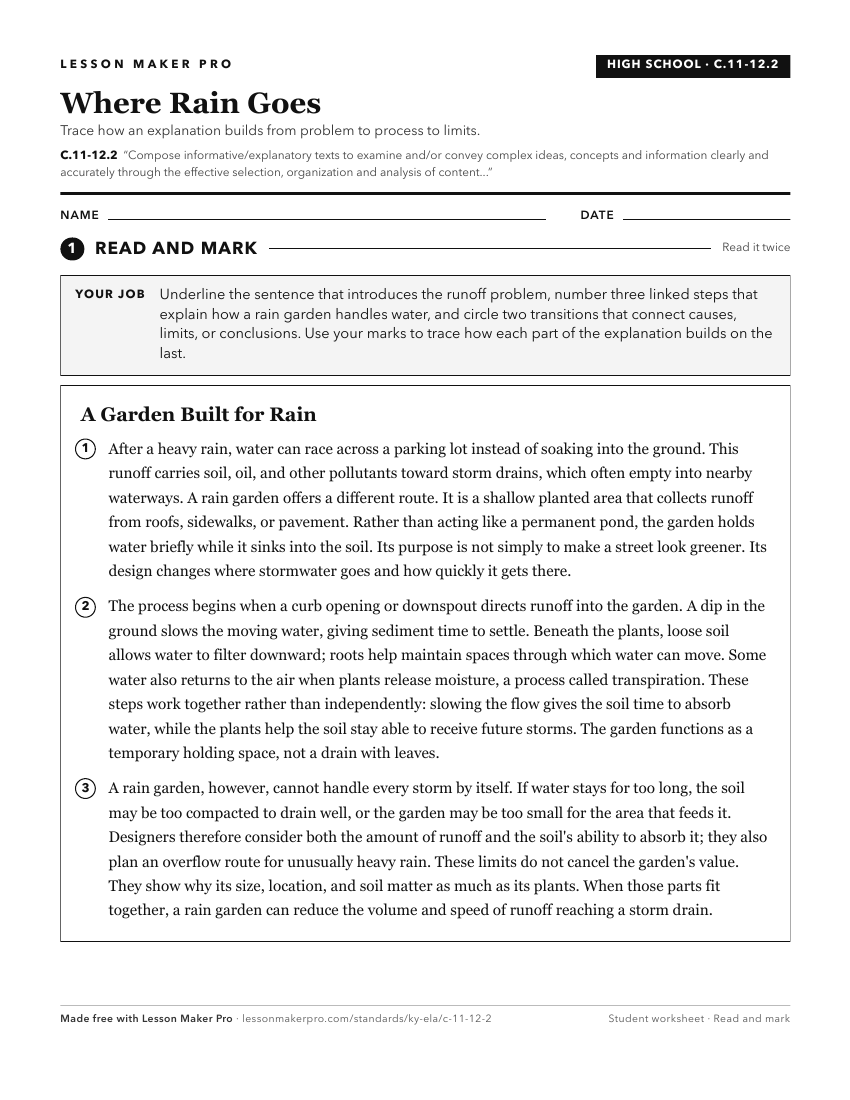
A ready-to-print activity worksheet aligned to C.11-12.2, with an answer key for the teacher on its own page. No account needed.
PDF, US Letter, prints cleanly in black and white.
Download the worksheetTurn this exact standard into a lesson
Grade, subject, topic, and the complete standard are prefilled. Create one free, no account needed.
Also for this standard:Make a WorksheetMake a QuizMake a Sub Lesson