Indiana Social Studies WH.5.2
The Standard
Explain the key ideas of the Enlightenment in European history, and describe its impact upon political and religious thought in Europe and the Americas, including the foundation of American government and subsequent revolutions.
2026 Indiana Academic Standards: K-12 Social Studies
Teacher's field guide
What This Standard Means
What Students Need to Do
- Students explain natural rights, consent of the governed, divided power, and religious tolerance in plain words. They trace how these ideas challenged kings and state churches, shaped American government, and influenced later revolutions.
What Mastery Looks Like
- A student can connect Locke's consent to the Declaration of Independence and Montesquieu's divided powers to the U.S. Constitution. They can explain how calls for religious tolerance challenged state churches and how Haitian revolutionaries used rights claims to oppose slavery.
Common Misconceptions
- Students may think Enlightenment thinkers all opposed religion, rather than arguing for freedom of worship. They may also assume rights applied equally to everyone or that ideas alone caused the French and Haitian revolutions.
How to Assess It
- Exit ticket: Explain how Locke's consent shaped the Declaration of Independence, how religious tolerance challenged state churches, and how natural rights informed the Haitian Revolution. Write one sentence for each connection.
Lesson moves
Ways to Teach It
Give pairs short excerpt cards from Locke, Montesquieu, and Voltaire; have them sort the cards by rights, divided power, and tolerance.
Ask: Why might a ruler oppose freedom of worship, and how would that freedom change life for someone outside the state church?
Run a card match: students pair natural rights with the French and Haitian revolutions, then explain why enslaved people demanded those rights.
Show a local election ballot; ask how choosing representatives reflects consent of the governed and who could not vote in 1776.
Free download
Printable WH.5.2 Worksheet
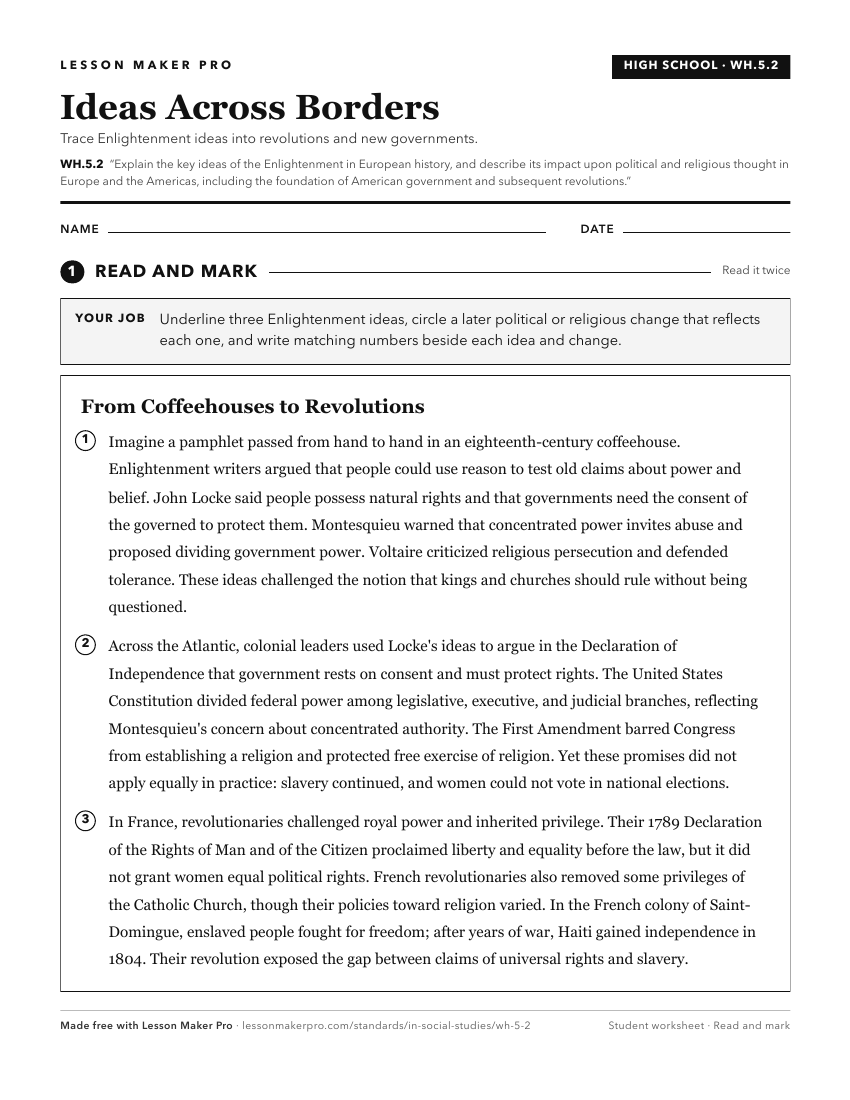
A ready-to-print activity worksheet aligned to WH.5.2, with an answer key for the teacher on its own page. No account needed.
PDF, US Letter, prints cleanly in black and white.
Download the worksheetKeep exploring
Related Standards
- 8.E.1
Identify economic factors contributing to European exploration and colonization in North America, the American Revolution, and the drafting of the United States...
- 5.H.8
Explain how the political, religious, and economic ideas brought about the American Revolution.
- WH.5.1
Explain the key developments of the Scientific Revolution and its impact on the world.
- 6.H.9
Explain the origin and spread of scientific, political, and social ideals associated with the Age of Enlightenment/Age of Reason.
Turn this exact standard into a lesson
Grade, subject, topic, and the complete standard are prefilled. Create one free, no account needed.
Also for this standard:Make a WorksheetMake a QuizMake a Sub Lesson