Indiana Social Studies WH.1.2
The Standard
Identify the key components that make up a civilization and the key differences between civilizations and how people organize themselves outside of civilizations.
2026 Indiana Academic Standards: K-12 Social Studies
Teacher's field guide
What This Standard Means
What Students Need to Do
- Students identify features often found in ancient civilizations, such as cities, specialized jobs, government, and systems for keeping records. They compare those features with how people in farming villages and mobile herding groups organized daily life.
What Mastery Looks Like
- A student can use details from two community descriptions to explain how each group got food, made decisions, and divided work. They can name features that differ without claiming that one group had no rules or trade.
Common Misconceptions
- Students may think every farming village was a civilization or that all civilizations had the same government. They may assume mobile herders had no leaders, trade, or shared rules.
How to Assess It
- Give students two short descriptions: Uruk has workshops and grain records; a herding camp moves with its animals and has shared grazing rules. Ask them to name one difference and one way both groups organized themselves.
Lesson moves
Ways to Teach It
Give pairs drawings of Uruk and a herding camp, then have them label food sources, work, homes, and decision makers.
Ask students to write three sentences answering, "How can a herding camp have rules and trade without a city?"
Have teams sort feature cards labeled grain records, seasonal movement, leaders, and trade into Uruk, herding camp, or both.
Use a local map to find markets, public offices, and homes, then compare their roles with places in Uruk and a herding camp.
Free download
Printable WH.1.2 Worksheet
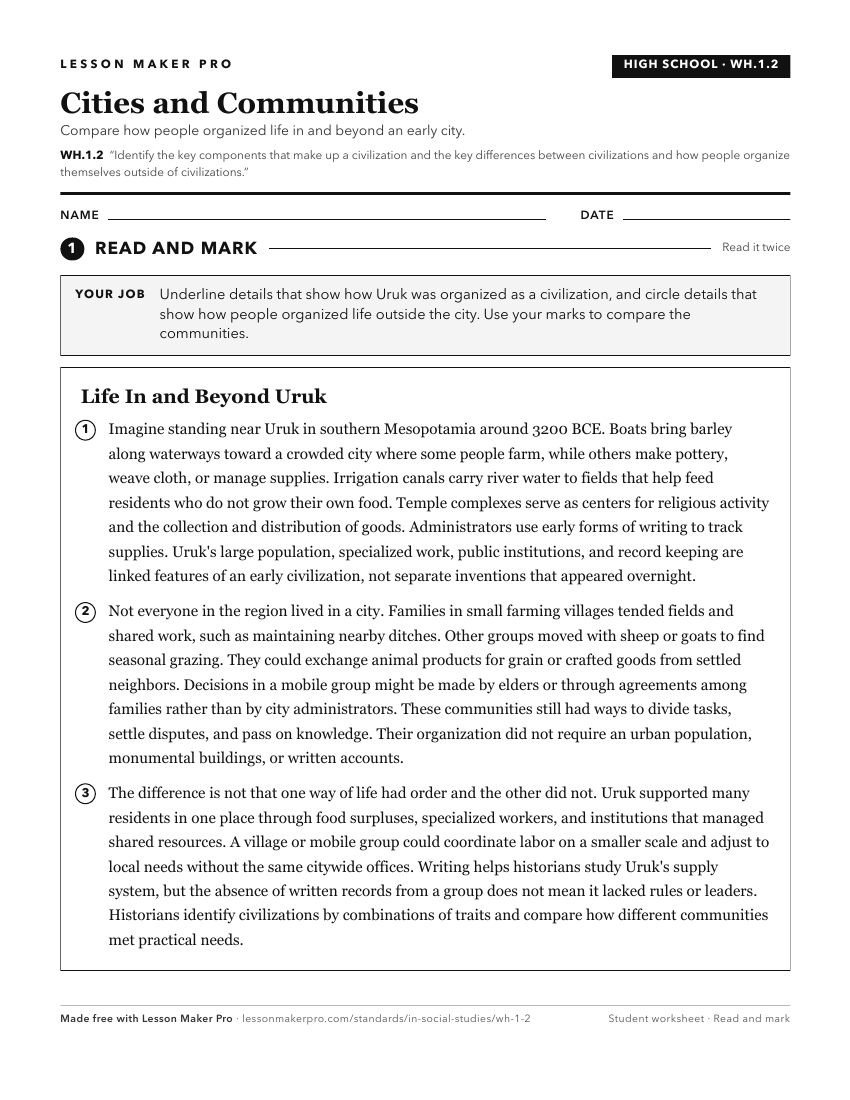
A ready-to-print activity worksheet aligned to WH.1.2, with an answer key for the teacher on its own page. No account needed.
PDF, US Letter, prints cleanly in black and white.
Download the worksheetKeep exploring
Related Standards
- WH.2.2
Examine the development of Greek civilization, including differing political and social structures and major conflicts.
- S.2.5
Identify examples of culture similarities and differences.
- 7.H.1
Identify and explain the conditions that led to the rise of early river valley civilizations and evaluate how the achievements in art, architecture, written lan...
- 6.C.7
Define and compare the citizen’s role and methods of participation in civil society in civilizations of Europe and the Americas.
Turn this exact standard into a lesson
Grade, subject, topic, and the complete standard are prefilled. Create one free, no account needed.
Also for this standard:Make a WorksheetMake a QuizMake a Sub Lesson