Indiana Social Studies USH.5.4
The Standard
Explain the experiences of African Americans, Asian Americans, Hispanic Americans, Native Americans, and women at war and on the homefront during World War II and explain how they were a catalyst for social change.
2026 Indiana Academic Standards: K-12 Social Studies · Students are expected to trace and analyze chronological periods and examine the significant themes and concepts in U.S. History. Students develop historical thinking and research skills using primary and secondary sources to explore topical issues to understand the cause for changes in the nation over time.
Teacher's field guide
What This Standard Means
What Students Need to Do
- Students describe how African Americans, Asian Americans, Hispanic Americans, Native Americans, and women served, worked, or faced restrictions during World War II. They explain how those experiences led people to press for fair treatment after the war.
What Mastery Looks Like
- Students connect the Double V campaign to desegregation efforts and Japanese American incarceration to later demands for redress. They connect the Zoot Suit riots to Mexican American rights organizing. They link Navajo code talkers' service to later recognition and WAC enlistment to wider roles for women in the military.
Common Misconceptions
- Students may think wartime service ended discrimination right away. They may treat all Asian Americans as Japanese Americans who were incarcerated, or confuse Mexican American citizens with Mexican nationals in the bracero program. They may assume all women worked in factories.
How to Assess It
- Exit ticket: Choose two of the five groups. Name one wartime experience for each and explain a later demand for change linked to each experience.
Lesson moves
Ways to Teach It
Pin Tuskegee, Heart Mountain, Los Angeles, Iwo Jima, and the Pentagon on a map; label each group's wartime experience.
Using a Double V editorial and a Japanese American incarceration notice, write three sentences on how wartime injustice led to later rights demands.
Give pairs event and change cards; match Double V to desegregation efforts, incarceration to redress demands, and WAC service to wider military roles.
Compare a 1943 WAC recruiting poster with a current Army recruiting page; list one change in women's roles and one question that remains.
Free download
Printable USH.5.4 Worksheet
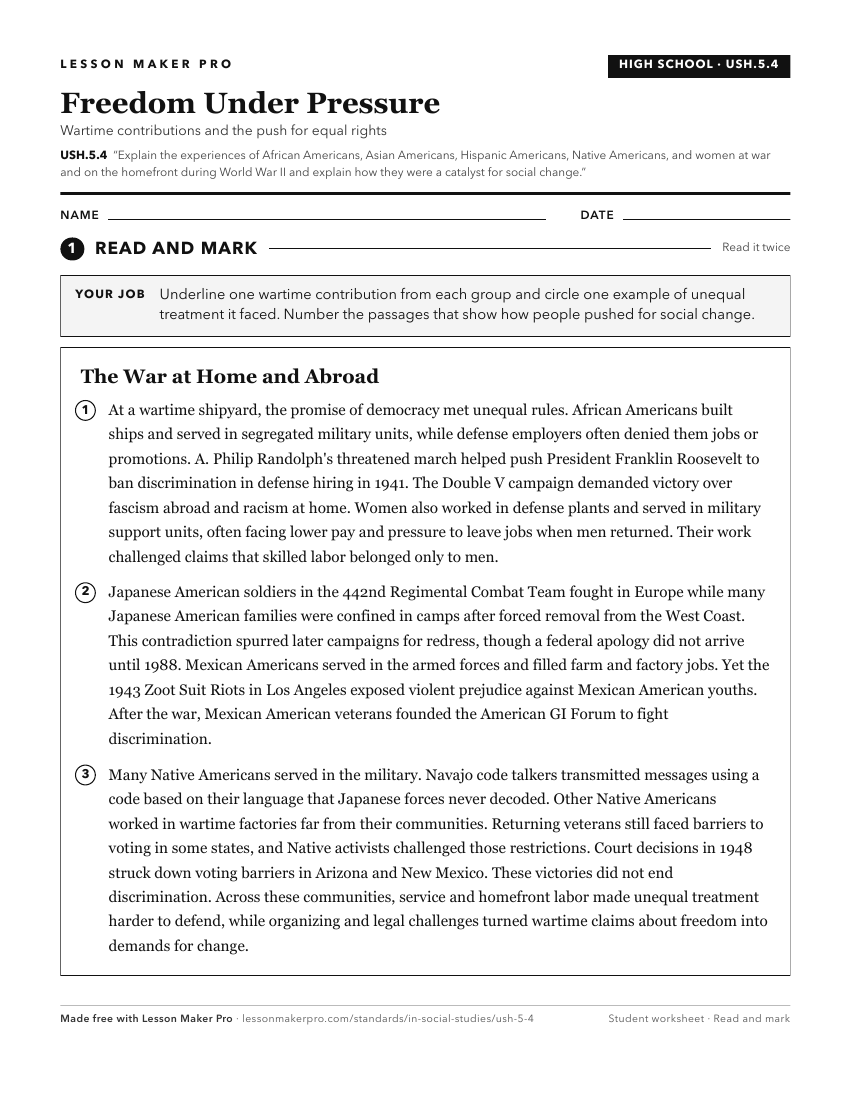
A ready-to-print activity worksheet aligned to USH.5.4, with an answer key for the teacher on its own page. No account needed.
PDF, US Letter, prints cleanly in black and white.
Download the worksheetKeep exploring
Related Standards
- USH.6.5
Explain the efforts of minority groups and women to assert their social, economic, and civic rights during this period.
- USH.6.2
Analyze key economic, cultural, political, and social changes in post-World War II American life.
- USH.5.2
Identify key leaders and events from World War II, and explain the significance of each.
- WH.6.4
Identify the causes (i.e., social, political, militaristic, and economic) and key events of World War II, and analyze the impact this war had on the global comm...
Turn this exact standard into a lesson
Grade, subject, topic, and the complete standard are prefilled. Create one free, no account needed.
Also for this standard:Make a WorksheetMake a QuizMake a Sub Lesson