Indiana Social Studies USG.5.5
The Standard
Explain and give examples of important citizen actions that can impact local, state, and federal government as individuals and members of interest groups.
2026 Indiana Academic Standards: K-12 Social Studies · Students understand the nature of citizenship, politics, and governments, understanding the rights and responsibilities of citizens and how these are part of local, state, and national government. Students examine how the United States Constitution protects rights and provides the structure and functions of various levels of government. Students examine how the United States interacts with other nations as well as the government's role in world affairs will be examined.
Teacher's field guide
What This Standard Means
What Students Need to Do
- Students explain how one person can influence a public decision by voting, contacting an official, or speaking at a meeting. They also explain how people in an interest group work together to seek change in local, state, or federal government.
What Mastery Looks Like
- Given a city park budget cut, a state voting bill, or a federal immigration bill, students identify who makes the decision. They choose a realistic citizen action and explain how it might affect that decision.
Common Misconceptions
- Students may think voting is the only way to have a say, or that a petition automatically changes a law. They may contact the wrong level of government or mistake an interest group for a government agency.
How to Assess It
- Exit ticket: For a city park budget cut, a state voting bill, and a federal immigration bill, name the decision-maker and one citizen action for each. For one issue, explain how an interest group could help.
Lesson moves
Ways to Teach It
Give pairs printed issue cards to match with local, state, or federal officials and a citizen action that could reach each one.
Ask students to write how a park neighbor and a neighborhood association could each influence a city council vote.
Play a three-card match: students pair an issue, a decision-maker, and a citizen action, then explain their match.
Open a city council agenda, pick an upcoming vote, and have students draft a two-sentence public comment requesting a specific action.
Free download
Printable USG.5.5 Worksheet
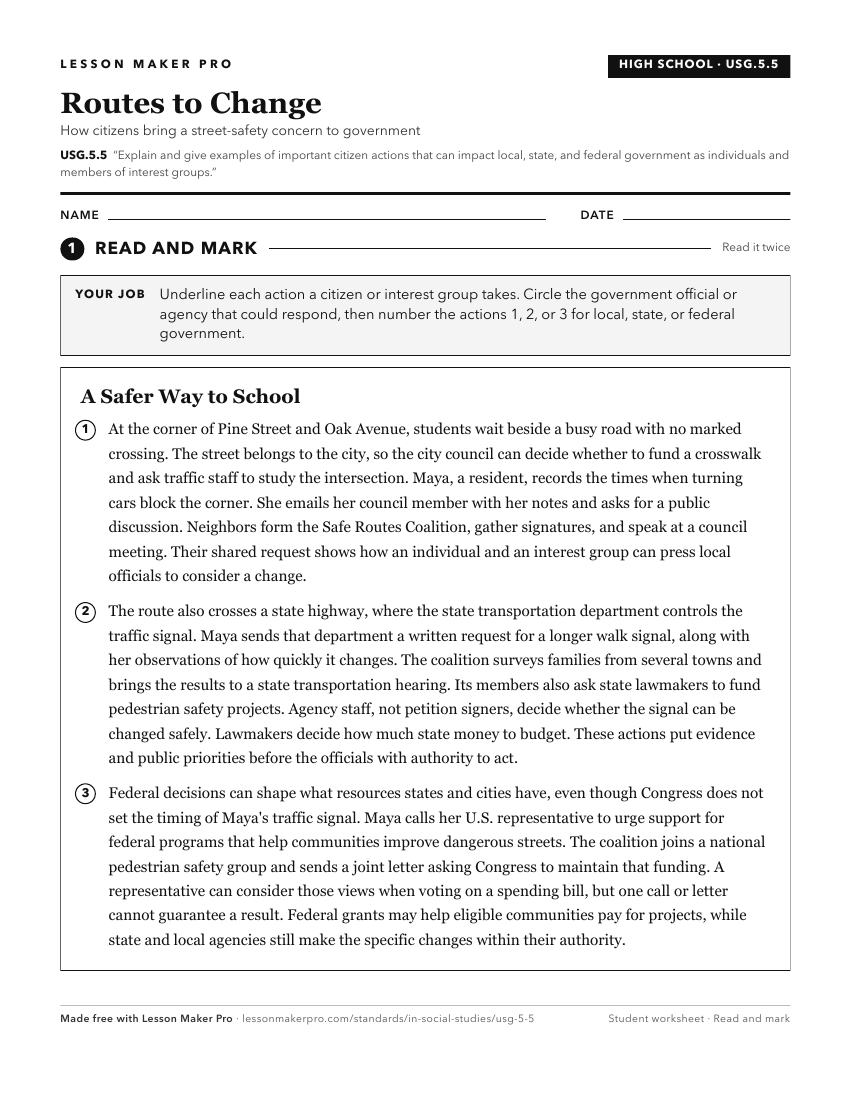
A ready-to-print activity worksheet aligned to USG.5.5, with an answer key for the teacher on its own page. No account needed.
PDF, US Letter, prints cleanly in black and white.
Download the worksheetKeep exploring
Related Standards
- 8.C.6
Explain ways that citizens can participate in the election process (e.g., political parties, campaigns, and elections) at the federal, state, and local levels.
- IS.2.4
Give examples of how citizens can participate in their state government and explain their rights and responsibilities, including civic engagement and voting.
- 8.C.7
Explain how citizens can monitor and influence the development and implementation of public policies at local, state, and federal levels of government.
- 3.C.5
Explain the role citizens have in making decisions and rules within the community, state, and nation, such as participating in local and regional activities, vo...
Turn this exact standard into a lesson
Grade, subject, topic, and the complete standard are prefilled. Create one free, no account needed.
Also for this standard:Make a WorksheetMake a QuizMake a Sub Lesson