Indiana Social Studies USG.3.7
The Standard
Analyze the functions of the judicial branch of the United States and Indiana governments with emphasis on the principles of due process, judicial review, and an independent judiciary.
2026 Indiana Academic Standards: K-12 Social Studies · Students understand the nature of citizenship, politics, and governments, understanding the rights and responsibilities of citizens and how these are part of local, state, and national government. Students examine how the United States Constitution protects rights and provides the structure and functions of various levels of government. Students examine how the United States interacts with other nations as well as the government's role in world affairs will be examined.
Teacher's field guide
What This Standard Means
What Students Need to Do
- Students explain how Indiana and federal courts decide cases and review government actions. They identify when people need notice and a chance to respond. They explain why judges must decide cases without pressure from elected officials.
What Mastery Looks Like
- Given a case, students can name a court that could hear it and spot a due process problem. They can explain when a court may reject an unconstitutional law and why a governor or president cannot dictate the ruling.
Common Misconceptions
- Students may think judges can reject laws simply because the laws seem unfair. Some think due process guarantees a win or always requires a jury. Others think independent judges are not subject to appeals or ethics rules.
How to Assess It
- An Indiana agency revokes a business license without notice under a new law. The owner says the law violates the U.S. Constitution, and the governor tells the judge to dismiss the case. Ask students to name the due process problem, what the judge may review, and why the governor cannot direct the ruling.
Lesson moves
Ways to Teach It
Give pairs cards showing a license revoked without notice, a challenged law, and a pressured judge; have them match each to a principle.
Ask, “Should an Indiana judge obey a governor who requests a ruling on a challenged law?” Have students defend their answer in two sentences.
Race to arrange Indiana trial, appellate, and supreme court cards alongside federal district, appeals, and U.S. Supreme Court cards in appeal order.
Print a city parking-ticket appeal notice; students circle the deadline and hearing steps, then explain where due process appears.
Free download
Printable USG.3.7 Worksheet
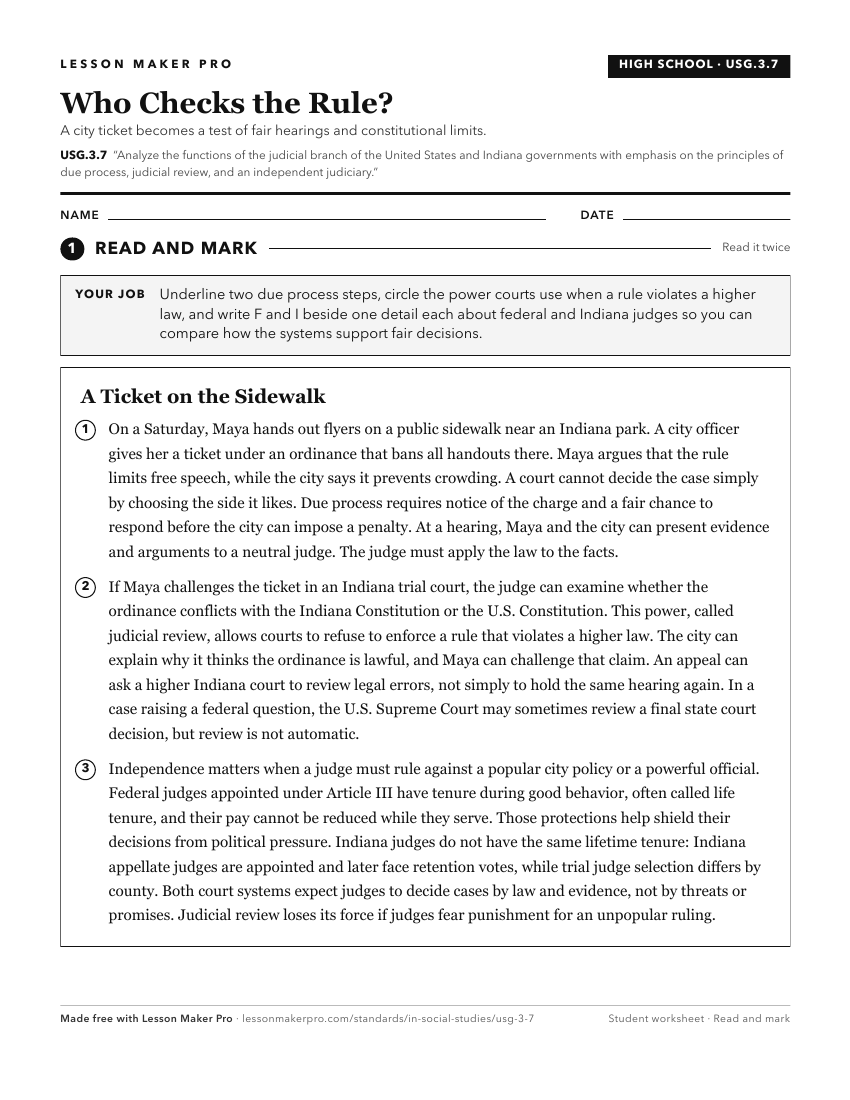
A ready-to-print activity worksheet aligned to USG.3.7, with an answer key for the teacher on its own page. No account needed.
PDF, US Letter, prints cleanly in black and white.
Download the worksheetKeep exploring
Related Standards
- 8.C.3
Compare and contrast the different functions of federal and state government within the federal system by analyzing the United States Constitution and the India...
- IS.2.6
Analyze the service of people from Indiana to national offices such as the presidency, vice-presidency, judiciary, and legislature including their ideas about t...
- USG.5.2
Analyze the roles and responsibilities of citizens in Indiana and the United States.
- IS.2.3
Analyze and compare the major functions, responsibilities, and relationships of the legislative (Article 4), executive (Article 5), and judicial branches (Artic...
Turn this exact standard into a lesson
Grade, subject, topic, and the complete standard are prefilled. Create one free, no account needed.
Also for this standard:Make a WorksheetMake a QuizMake a Sub Lesson