Indiana Social Studies USG.3.3
The Standard
Compare and contrast the enumerated, implied, and denied powers of legislatures in both the United States Constitution and the Indiana Constitution.
2026 Indiana Academic Standards: K-12 Social Studies · Students understand the nature of citizenship, politics, and governments, understanding the rights and responsibilities of citizens and how these are part of local, state, and national government. Students examine how the United States Constitution protects rights and provides the structure and functions of various levels of government. Students examine how the United States interacts with other nations as well as the government's role in world affairs will be examined.
Teacher's field guide
What This Standard Means
What Students Need to Do
- Students identify powers a constitution names, powers that follow from a granted power, and powers it forbids. They compare Congress's list of powers with Indiana's broad grant of lawmaking power and its specific limits.
What Mastery Looks Like
- A student can explain why Congress's tax power allows it to create a tax collection agency. They can point to Indiana's property tax rules and explain how the state's grant of lawmaking power differs from Congress's list. They can identify retroactive criminal laws as forbidden to both legislatures.
Common Misconceptions
- Students may assume Indiana lawmakers can act only when a power appears on a list, as Congress must. They may call any useful law an implied power. Some mistake a forbidden power for one lawmakers simply have not used.
How to Assess It
- Exit ticket: Label a federal tax collection agency, Indiana's uniform property tax assessments, and a retroactive criminal law as named, implied, or denied powers. Ask students to cite a constitutional passage for each and explain one difference between the two legislatures' powers.
Lesson moves
Ways to Teach It
Give pairs printed excerpts from U.S. Article I and Indiana Articles I, IV, and X; have them sort tax and criminal law cards by power type.
Ask: Why must Congress trace a law to a granted power, while Indiana lawmakers have a broad grant of lawmaking power?
Play a three-column relay: teams place federal tax agency, Indiana property tax, and retroactive crime cards under named, implied, or denied, then explain their choices.
Show a state property tax notice and a federal tax form; students find the constitutional authority for each tax.
Free download
Printable USG.3.3 Worksheet
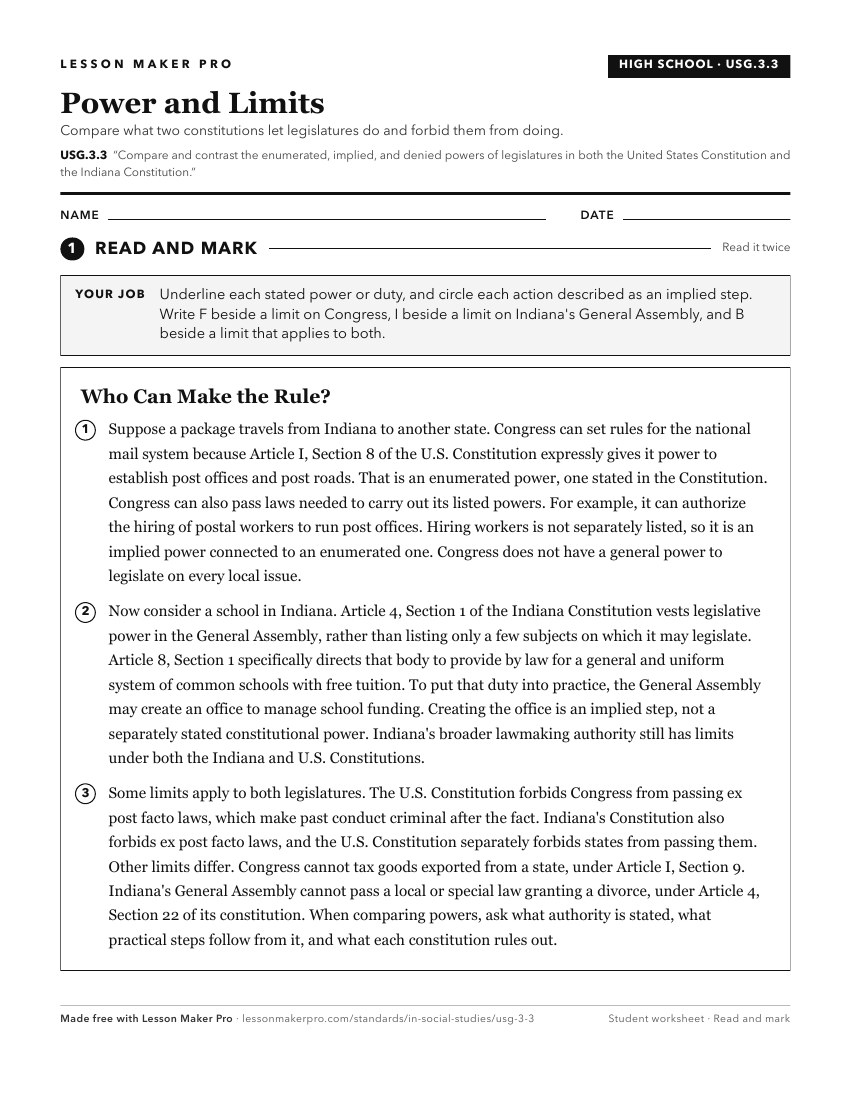
A ready-to-print activity worksheet aligned to USG.3.3, with an answer key for the teacher on its own page. No account needed.
PDF, US Letter, prints cleanly in black and white.
Download the worksheetKeep exploring
Related Standards
- 4.C.3
Identify and explain the major responsibilities of the legislative (Article 4), executive (Article 5), and judicial branches (Article 7) of state government as ...
- 8.C.3
Compare and contrast the different functions of federal and state government within the federal system by analyzing the United States Constitution and the India...
- IS.2.3
Analyze and compare the major functions, responsibilities, and relationships of the legislative (Article 4), executive (Article 5), and judicial branches (Artic...
- 8.C.2
Compare and contrast the delegated, reserved, and concurrent powers (division of power or federal system) contained in the United States Constitution.
Turn this exact standard into a lesson
Grade, subject, topic, and the complete standard are prefilled. Create one free, no account needed.
Also for this standard:Make a WorksheetMake a QuizMake a Sub Lesson