Indiana Social Studies S.6.6
The Standard
Describe leadership styles (authoritarian, democratic, laissez-faire) and the benefits and drawbacks of each.
2026 Indiana Academic Standards: K-12 Social Studies
Teacher's field guide
What This Standard Means
What Students Need to Do
- Students tell the difference between a leader who makes decisions alone, one who seeks group input, and one who lets members decide. They explain when each approach helps a group and when it can cause problems.
What Mastery Looks Like
- Given a short group scenario, a student can identify the leader's approach from how decisions are made. They can name a realistic benefit and drawback of each approach and choose one that fits the task.
Common Misconceptions
- Students may think a leader who takes charge is always effective, even when group members have useful ideas. They may mistake asking for input for giving up control, or assume a hands-off approach works without clear goals.
How to Assess It
- Exit ticket: Match each to authoritarian, democratic, or laissez-faire: the leader decides alone; the leader seeks group input; members make most decisions. Write one benefit and one drawback of each.
Lesson moves
Ways to Teach It
In three rounds, groups build index-card towers as leaders give orders, seek input, or step back; record each tower's height.
Ask, 'Who should lead a school dance committee, and when might that approach fail?' Have students name a decision the committee faces.
Read three short leader scripts aloud; students hold up A, D, or L cards and write one likely benefit and drawback.
Compare a restaurant manager's rush-hour directions with staff planning next week's menu; students choose a leadership approach for each and explain why.
Free download
Printable S.6.6 Worksheet
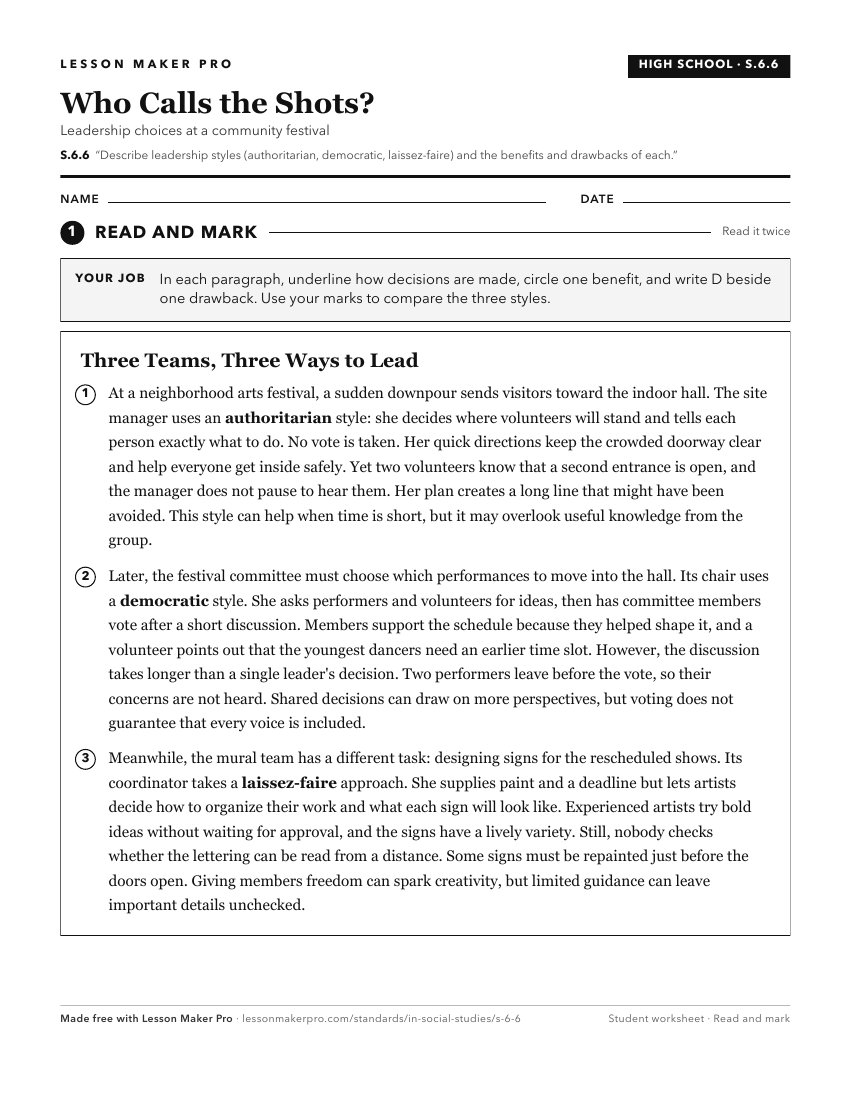
A ready-to-print activity worksheet aligned to S.6.6, with an answer key for the teacher on its own page. No account needed.
PDF, US Letter, prints cleanly in black and white.
Download the worksheetKeep exploring
Related Standards
- E.1.6
Describe and compare the various economic systems (i.e., traditional, market, command, mixed, feudal, mercantile) and explain their strengths and weaknesses.
- S.8.9
Discuss the impact of leaders of different social movements.
- GE.2.3
Evaluate the strengths and weaknesses of various economic systems.
- USG.1.4
Compare and contrast types of government including representative democracy, monarchy, oligarchy, totalitarianism, and anarchy.
Turn this exact standard into a lesson
Grade, subject, topic, and the complete standard are prefilled. Create one free, no account needed.
Also for this standard:Make a WorksheetMake a QuizMake a Sub Lesson