Indiana Social Studies P.3.4
The Standard
Describe the physical, cognitive, and moral changes that occur during adolescence, including the key foundational aspect of identity formation.
2026 Indiana Academic Standards: K-12 Social Studies
Teacher's field guide
What This Standard Means
What Students Need to Do
- Students describe changes in puberty and sleep, in how teens think and plan, and in how they judge fairness. They explain how trying new roles and interests helps teens figure out who they are.
What Mastery Looks Like
- Given a teen scenario, a student can identify a sleep shift as physical, planning ahead as cognitive, and weighing a rule's fairness as moral. They can explain how joining a club might be part of exploring identity.
Common Misconceptions
- Students may think puberty starts at the same age for everyone. They may assume better reasoning means teens always make careful choices. They may see trying new interests as indecision rather than identity exploration.
How to Assess It
- Give students this exit ticket: A teen stays up later, compares two job options, questions whether a school rule is fair, and joins a new club. Label the physical, cognitive, and moral changes, then explain how the club choice relates to identity.
Lesson moves
Ways to Teach It
Have pairs place cards about puberty, future plans, fair rules, and trying a club on four labeled posters, then explain each choice.
Ask: If a teen calls a school rule unfair, what would show moral reasoning rather than frustration? Have students write two sentences.
Run a four-corners game: read teen scenarios aloud, then have students choose physical, cognitive, moral, or identity and defend their choice.
Bring a school club sign-up sheet and ask how choosing or leaving a club might help a teen test interests and shape identity.
Free download
Printable P.3.4 Worksheet
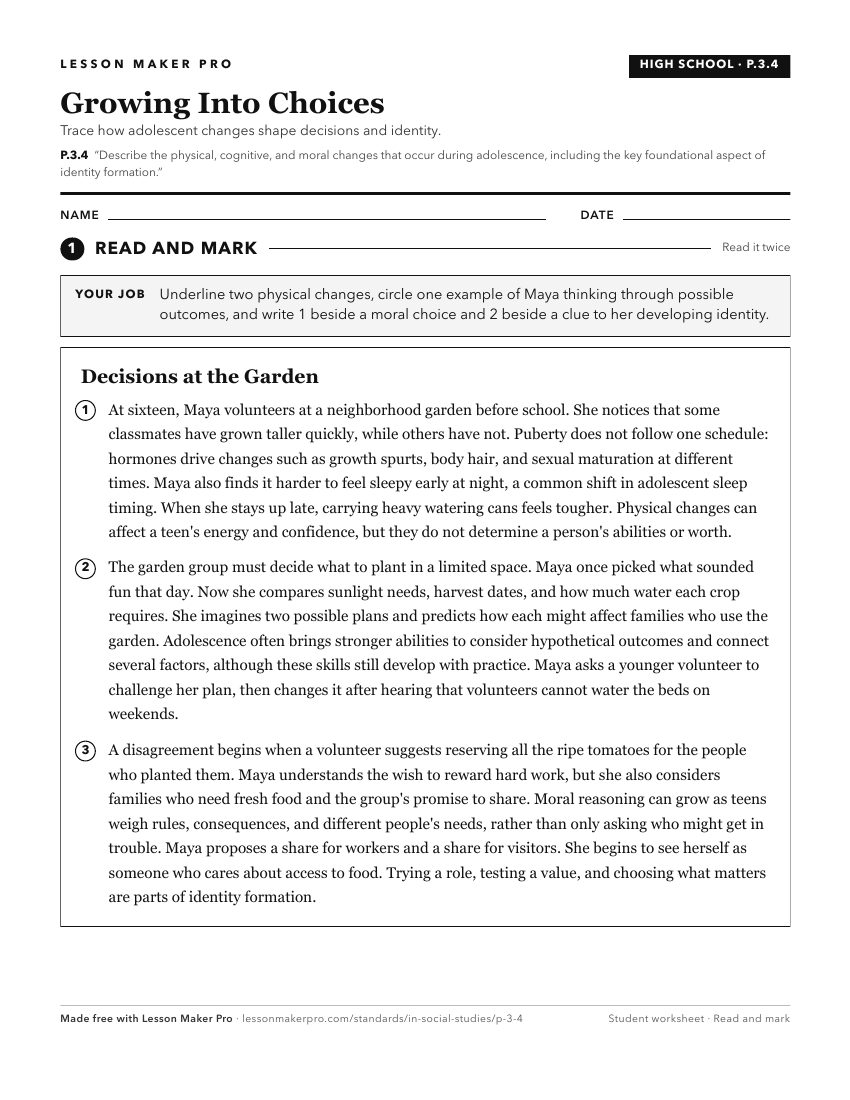
A ready-to-print activity worksheet aligned to P.3.4, with an answer key for the teacher on its own page. No account needed.
PDF, US Letter, prints cleanly in black and white.
Download the worksheetKeep exploring
Related Standards
- P.3.5
Describe the major physical, cognitive, and social issues that accompany adulthood and aging.
- P.5.6
Evaluate the influences of variables, such as culture (belonging to an individualist or collectivist culture), family, and genetics, on personality development ...
- S.8.2
Examine various social influences that can lead to immediate and long-term changes.
- S.3.1
Define socialization as a process that takes place from birth to death, and how it changes throughout the life cycle.
Turn this exact standard into a lesson
Grade, subject, topic, and the complete standard are prefilled. Create one free, no account needed.
Also for this standard:Make a WorksheetMake a QuizMake a Sub Lesson