Indiana Social Studies IS.4.8
The Standard
Describe the growth of unions and the labor movement and evaluate various approaches and methods used by different labor leaders and organizations in Indiana from 1870-1900.
2026 Indiana Academic Standards: K-12 Social Studies
Teacher's field guide
What This Standard Means
What Students Need to Do
- Trace why more Indiana workers joined unions as railroads, mines, and factories grew. Compare how the Knights of Labor, coal miners' unions, and Terre Haute's Eugene V. Debs organized workers and pressed employers. Judge the gains and risks of their methods.
What Mastery Looks Like
- A student can name a method used by each group and explain why workers chose it. They can explain how Debs's 1894 rail boycott drew attention but failed to win workers' demands.
Common Misconceptions
- Students may assume every union used the same methods or that every strike won higher pay. They may think the Pullman strike began in Indiana because Debs was from Terre Haute.
How to Assess It
- Exit ticket: Compare a coal miners' strike with Debs's 1894 rail boycott. Name one possible gain and one risk of each method.
Lesson moves
Ways to Teach It
Have pairs arrange paper cards for Indiana's Knights of Labor, coal miners' unions, and Debs's rail boycott on a timeline, then label each method.
Ask students to write: Would you support Debs's 1894 rail boycott if your job depended on the railroad? Give one reason and one risk.
Play a card match with three union names and cards showing broad membership, mine strikes, and a rail boycott.
Give students a mock workplace pay offer; have them choose bargaining, a strike, or a boycott and compare their choice with Debs's.
Free download
Printable IS.4.8 Worksheet
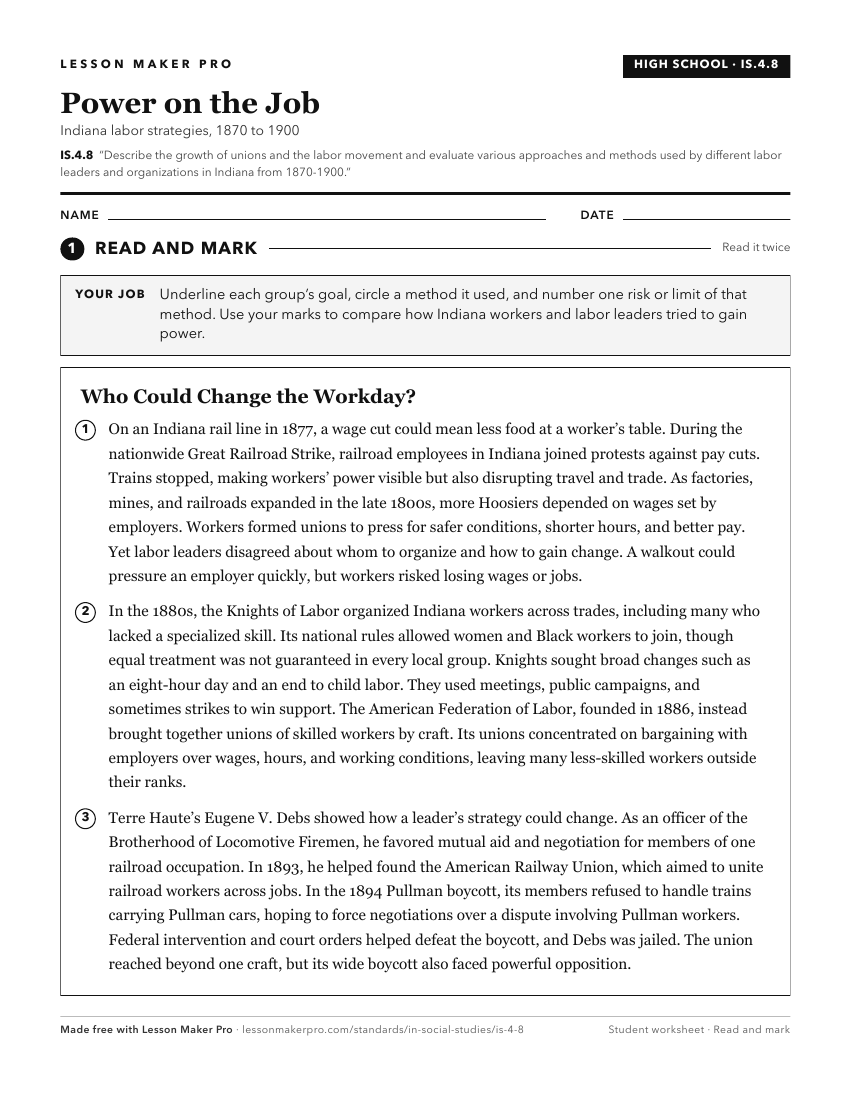
A ready-to-print activity worksheet aligned to IS.4.8, with an answer key for the teacher on its own page. No account needed.
PDF, US Letter, prints cleanly in black and white.
Download the worksheetKeep exploring
Related Standards
- IS.1.11
Describe the growth of unions and the labor movement and evaluate various approaches and methods used by different labor leaders and organizations.
- IS.1.17
Identify the social, political, economic, and cultural movements of the 1920s and analyze how these movements reflected and shaped Indiana society.
- IS.1.14
Explain the origins, goals, achievements, and limitations of the Progressive Movement in addressing political, economic, and social reform in Indiana.
- IS.4.10
Summarize the impact of industrialization and immigration on social movements in Indiana from 1870-1900, including contributions of specific individuals and gro...
Turn this exact standard into a lesson
Grade, subject, topic, and the complete standard are prefilled. Create one free, no account needed.
Also for this standard:Make a WorksheetMake a QuizMake a Sub Lesson