Indiana Social Studies IS.1.8
The Standard
Describe the economic developments that transformed Indiana into a major industrial power and the factors necessary for industrialization.
2026 Indiana Academic Standards: K-12 Social Studies · Industrialization and Immigration in Indiana: 1865 to 1900
Teacher's field guide
What This Standard Means
What Students Need to Do
- Students explain how railroads, fuel, workers, and investment helped Indiana factories grow after the Civil War. They connect those conditions to industries such as Muncie glassmaking and Bedford limestone quarrying.
What Mastery Looks Like
- A student can explain why Muncie attracted glassmakers in the late 1800s. They can tell how natural gas powered furnaces, while railroads brought supplies and carried finished goods to buyers.
Common Misconceptions
- Some students think natural gas was an ingredient in glass, rather than fuel for its furnaces. Others credit Gary's steel mills with Indiana's growth before 1900, though Gary was founded in 1906.
How to Assess It
- Exit ticket: Why did glass factories grow in Muncie in the late 1800s? Name three conditions they needed and explain how each helped.
Lesson moves
Ways to Teach It
Give groups cards labeled natural gas, rail lines, workers, investors, and glass factory; have them arrange a cause-and-effect chain for Muncie.
Ask, "Why did Ball Brothers move to Muncie in 1887?" Have students write two sentences using natural gas and rail access.
Run a factory-site game: pairs choose between two towns with listed fuel, rail access, workers, and investors, then defend their pick.
Show a Ball jar or its photo; have students label the sand, fuel, workers, and rail shipping needed to make and sell it.
Free download
Printable IS.1.8 Worksheet
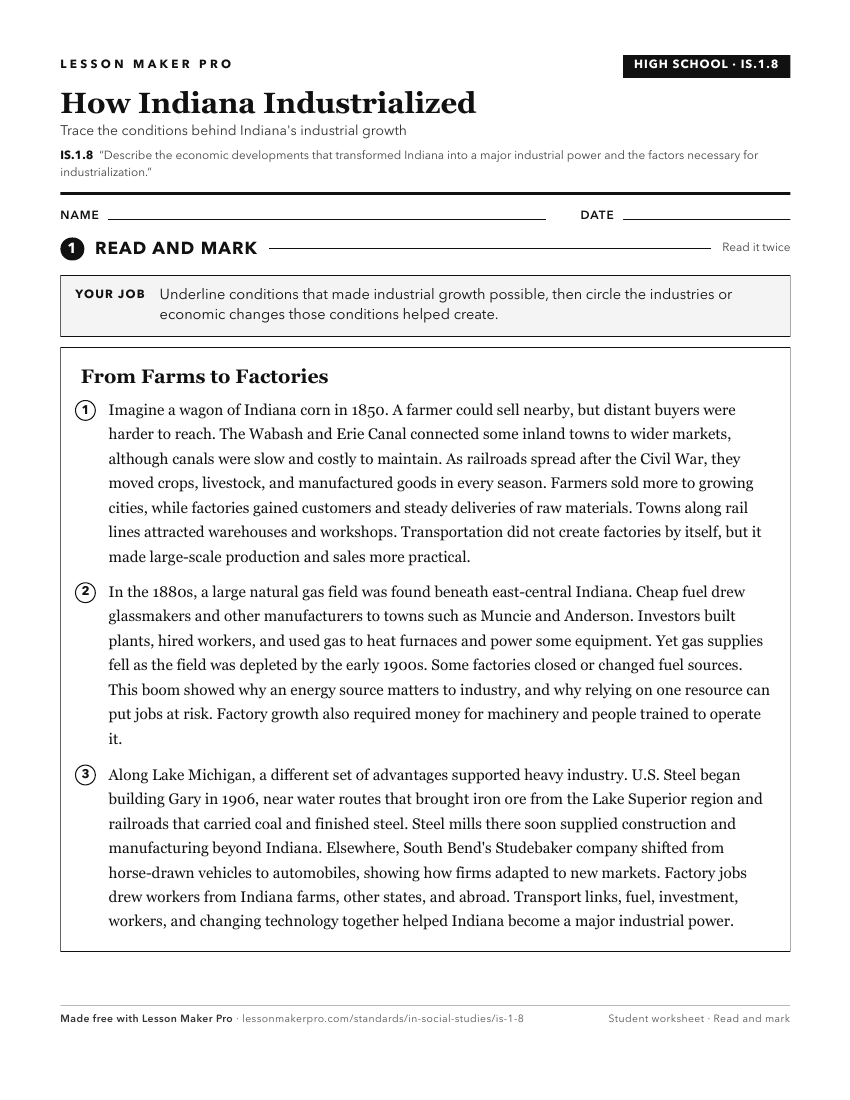
A ready-to-print activity worksheet aligned to IS.1.8, with an answer key for the teacher on its own page. No account needed.
PDF, US Letter, prints cleanly in black and white.
Download the worksheetKeep exploring
Related Standards
- IS.4.1
Describe the economic developments in Indiana that helped transform the U.S. into a major industrial power.
- 4.H.7
Give examples of Indiana's increasing agricultural, industrial, political, and business development in the nineteenth century.
- IS.4.7
Examine the rise and decline of industrial cities in Indiana.
- IS.4.11
Explain the impact of “New” Immigration and the Great Migration on industrialization and urbanization in promoting economic growth in Indiana from 1897 to 1920.
Turn this exact standard into a lesson
Grade, subject, topic, and the complete standard are prefilled. Create one free, no account needed.
Also for this standard:Make a WorksheetMake a QuizMake a Sub Lesson