Indiana Social Studies GHW.12.3
The Standard
Evaluate the emerging trends toward reducing environmental footprints.
2026 Indiana Academic Standards: K-12 Social Studies
Teacher's field guide
What This Standard Means
What Students Need to Do
- Students examine ways to cut resource use, waste, and emissions, such as renewable power, repair, and reuse. They compare likely savings with impacts from making, using, and disposing of products.
What Mastery Looks Like
- A student can use data to judge whether a proposed change lowers an environmental footprint overall. They can name a tradeoff and explain what more they need to know.
Common Misconceptions
- Students may assume an electric vehicle has no emissions because it has no tailpipe. They may ignore mining, manufacturing, and disposal, or assume every recycling program saves the same amount of resources.
How to Assess It
- Exit ticket: A city replaces diesel buses with electric buses powered mostly by coal. Name one likely gain, one possible cost, and one number you need to judge the change.
Lesson moves
Ways to Teach It
Use paper cutouts for cotton, factory, store, and landfill; add a clothing resale loop and mark one saved resource and one added cost.
Ask, 'When might an electric bus have a bigger footprint than expected?' Have students write a claim about batteries or electricity sources.
Play claim check with three cards: 'Solar panels make no emissions,' 'Refills reduce packaging,' and 'Recycling always saves energy'; defend each placement.
Give students a printed local utility power-mix chart and ask them to judge whether electric school buses would likely cut emissions there.
Free download
Printable GHW.12.3 Worksheet
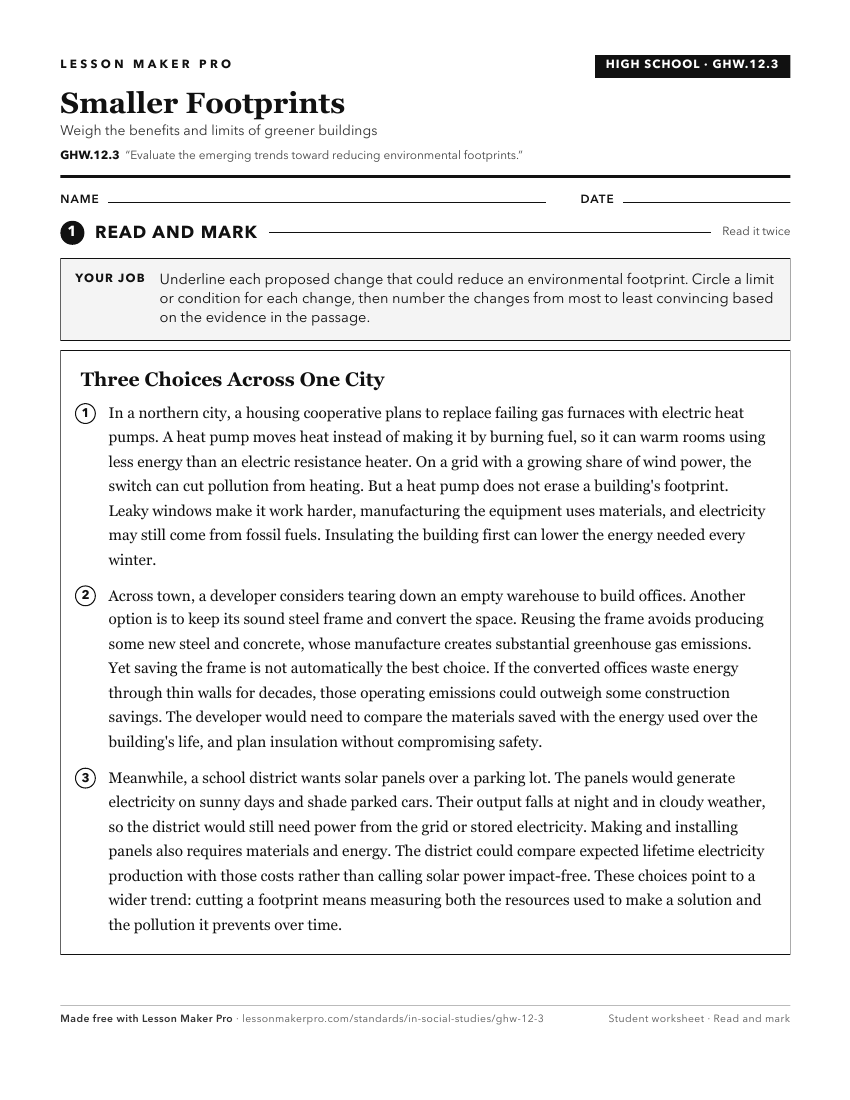
A ready-to-print activity worksheet aligned to GHW.12.3, with an answer key for the teacher on its own page. No account needed.
PDF, US Letter, prints cleanly in black and white.
Download the worksheetKeep exploring
Related Standards
- WG.5.6
Create basic policies designed to guide the use and management of Earth’s resources and that reflect multiple points of view.
- WG.5.4
Identify patterns of world resource distribution and utilization, and explain the impacts of using renewable and nonrenewable resources.
- IS.4.4
Analyze the economic, social, and environmental impact of technologies on the state.
- 7.G.9
Analyze current issues and developments related to the environment in selected countries in Africa, Asia, and the Southwest Pacific.
Turn this exact standard into a lesson
Grade, subject, topic, and the complete standard are prefilled. Create one free, no account needed.
Also for this standard:Make a WorksheetMake a QuizMake a Sub Lesson