Indiana Social Studies E.2.6
The Standard
Analyze the earnings of workers in different industries using factors such as product value, worker productivity, and market structure.
2026 Indiana Academic Standards: K-12 Social Studies · Students explain that because resources are limited, people must make choices, understanding the role that supply, demand, prices, and profits play in a market economy. Key elements of the course include study of scarcity and economic reasoning, supply and demand, market structures, the role of government, national economic performance, the role of financial institutions, economic stabilization, and trade.
Teacher's field guide
What This Standard Means
What Students Need to Do
- Students compare jobs in different industries by looking at what workers make, how much they make, and what buyers pay. They also look at how many employers compete to hire those workers.
What Mastery Looks Like
- Given output and prices, students calculate the sales value a worker produces per hour. They explain why that figure is not the worker's wage and how having more employers to choose from can affect pay.
Common Misconceptions
- Students may mistake a product's sale price for the worker's pay or overlook how many items the worker makes per hour. They may assume workers in a profitable industry always earn more, even when they have few other places to work.
How to Assess It
- On an exit ticket, show a baker making 20 loaves an hour at $5 each and an assembler making four lamps an hour at $30 each. Ask students to calculate both hourly sales totals and explain how having only one local lamp factory might affect the assembler's pay.
Lesson moves
Ways to Teach It
Give pairs paper loaves and lamps with price tags, then have them arrange the items into hourly output groups and calculate sales totals.
Ask: Would one factory in town offer the same pay as five competing factories? Have students explain using a worker's job choices.
Run three rounds of wage bidding with employer cards that show hourly output, product prices, and how many firms are hiring.
Bring in two local job ads, such as cashier and dental hygienist, and have students propose reasons for the posted pay gap.
Free download
Printable E.2.6 Worksheet
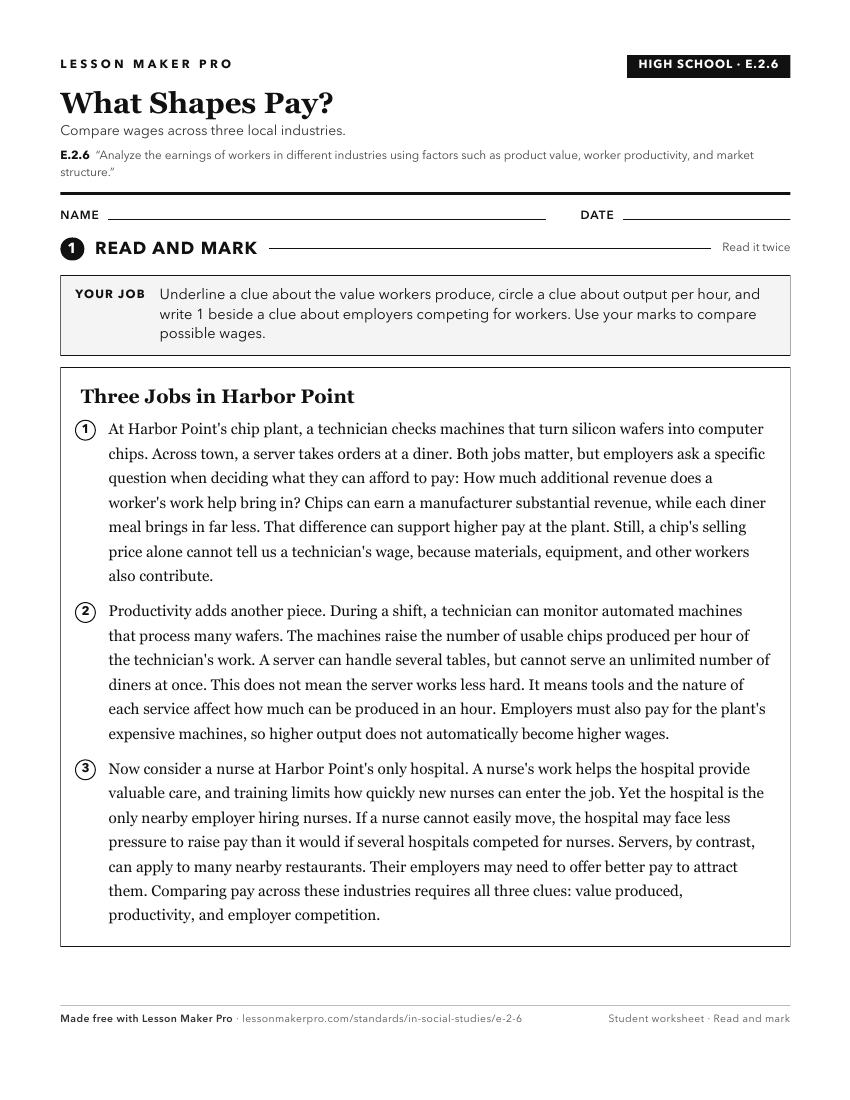
A ready-to-print activity worksheet aligned to E.2.6, with an answer key for the teacher on its own page. No account needed.
PDF, US Letter, prints cleanly in black and white.
Download the worksheetKeep exploring
Related Standards
- WG.4.9
Identify patterns of economic activity in terms of primary (growing or extracting), secondary (manufacturing), tertiary (distributing and services), quaternary ...
- GE.3.4
Explain the role and effect of labor unions, nonprofit organizations, and cooperatives in a given economy.
- GE.5.7
Investigate the effect of Gross Domestic Product (GDP), unemployment, and inflation on economies.
- GE.3.1
Define labor productivity and explain the basic factors which affect productivity.
Turn this exact standard into a lesson
Grade, subject, topic, and the complete standard are prefilled. Create one free, no account needed.
Also for this standard:Make a WorksheetMake a QuizMake a Sub Lesson