Indiana Social Studies E.1.4
The Standard
Define scarcity, and explain how choices incur opportunity costs, utility, and trade-offs.
2026 Indiana Academic Standards: K-12 Social Studies · Students explain that because resources are limited, people must make choices, understanding the role that supply, demand, prices, and profits play in a market economy. Key elements of the course include study of scarcity and economic reasoning, supply and demand, market structures, the role of government, national economic performance, the role of financial institutions, economic stabilization, and trade.
Teacher's field guide
What This Standard Means
What Students Need to Do
- Students explain why limited time or money forces choices. They identify the next-best option given up as opportunity cost. They compare trade-offs and the utility, or satisfaction, each option offers.
What Mastery Looks Like
- Given a budget and several priced options, students explain why they cannot have everything. They name the best option they gave up, not every option they rejected. They explain why their choice gives them more satisfaction.
Common Misconceptions
- Students may think scarcity means having no money, rather than having limits on what money can buy. They may call every rejected option an opportunity cost instead of naming the best one. Some confuse utility with price or assume everyone values an item the same way.
How to Assess It
- Exit ticket: You have $10 and can buy one of these: a $10 movie ticket, a $10 bus pass, or a $10 meal. Choose one, name your next-best option, and explain why your choice gives you more satisfaction.
Lesson moves
Ways to Teach It
Give pairs 12 paper dollars and price cards for lunch ($7), bus fare ($5), and a movie ($10); have them buy and name what they give up.
Ask, "Why might two students with $12 make different choices from the same price cards? What satisfaction does each expect?"
Give students a two-hour window and cards for work, practice, and studying, each taking two hours; partners choose and name their next-best option.
Use a grocery flyer to price pasta with sauce and rice with beans under $15; students choose a dinner and explain what they forgo.
Free download
Printable E.1.4 Worksheet
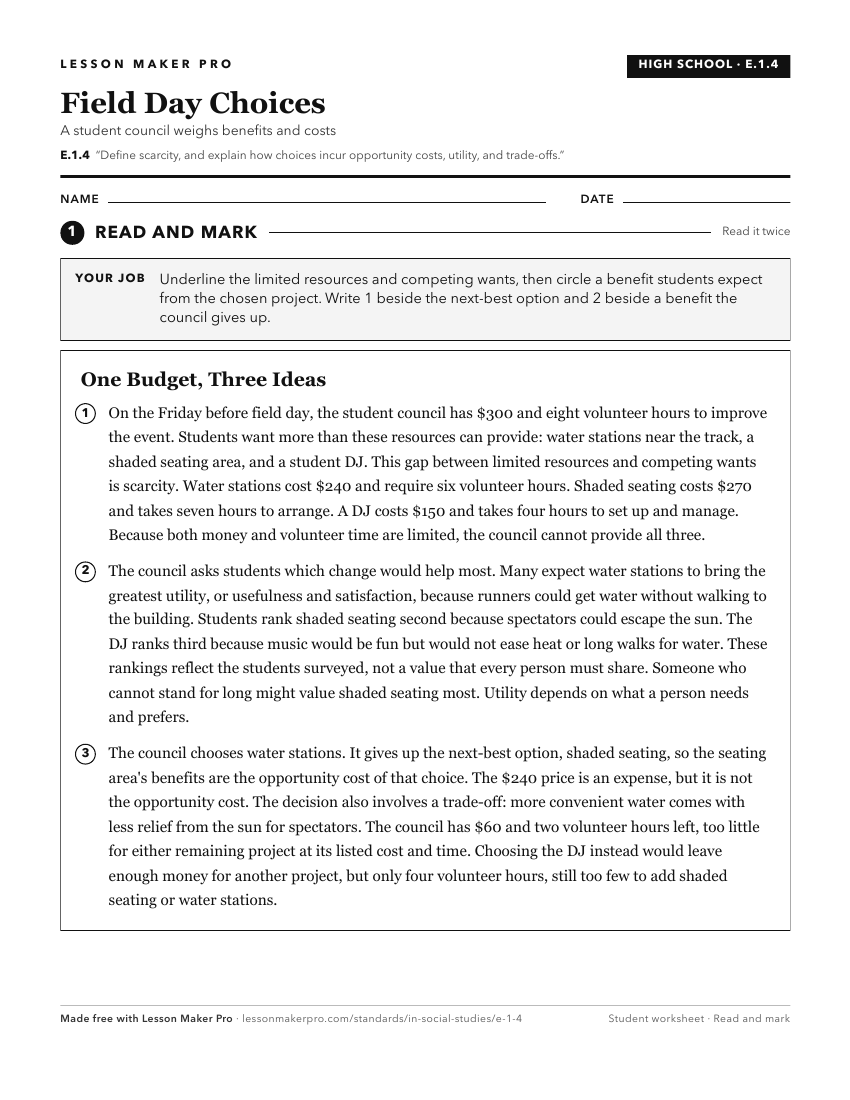
A ready-to-print activity worksheet aligned to E.1.4, with an answer key for the teacher on its own page. No account needed.
PDF, US Letter, prints cleanly in black and white.
Download the worksheetKeep exploring
Related Standards
- GE.1.2
Define scarcity and explain how opportunity costs and tradeoffs exist.
- 2.E.3
Define opportunity cost and explain that because resources are limited in relation to people’s wants (e.g., scarcity), people must make choices as to how to use...
- 3.E.1
Give examples from the local community that illustrate scarcity of resources and explain how scarcity requires people to make choices and give up other options ...
- 1.E.3
Explain that people must make choices about goods and services because resources are limited in relation to people’s wants (e.g., scarcity).
Turn this exact standard into a lesson
Grade, subject, topic, and the complete standard are prefilled. Create one free, no account needed.
Also for this standard:Make a WorksheetMake a QuizMake a Sub Lesson