Indiana Social Studies 5.H.4
The Standard
Locate the early Spanish, French, and British settlements on a map, and compare the origins, physical structure, and social structure of these settlements.
2026 Indiana Academic Standards: K-12 Social Studies
Teacher's field guide
What This Standard Means
What Students Need to Do
- Students locate St. Augustine, Quebec, and Jamestown on a map. They compare why each began, what was built, and who led, worked, and traded in and around each settlement.
What Mastery Looks Like
- A student places all three near the correct coast or river. They explain that St. Augustine guarded Spanish interests, Quebec supported the French fur trade, and Jamestown sought English profit. They compare the forts and trading post and identify the roles of leaders, workers, and Indigenous neighbors.
Common Misconceptions
- Students may place Quebec in the present-day United States. They may think all three settlements began for the same reason or had the same layout. They may assume Indigenous neighbors were part of the colonial government.
How to Assess It
- On a blank map, label St. Augustine, Quebec, and Jamestown. Choose two and write how they differed in purpose, buildings, and who held power.
Lesson moves
Ways to Teach It
Give pairs a blank map and three settlement cards; have them place each site and mark its nearby coast or river.
Ask students to write why Quebec and Jamestown began, then compare who held power and who did the work.
Play a clue-matching game with cards for Spanish defense, French fur trade, English profit, forts, and a trading post.
Find St. Augustine, Quebec, and Jamestown on a current map; ask how each coast or river still shapes the city.
Free download
Printable 5.H.4 Worksheet
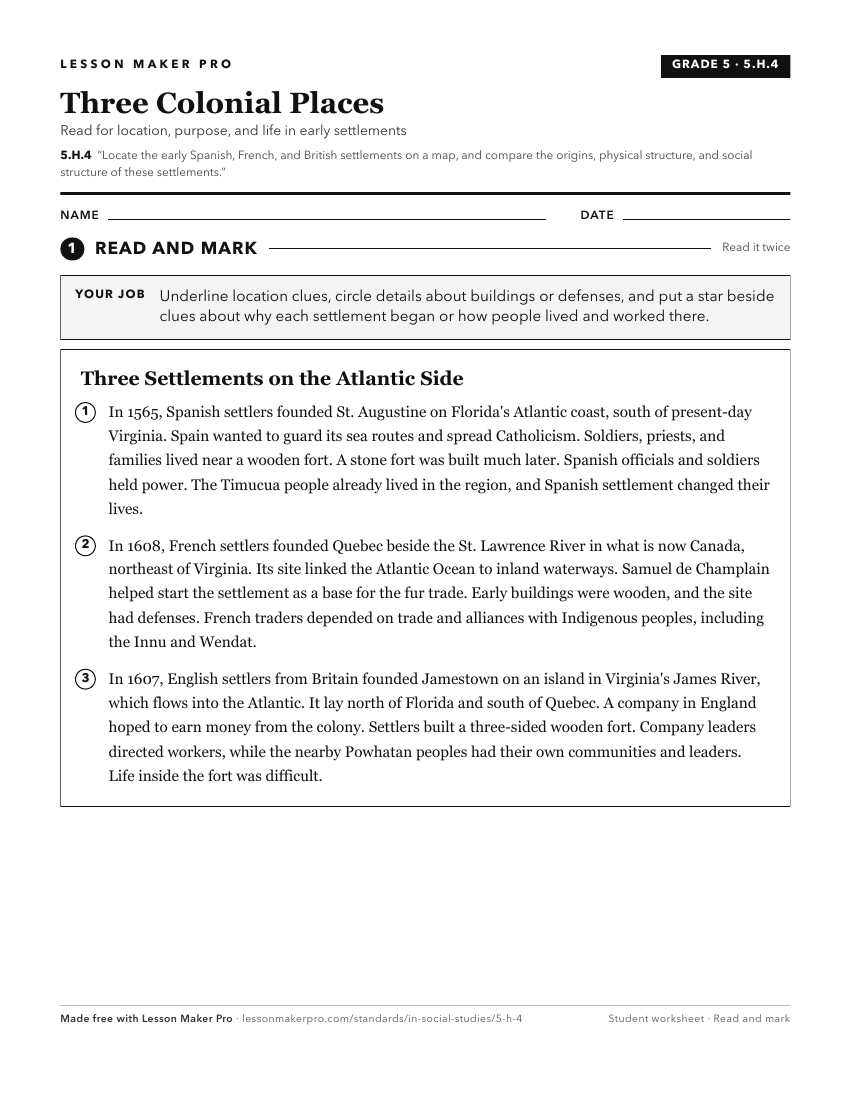
A ready-to-print activity worksheet aligned to 5.H.4, with an answer key for the teacher on its own page. No account needed.
PDF, US Letter, prints cleanly in black and white.
Download the worksheetKeep exploring
Related Standards
- WG.4.2
Develop maps of human migration and settlement patterns at different times in history and compare them to the present.
- 8.H.2
Compare and contrast reasons for British, French, Spanish, and Dutch colonization in the New World.
- 5.H.3
Compare and contrast historic Native American groups of the West, Southwest, Northwest, Arctic and sub-Arctic, Great Plains, and Eastern Woodlands regions at th...
- 5.H.1
Identify and describe early cultures and settlements that existed in North America prior to contact with Europeans.
Turn this exact standard into a lesson
Grade, subject, topic, and the complete standard are prefilled. Create one free, no account needed.
Also for this standard:Make a WorksheetMake a QuizMake a Sub Lesson