Indiana Social Studies 5.E.5
The Standard
Explain the purpose and components of a personal budget, and compare factors that influence household saving and spending decisions.
2026 Indiana Academic Standards: K-12 Social Studies
Teacher's field guide
What This Standard Means
What Students Need to Do
- Students make a plan for money coming in, bills, other purchases, and savings. They compare how income, prices, family needs, and goals change what a household saves or spends.
What Mastery Looks Like
- Given an income and a list of expenses, students make a plan that covers needs and sets aside money to save. They explain why a higher food bill or a new goal changes what the household can buy.
Common Misconceptions
- Students may treat income as money left after bills or leave savings out of the plan. They may call every purchase a need or assume families with the same income can save the same amount.
How to Assess It
- Exit ticket: A household earns $100 and plans $40 for housing, $25 for food, and $15 for transport. Find the amount available to save, then explain how a $10 increase in food costs changes the plan.
Lesson moves
Ways to Teach It
Give pairs $100 in play money and envelopes labeled housing $40, food $25, transport $15, and savings; have them divide the cash.
Ask students to write: Why might two families earning $100 each save different amounts if one pays $20 more for transport?
Play a budget change game: draw a card marked “food costs rise $10” or “income drops $10,” then revise a $100 plan.
Use a grocery flyer to price two dinners for four, then show how choosing the cheaper one changes a family's weekly savings.
Free download
Printable 5.E.5 Worksheet
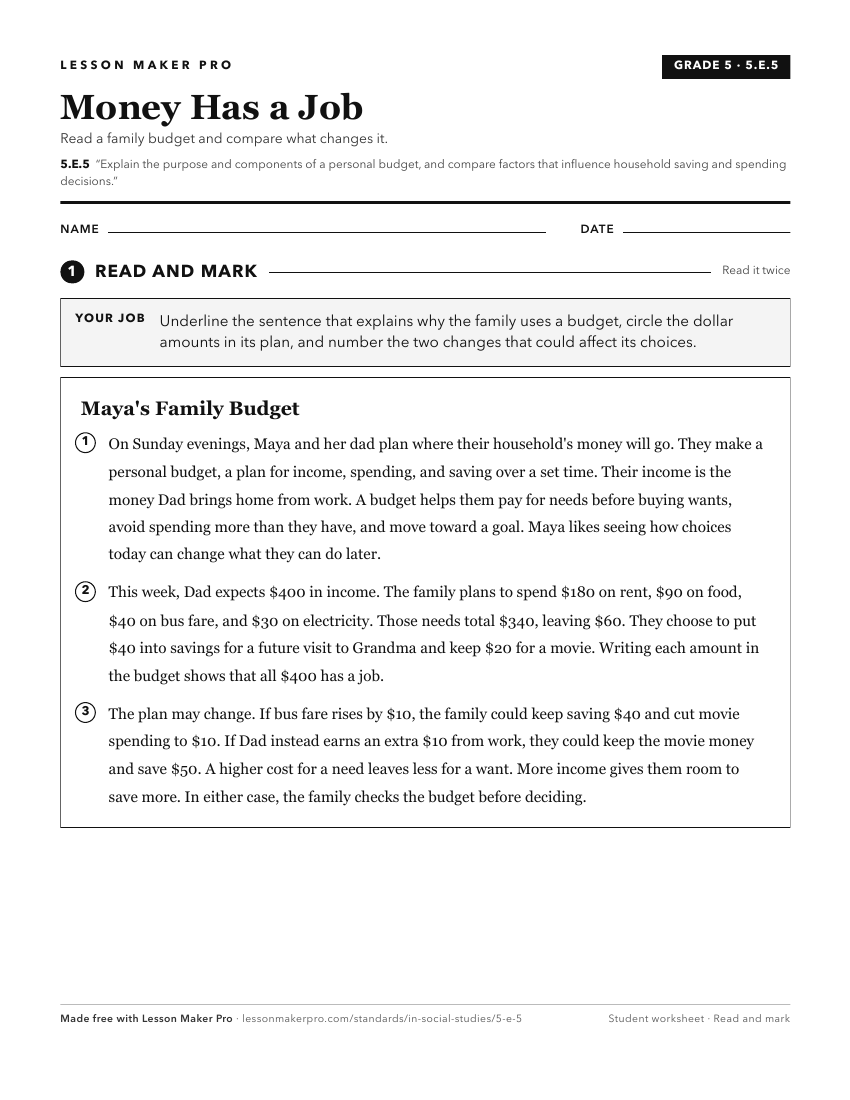
A ready-to-print activity worksheet aligned to 5.E.5, with an answer key for the teacher on its own page. No account needed.
PDF, US Letter, prints cleanly in black and white.
Download the worksheetKeep exploring
Related Standards
- 3.E.8
Identify different ways people save their income, and explain advantages and disadvantages of each.
- E.4.3
Describe the major revenue and expenditure categories in state and federal budgets and their respective proportions, and the challenges of achieving a balanced ...
- 2.E.5
Explain the concept of savings and why this is important for individuals and for the economy.
- E.4.5
Define budget debt and budget deficit and distinguish between the two. Explain the effects of both on the economy.
Turn this exact standard into a lesson
Grade, subject, topic, and the complete standard are prefilled. Create one free, no account needed.
Also for this standard:Make a WorksheetMake a QuizMake a Sub Lesson