Indiana Science HS-PSII-6.1
The Standard
Describe the magnetic properties of ferromagnetic, paramagnetic, and diamagnetic materials on a macroscopic scale and atomic scale.
Indiana Academic Standards for Science (2023) · Magnetism
Teacher's field guide
What This Standard Means
What Students Need to Do
- Students compare how steel, aluminum, and bismuth respond to a magnet. They explain the differences using magnetic domains, unpaired electron moments, and induced moments that oppose the field.
What Mastery Looks Like
- A student identifies strong attraction, weak attraction, and weak repulsion from test results. They sketch aligned domains in steel, temporarily aligned moments in aluminum, and opposing induced moments in bismuth. They predict that steel may stay magnetized after the magnet is removed.
Common Misconceptions
- Students often call anything that does not stick to a fridge magnet nonmagnetic, missing weak attraction and repulsion. Some think all materials have permanent magnetic domains, or that repulsion means electrons have no magnetic response.
How to Assess It
- Exit ticket: A sensor shows strong attraction for steel, weak attraction for aluminum, and weak repulsion for bismuth. Name each type and sketch what causes its response at the atomic scale.
Lesson moves
Ways to Teach It
Test a steel paper clip with a fridge magnet, then compare printed sensor readings for aluminum and bismuth; label each response.
Write two sentences explaining steel's domains, aluminum's unpaired electron moments, and bismuth's induced opposing moments near a magnet.
Sort cards showing materials, sensor readings, and electron diagrams into three groups, then match each group to a magnetic response.
Hold a fridge magnet against a steel refrigerator door and an aluminum drink can, then explain why only one holds the magnet.
Free download
Printable HS-PSII-6.1 Worksheet
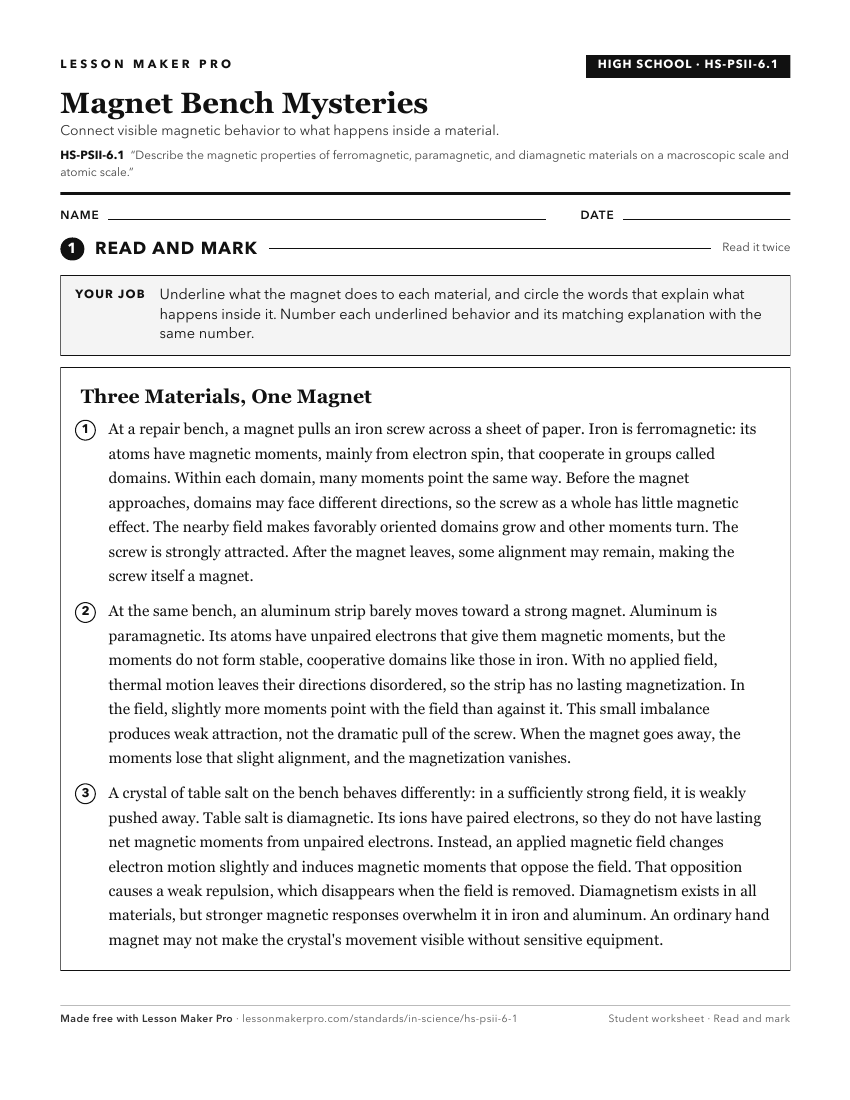
A ready-to-print activity worksheet aligned to HS-PSII-6.1, with an answer key for the teacher on its own page. No account needed.
PDF, US Letter, prints cleanly in black and white.
Download the worksheetKeep exploring
Related Standards
- HS-PSII-7.2
Develop graphical and mathematical representations that describe the relationship between the rate of change of magnetic flux and the amount of voltage induced ...
- HS-PSII-6.5
Describe the practical uses of magnetism in motors, electronic devices, mass spectroscopy, MRIs, and other applications.
Turn this exact standard into a lesson
Grade, subject, topic, and the complete standard are prefilled. Create one free, no account needed.
Also for this standard:Make a WorksheetMake a QuizMake a Sub Lesson