Indiana Science HS-PSII-10.3
The Standard
Qualitatively compare and contrast how particle interactions, fission, and fusion can convert matter into energy and energy into matter and calculate the relative amounts of matter and energy in such processes.
Indiana Academic Standards for Science (2023) · Modern Physics
Teacher's field guide
What This Standard Means
What Students Need to Do
- Students compare fission, fusion, particle annihilation, and particle-pair creation. They track changes in mass and use E = mc² to calculate the matching amount of energy.
What Mastery Looks Like
- A student can explain why fission and fusion release energy when their products have less mass. They can calculate energy from a mass difference, or find the mass equivalent of a given amount of energy.
Common Misconceptions
- Students may think all the starting matter disappears in fission or fusion. They may also think any photon can create a particle pair, regardless of its energy.
How to Assess It
- For an exit ticket, give students a 0.001 kg mass loss in fission and 9 × 10¹³ J entering a particle collision. Ask them to use c = 3 × 10⁸ m/s to find the energy released and the collision energy's mass equivalent.
Lesson moves
Ways to Teach It
Give pairs labeled nucleus cards and paper energy tokens; have them build fission and fusion reactions, then place tokens beside the lighter products.
Ask: Why do fission and fusion release energy, while creating an electron and positron from a photon requires energy?
Run a four-card match with diagrams of fission, fusion, annihilation, and pair production; students match each diagram to its mass and energy changes.
Show a reactor diagram and a PET scan image; have students label nuclear mass loss and electron-positron annihilation.
Free download
Printable HS-PSII-10.3 Worksheet
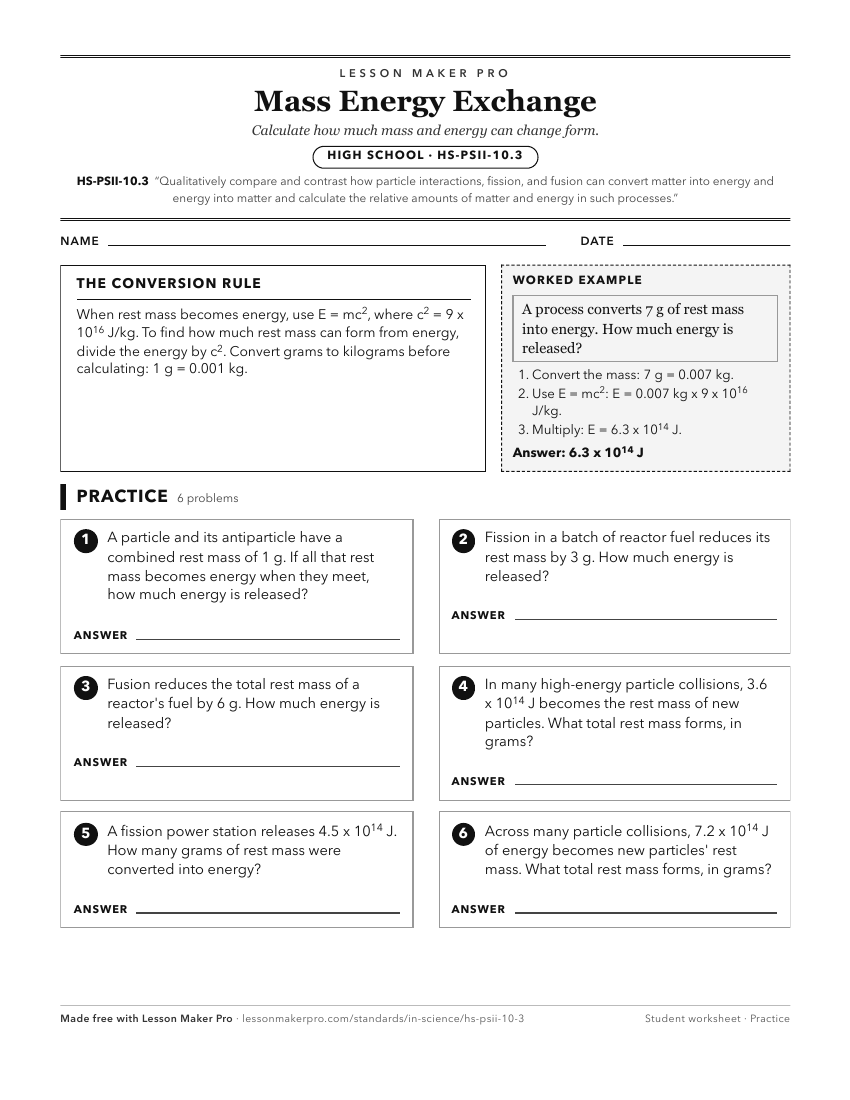
A ready-to-print activity worksheet aligned to HS-PSII-10.3, with an answer key for the teacher on its own page. No account needed.
PDF, US Letter, prints cleanly in black and white.
Download the worksheetKeep exploring
Related Standards
Turn this exact standard into a lesson
Grade, subject, topic, and the complete standard are prefilled. Create one free, no account needed.
Also for this standard:Make a WorksheetMake a QuizMake a Sub Lesson