Indiana Science HS-AP2-1
The Standard
Analyze the structural characteristics and functional importance of the integumentary system to maintain homeostasis of the body.
Indiana Academic Standards for Science (2023) · Movement and Support, the Integumentary System
Teacher's field guide
What This Standard Means
What Students Need to Do
- Students identify the epidermis, dermis, sweat glands, blood vessels, and sensory receptors on a skin diagram. They explain how skin limits water loss, detects harm, and helps keep body temperature steady.
What Mastery Looks Like
- Given a hot-day scenario, a student explains how evaporating sweat and wider blood vessels in the dermis release heat. They explain why a damaged epidermis raises the risk of water loss and infection.
Common Misconceptions
- Students may think sweat cools the body as soon as it appears, rather than when it evaporates. They may think the epidermis contains blood vessels or that skin only acts as a covering.
How to Assess It
- On a skin diagram, label the epidermis, a sweat gland, and a blood vessel in the dermis. Explain how each helps the body on a hot day.
Lesson moves
Ways to Teach It
Wrap wet and dry paper towels around two thermometers, fan both for three minutes, and compare temperatures to show evaporative cooling.
Draw a shallow scrape and a deep cut on a skin cross-section, then explain why only the deep cut bleeds.
Give pairs cards naming epidermis, sweat gland, blood vessel, and sensory receptor; have them match each card to its job during a hot walk.
Read a local heat advisory and have students explain why a roofer sweats, flushes, and needs water breaks.
Free download
Printable HS-AP2-1 Worksheet
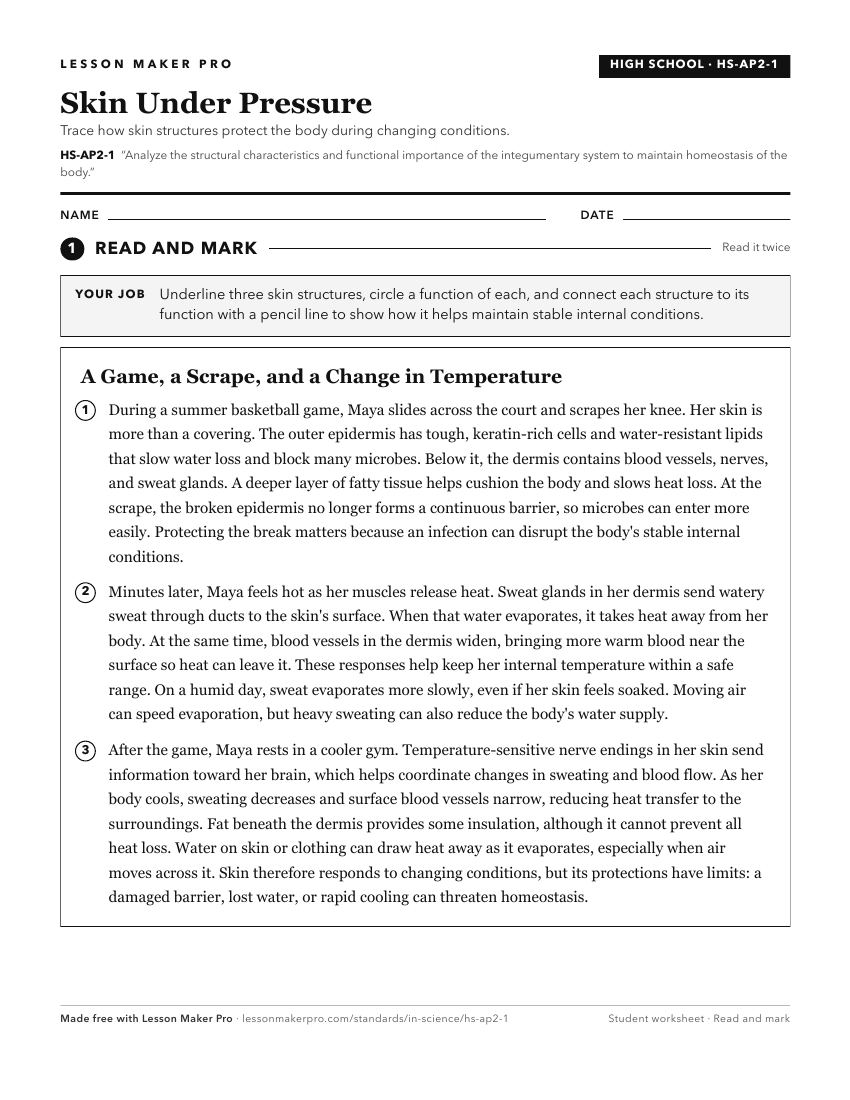
A ready-to-print activity worksheet aligned to HS-AP2-1, with an answer key for the teacher on its own page. No account needed.
PDF, US Letter, prints cleanly in black and white.
Download the worksheetKeep exploring
Related Standards
- HS-AP2-2
Evaluate and explain the consequence of injury (e.g., Burns) and/or disease (e.g., skin cancer, vitiligo) to the functionality of the integumentary system.
- HS-AP8-3
Investigate the primary structures of the cardiovascular system and explore their functional importance to maintaining homeostasis.
- HS-AP8-1
Perform an investigation to identify the composition and function of whole blood components, and the role they play in maintaining homeostasis.
- HS-AP1-5
Compare and contrast the major organ systems and describe their basic functional importance.
Turn this exact standard into a lesson
Grade, subject, topic, and the complete standard are prefilled. Create one free, no account needed.
Also for this standard:Make a WorksheetMake a QuizMake a Sub Lesson