Indiana ELA 9-10.W.3.a
The Standard
- 9-10.W
- Students compose writing and presentations for various genres which demonstrate a command of English grammar and usage through the writing and research processes; compositions will include correct use of standard formatting (e.g., MLA, APA) with correctly cited sources.
- 9-10.W.3
- Write narrative compositions in a variety of forms that: a. Engage and orient the reader by setting out a problem, situation, or observation, establishing one or multiple point(s) of view, and introducing a narrator and/or characters. b. Create a smooth progression of experiences or events. c. Use narrative techniques, such as dialogue, pacing, description, reflection, and multiple plotlines to develop experiences, events, and/or characters. d. Use a variety of techniques to sequence events so that they build on one another to create a coherent whole. e. Use precise words and phrases, telling details, and sensory language to convey a vivid picture of the experiences, events, setting, and/or characters. f. Provide an ending that follows and reflects on what is experienced, observed, or resolved over the course of the narrative. (E)
Engage and orient the reader by setting out a problem, situation, or observation, establishing one or multiple point(s) of view, and introducing a narrator and/or characters.
Indiana Academic Standards for English/Language Arts (2023)
Teacher's field guide
What This Standard Means
What Students Need to Do
- Students write an opening that gives readers a clear situation, problem, or observation. They introduce who is telling the story, whose perspective readers follow, and any characters needed to understand the scene.
What Mastery Looks Like
- A reader can tell who is present, what is happening, and why it matters. The opening keeps a clear point of view and gives the reader a reason to continue.
Common Misconceptions
- Students may start with a vague hook that hides who is speaking or what is happening. They may switch between first and third person without a clear reason, or list character traits before anything happens.
How to Assess It
- Exit ticket: Write four sentences about a missed bus that show who is telling the story, who is involved, and why the bus matters. Circle the words that establish point of view.
Lesson moves
Ways to Teach It
Give pairs cards reading 'new student,' 'locked classroom,' and 'first-person narrator'; have them arrange the cards and write a four-sentence opening.
Read the first paragraph of a class novel and ask, 'Who speaks, what is happening, and what makes you want to read on?'
Play opening repair: give groups 'Something happened and everyone was upset,' then have them add a narrator, a character, and a specific problem.
Have students draft a first-person account of arriving late to a job interview, making the interviewer and the immediate problem clear in four sentences.
Free download
Printable 9-10.W.3.a Worksheet
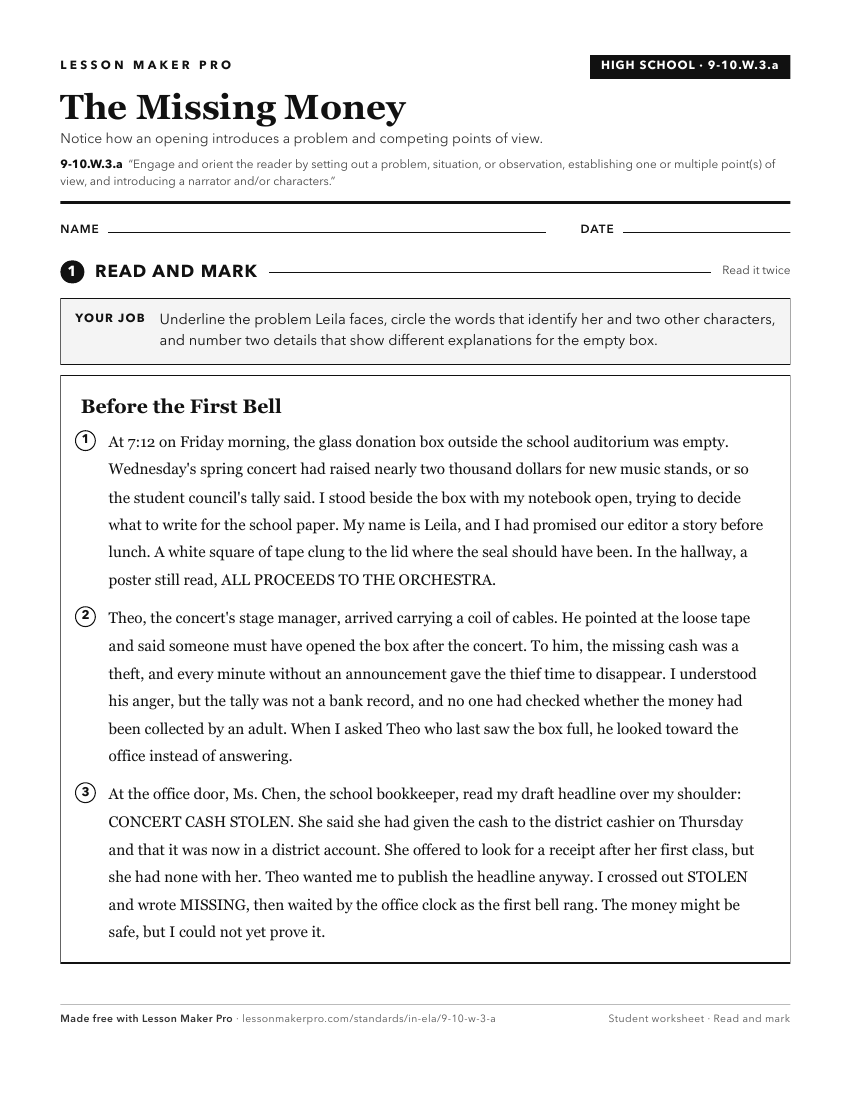
A ready-to-print activity worksheet aligned to 9-10.W.3.a, with an answer key for the teacher on its own page. No account needed.
PDF, US Letter, prints cleanly in black and white.
Download the worksheetKeep exploring
Related Standards
- 11-12.W.3.a
Engage and orient the reader by setting out a problem, situation, or observation and its significance, establishing one or multiple point(s) of view, and introd...
- 7.W.3.a
Engage and orient the reader by establishing a context and point of view and introducing a narrator and/or characters.
- 8.W.3.a
Engage and orient the reader by establishing a context and point of view and introducing a narrator and/or characters.
- 6.W.3.a
Engage and orient the reader by developing an exposition (e.g., describe the setting, establish the situation, introduce the narrator and/or characters).
Turn this exact standard into a lesson
Grade, subject, topic, and the complete standard are prefilled. Create one free, no account needed.
Also for this standard:Make a WorksheetMake a QuizMake a Sub Lesson