Indiana ELA 8.W.3.a
The Standard
- 8.W
- Students compose writing and presentations for various genres which demonstrate a command of English grammar and usage through the writing and research processes.
- 8.W.3
- Write narrative compositions in a variety of forms that: a. Engage and orient the reader by establishing a context and point of view and introducing a narrator and/or characters. b. Organize an event sequence (e.g., conflict, climax, resolution) that unfolds naturally and logically, using a variety of transition words, phrases, and clauses to convey sequence and signal shifts from one time frame or setting to another. c. Use narrative techniques, such as dialogue, pacing, description, and reflection, to develop experiences, events, and/or characters. d. Use precise words and phrases, relevant descriptive details, and sensory language to capture the action and convey experiences and events. e. Provide an ending that follows and reflects on the narrated experiences or events. (E)
Engage and orient the reader by establishing a context and point of view and introducing a narrator and/or characters.
Indiana Academic Standards for English/Language Arts (2023)
Teacher's field guide
What This Standard Means
What Students Need to Do
- Write the first few lines of a story so readers know where it happens and whose eyes they are seeing through. Introduce a character and give readers a reason to keep reading.
What Mastery Looks Like
- After one paragraph, a reader can identify the setting, the viewpoint character, and someone else involved. The point of view stays clear, and a small problem gives the story somewhere to go.
Common Misconceptions
- Students may open with unexplained dialogue or an unnamed “he,” leaving readers unsure who is speaking. They may switch from “I” to an all-knowing narrator by accident, or hide the setting to create suspense.
How to Assess It
- Exit ticket: Write four opening sentences about finding a backpack on a bus. Show whose eyes we follow and introduce one other character, then circle the words that reveal the point of view.
Lesson moves
Ways to Teach It
Give pairs cards marked place, time, first or third person, and trouble; have them draw one of each and write an opening.
Write two opening lines about a missing backpack, one from the finder’s view and one from the owner’s; discuss which raises more questions.
Play opening repair: swap three-sentence drafts, circle unclear pronouns, and revise one sentence to show who is speaking and where.
Turn a school lost-and-found notice into a first-person story opening set in the hallway, with the finder and owner on the page.
Free download
Printable 8.W.3.a Worksheet
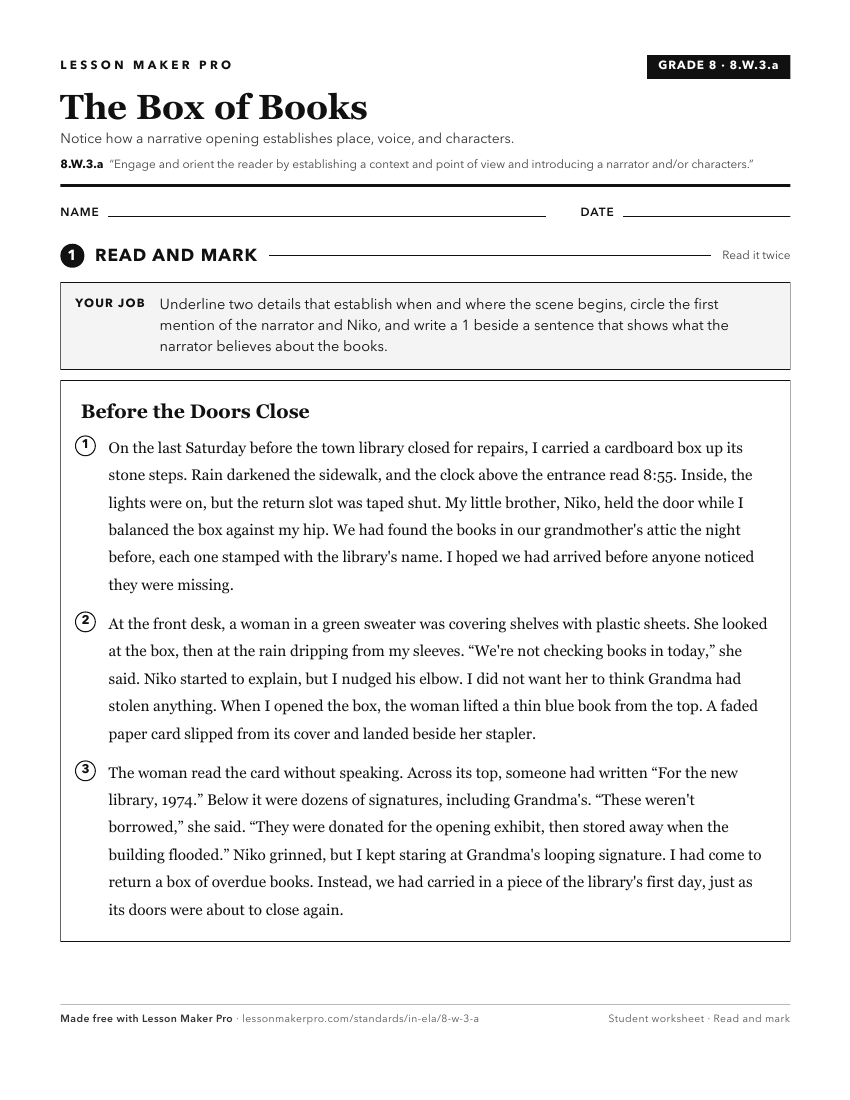
A ready-to-print activity worksheet aligned to 8.W.3.a, with an answer key for the teacher on its own page. No account needed.
PDF, US Letter, prints cleanly in black and white.
Download the worksheetKeep exploring
Related Standards
- 7.W.3.a
The 7th Grade version of this standard.
- 9-10.W.3.a
Engage and orient the reader by setting out a problem, situation, or observation, establishing one or multiple point(s) of view, and introducing a narrator and/...
- 11-12.W.3.a
Engage and orient the reader by setting out a problem, situation, or observation and its significance, establishing one or multiple point(s) of view, and introd...
- 6.W.3.a
Engage and orient the reader by developing an exposition (e.g., describe the setting, establish the situation, introduce the narrator and/or characters).
Turn this exact standard into a lesson
Grade, subject, topic, and the complete standard are prefilled. Create one free, no account needed.
Also for this standard:Make a WorksheetMake a QuizMake a Sub Lesson