Indiana ELA 3.RF.3
The Standard
- 3.RF
- Students read grade-level text independently and fluently.
Know and use more difficult word families when reading unfamiliar words (e.g., -ight).
Indiana Academic Standards for English/Language Arts (2023)
Teacher's field guide
What This Standard Means
What Students Need to Do
- Students spot a familiar letter pattern inside an unfamiliar word. They use its sound and the beginning letters to read the word, then check that it makes sense in the sentence.
What Mastery Looks Like
- A student uses night to work out fright without being told the word. They can read fright in a sentence and explain that the shared -ight helped them.
Common Misconceptions
- Some students sound out every letter in -ight separately. Others guess a word from its first letter or miss a familiar pattern inside a longer word like moonlight.
How to Assess It
- Write, “The bright light gave me a fright.” Ask each student to read it aloud, circle the shared pattern, and explain how it helped with fright.
Lesson moves
Ways to Teach It
Give pairs an -ight card and letter cards for l, br, fl, and n. Have them build and read each word.
Ask, “How can knowing night help you read fright?” Have students write one sentence explaining their thinking.
Play word-family bingo with -ight, -atch, and -ound cards. Call out fright, scratch, and ground for students to match.
Hand out a weather forecast reading “Bright skies tonight.” Have students underline -ight and read the forecast to a partner.
Free download
Printable 3.RF.3 Worksheet
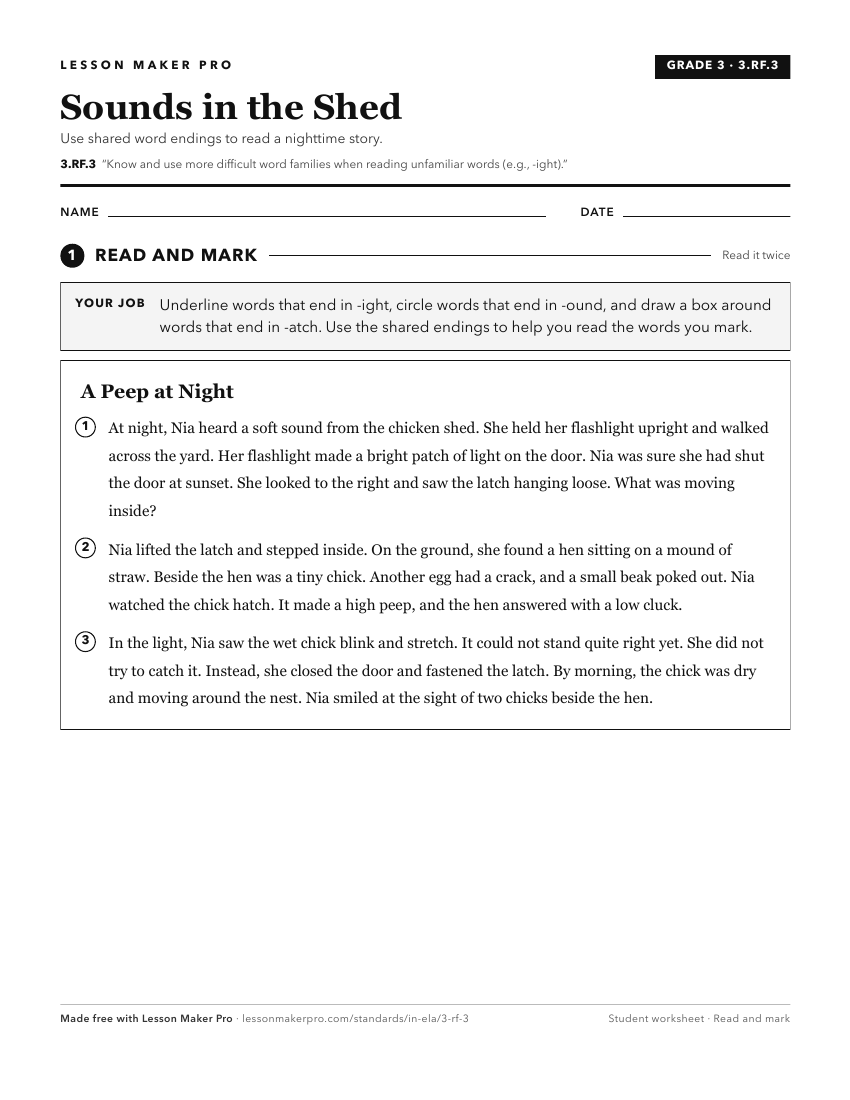
A ready-to-print activity worksheet aligned to 3.RF.3, with an answer key for the teacher on its own page. No account needed.
PDF, US Letter, prints cleanly in black and white.
Download the worksheetKeep exploring
Related Standards
- 4.RF.2
Use knowledge of all letter-sound correspondences, syllabication patterns, and morphology (e.g., roots and affixes) to accurately read unfamiliar, multisyllabic...
- 5.RF.1
Use knowledge of all letter-sound correspondences, syllabication patterns, and morphology (e.g., roots and affixes) to accurately read unfamiliar, multisyllabic...
- 2.RF.2
Apply knowledge of short and long vowels (including vowel teams) when reading regularly-spelled, one-syllable words.
- 3.RF.4
Read multisyllabic words composed of roots and related prefixes and suffixes; read irregular contractions (e.g., will not = won't) and possessives (e.g., childr...
Turn this exact standard into a lesson
Grade, subject, topic, and the complete standard are prefilled. Create one free, no account needed.
Also for this standard:Make a WorksheetMake a QuizMake a Sub Lesson