Indiana ELA 4.RF.2
The Standard
- 4.RF
- Students read grade-level text independently and fluently.
Use knowledge of all letter-sound correspondences, syllabication patterns, and morphology (e.g., roots and affixes) to accurately read unfamiliar, multisyllabic words in context.
Indiana Academic Standards for English/Language Arts (2023)
Teacher's field guide
What This Standard Means
What Students Need to Do
- Students break unfamiliar long words into syllables and familiar parts, such as prefixes, roots, and endings. They blend the parts to read the word, then check whether it makes sense in the sentence.
What Mastery Looks Like
- Given a new paragraph, a student reads words such as “unhelpful” and “repainting” aloud without guessing from the first letters. If a word sounds wrong, they check its parts and reread the sentence.
Common Misconceptions
- Students may guess “careful” when they see “careless” because both start the same way. They may sound out the letters in “tion” one by one or leave off an ending such as “ed.”
How to Assess It
- Give students this sentence: “After the rain, the playground was unusable.” Ask them to read it aloud, mark the parts of “unusable,” and explain how the sentence helps them check the word.
Lesson moves
Ways to Teach It
Give pairs printed words such as “repainting” and “unhelpful” to cut into word parts, put back together, and read in sentences.
Read “The trail was impassable after the storm.” Ask, “Which parts help you read impassable, and how does the sentence help?”
Play word-part relay: teams build “unpredictable” from un, predict, and able, then read it aloud in a sentence.
Post a school lunch menu; students circle long words such as “vegetarian,” break them into syllables, and read the menu aloud.
Free download
Printable 4.RF.2 Worksheet
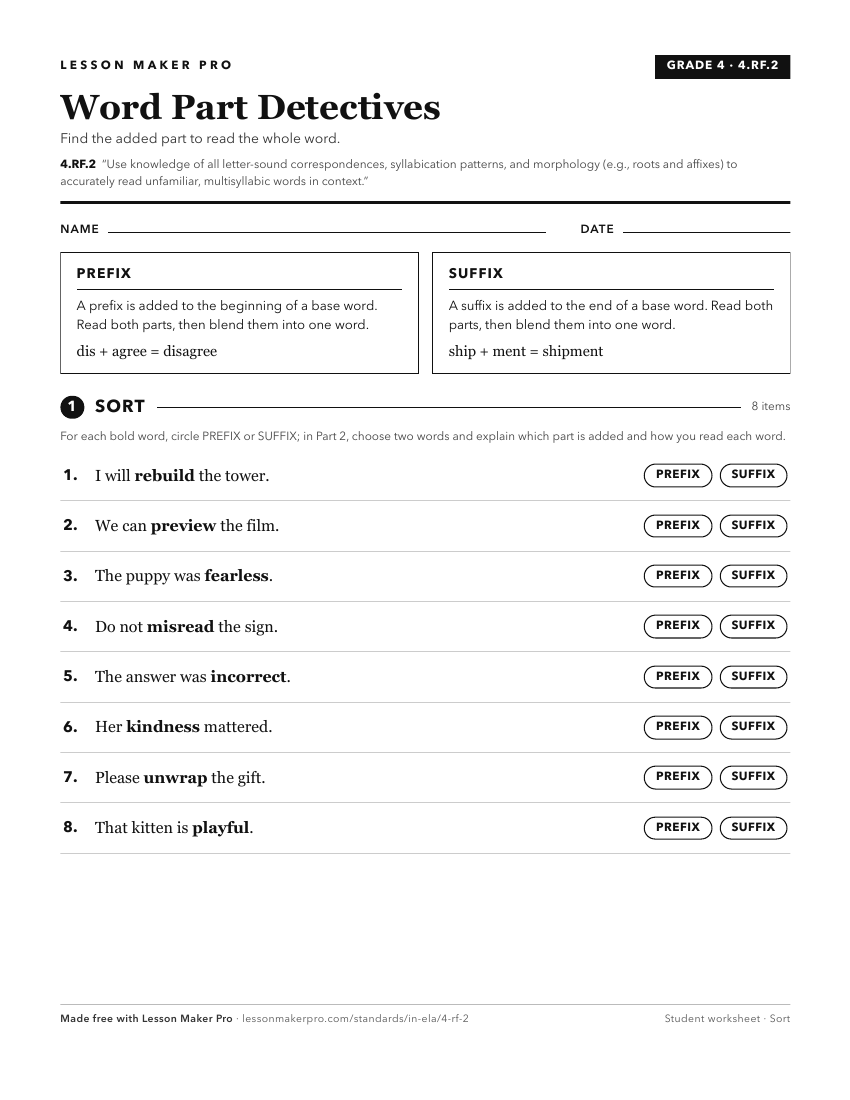
A ready-to-print activity worksheet aligned to 4.RF.2, with an answer key for the teacher on its own page. No account needed.
PDF, US Letter, prints cleanly in black and white.
Download the worksheetKeep exploring
Related Standards
- 5.RF.1
Use knowledge of all letter-sound correspondences, syllabication patterns, and morphology (e.g., roots and affixes) to accurately read unfamiliar, multisyllabic...
- K.RF.8
Use letter-sound knowledge to decode words, including open and closed syllables, consonant digraphs, and blends. (E)
- 1.RF.5
Use letter-sound knowledge of single consonants (hard and soft sounds), short and long vowels, consonant blends and digraphs, vowel teams (e.g., ai) and digraph...
Turn this exact standard into a lesson
Grade, subject, topic, and the complete standard are prefilled. Create one free, no account needed.
Also for this standard:Make a WorksheetMake a QuizMake a Sub Lesson