Indiana ELA 2.RF.3
The Standard
- 2.RF
- Students develop word recognition by building on print concepts, phonemic awareness, and phonics to decode.
Decode multisyllabic words composed of base, prefixes, and suffixes; read contractions, possessives (e.g., kitten’s, sisters’), and compound words.
Indiana Academic Standards for English/Language Arts (2023)
Teacher's field guide
What This Standard Means
What Students Need to Do
- Students break longer words into prefixes, base words, and suffixes, then blend the parts to read the whole word. They read compound words and contractions. They use apostrophe placement to read possessive words.
What Mastery Looks Like
- A student reads unhappy, helpful, sunshine, and can't without guessing. They read kitten's and sisters' and tell whether one kitten or several sisters own something.
Common Misconceptions
- Students may guess a long word from its first syllable instead of reading each part. They may read sisters' as one sister's or mistake the apostrophe in can't for a sign of ownership.
How to Assess It
- Have students read unhappy, helpful, sunshine, can't, kitten's, and sisters' aloud. Ask them to split unhappy and helpful into parts, expand can't, and identify who owns something in each possessive.
Lesson moves
Ways to Teach It
Give pairs cards labeled un, happy, help, ful, sun, and shine; have them build, split, and read unhappy, helpful, and sunshine.
Ask students to write one sentence with kitten's and one with sisters', then explain who owns something in each.
Sort cards labeled unhappy, helpful, sunshine, can't, and kitten's into word-part, compound, contraction, and possessive piles; read each card aloud.
Post a lost-and-found sign reading 'Teacher's raincoat and students' lunchboxes can't stay here'; have students read it and explain the apostrophes.
Free download
Printable 2.RF.3 Worksheet
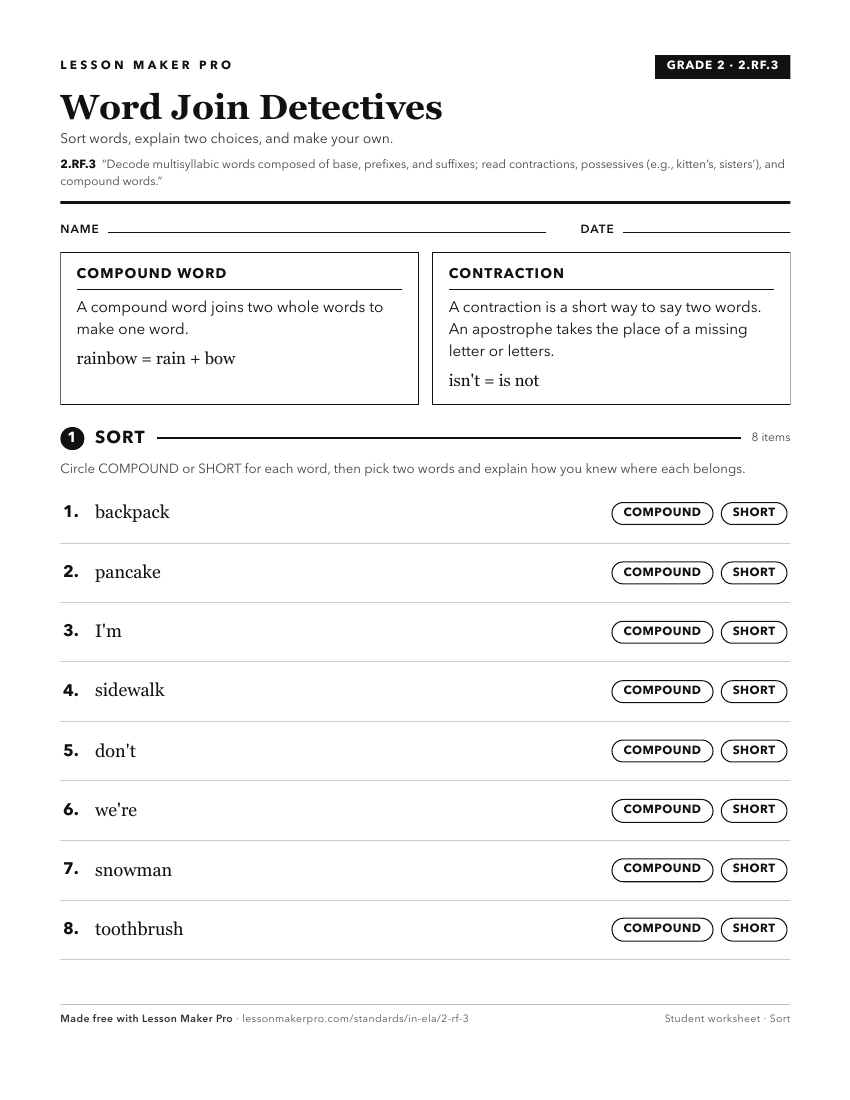
A ready-to-print activity worksheet aligned to 2.RF.3, with an answer key for the teacher on its own page. No account needed.
PDF, US Letter, prints cleanly in black and white.
Download the worksheetKeep exploring
Related Standards
- 3.RF.4
Read multisyllabic words composed of roots and related prefixes and suffixes; read irregular contractions (e.g., will not = won't) and possessives (e.g., childr...
- 1.RF.7
Decode grade-appropriate base words and affixes including common prefixes plurals, verb tense, inflectional suffixes (e.g., plurals, verb tenses), simple compou...
- 4.RF.2
Use knowledge of all letter-sound correspondences, syllabication patterns, and morphology (e.g., roots and affixes) to accurately read unfamiliar, multisyllabic...
- 5.RF.1
Use knowledge of all letter-sound correspondences, syllabication patterns, and morphology (e.g., roots and affixes) to accurately read unfamiliar, multisyllabic...
Turn this exact standard into a lesson
Grade, subject, topic, and the complete standard are prefilled. Create one free, no account needed.
Also for this standard:Make a WorksheetMake a QuizMake a Sub Lesson