Idaho Social Studies 9-12.GOV.48
The Standard
Compare partisan and non-partisan offices and elections.
Idaho Content Standards: K-12 Social Studies · Function And Structure of the U.S. Political System
Teacher's field guide
What This Standard Means
What Students Need to Do
- Students compare elections that list party affiliations with elections that do not. They check election rules to see whether parties nominate candidates for each office.
What Mastery Looks Like
- A student can explain why a U.S. House race is partisan and why a school board race may be nonpartisan. They can explain that a nonpartisan candidate may still have party ties.
Common Misconceptions
- Students may think nonpartisan candidates have no political views or party ties. They may assume every school board race is nonpartisan, or confuse an independent candidate with a nonpartisan election.
How to Assess It
- Exit ticket: A House ballot lists party labels. A school board ballot does not, and its rules prohibit party nominations. Identify each election type and explain whether school board candidates can still belong to a party.
Lesson moves
Ways to Teach It
Give pairs two printed mock ballots and election rule cards; have them underline party labels and sort the races by election type.
Ask students to write why a party endorsement does not automatically make a nonpartisan school board race partisan.
Run a card sort with U.S. House, a nonpartisan city council race, and an independent candidate in a partisan race; students justify each choice.
Open your county election office's sample ballot and rules; locate a race and check whether it uses party nominations or labels.
Free download
Printable 9-12.GOV.48 Worksheet
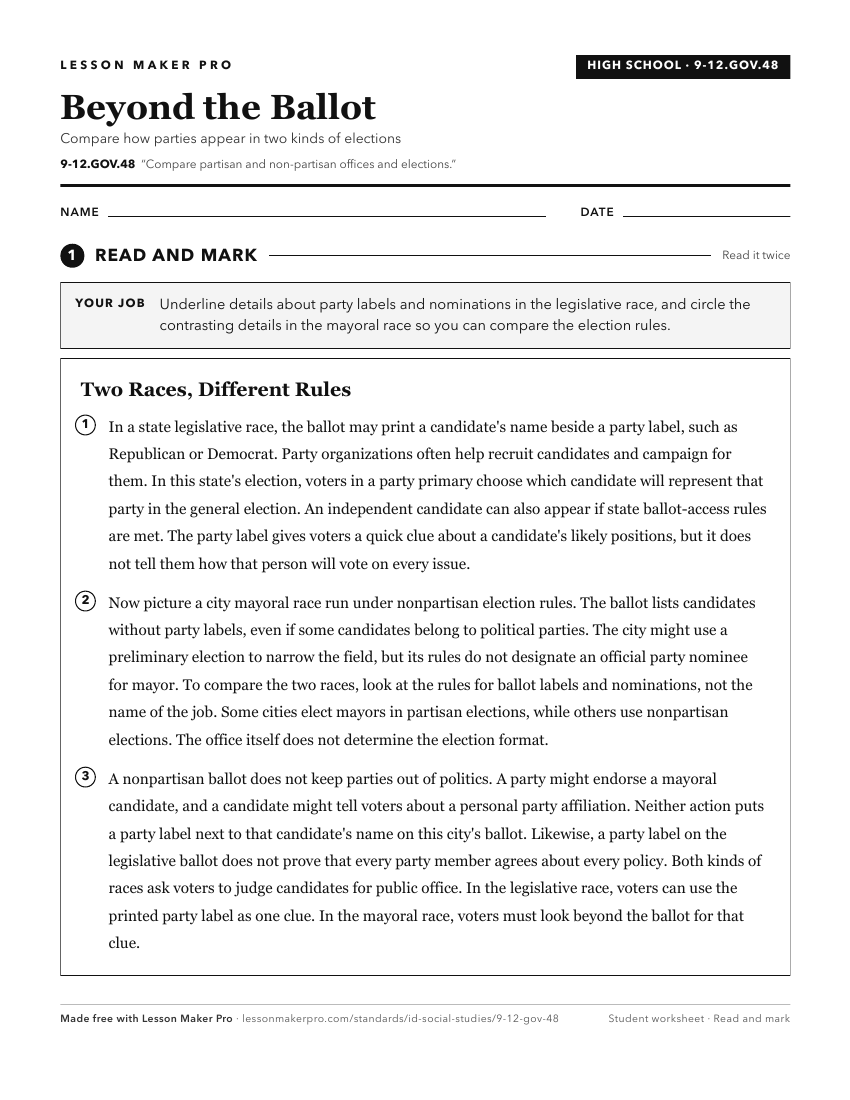
A ready-to-print activity worksheet aligned to 9-12.GOV.48, with an answer key for the teacher on its own page. No account needed.
PDF, US Letter, prints cleanly in black and white.
Download the worksheetKeep exploring
Related Standards
- 9-12.GOV.14
Compare and contrast major American political ideologies.
- 6-12.US1.18
Compare and contrast the political differences and similarities among early Republic Presidents, including the significance of the Election of 1800 and the Era ...
- 9-12.GOV.52
Analyze the influence of political parties, media coverage, campaign advertising, interest groups, public opinion polls, social media, and digital communication...
- 9-12.GOV.16
Explain the role and evolution of political parties in governing and in the recruitment/election of political candidates and the importance of and difference be...
Turn this exact standard into a lesson
Grade, subject, topic, and the complete standard are prefilled. Create one free, no account needed.
Also for this standard:Make a WorksheetMake a QuizMake a Sub Lesson