Idaho Social Studies 9-12.GOV.20
The Standard
Explain the history and significance of dual citizenship regarding American Indians.
Idaho Content Standards: K-12 Social Studies · Citizenship and Civic Participation
Teacher's field guide
What This Standard Means
What Students Need to Do
- Students trace earlier paths to U.S. citizenship and the change made by the 1924 Indian Citizenship Act. They explain how U.S. citizenship can coexist with citizenship in a tribal nation. They also explain why some Native people still could not vote after 1924.
What Mastery Looks Like
- Given a timeline, a student can explain who gained U.S. citizenship in 1924 and why some people were citizens before then. They can name tribal citizenship as a separate status and explain how a state voting restriction could still apply.
Common Misconceptions
- Students may think the 1924 law created tribal citizenship or required people to give it up. Others assume no American Indians were U.S. citizens before 1924, or that everyone could vote as soon as the law passed.
How to Assess It
- Exit ticket: A tribal citizen born in the U.S. had not gained U.S. citizenship by 1923. What changed in 1924, what status did they keep, and what voting barrier might remain?
Lesson moves
Ways to Teach It
Have pairs pin cards for the 1887 allotment law, the 1924 citizenship law, and Arizona's 1948 voting ruling onto a string timeline.
Read a 1924 law excerpt and a summary of Arizona's 1948 voting ruling, then ask: Why did U.S. citizenship not guarantee a ballot?
Sort cards marked 'tribe sets membership,' '1924 federal citizenship,' and 'Arizona voting restriction' into tribal citizenship, U.S. citizenship, or voting access piles.
Compare a current tribal nation's membership requirements with a state voter registration form, then identify which citizenship each document asks about.
Free download
Printable 9-12.GOV.20 Worksheet
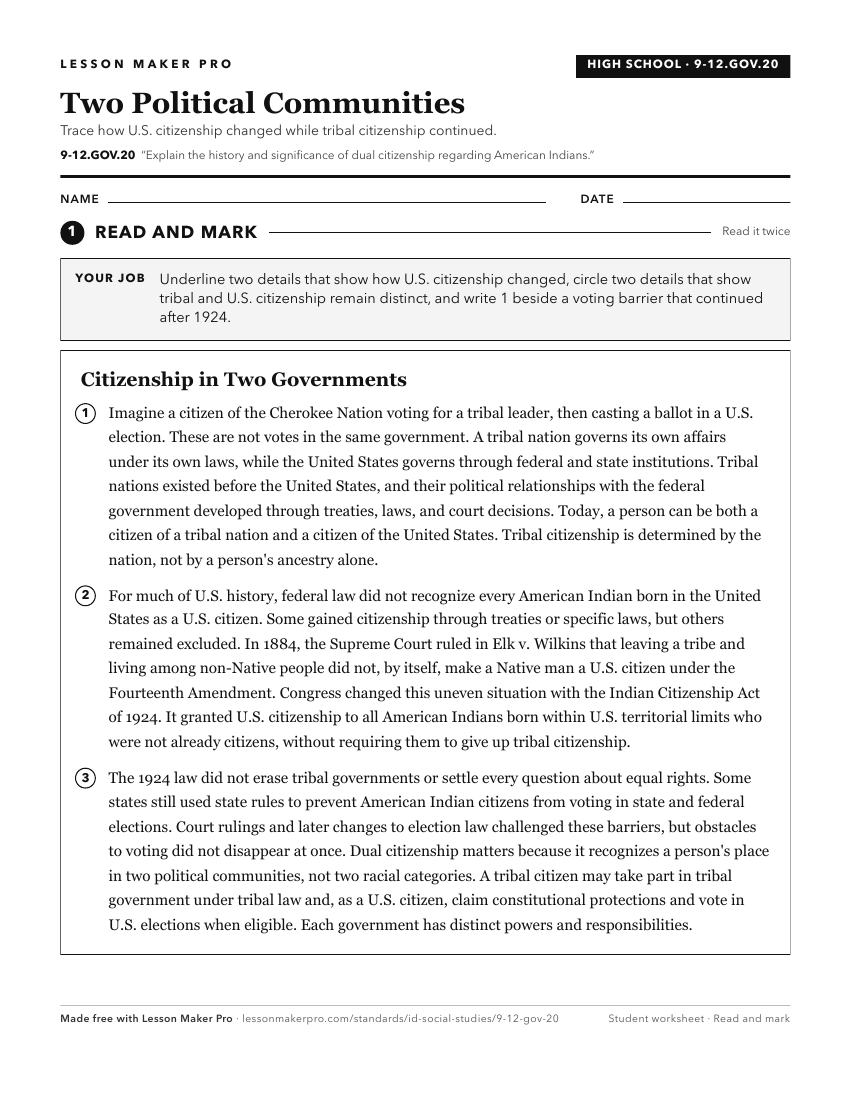
A ready-to-print activity worksheet aligned to 9-12.GOV.20, with an answer key for the teacher on its own page. No account needed.
PDF, US Letter, prints cleanly in black and white.
Download the worksheetKeep exploring
Related Standards
- 6-12.US1.31
Trace and explain how settlement patterns, federal policies, and treaties impacted American Indians through reservations, removal, and forced assimilation.
- 6-12.US1.48
Describe relations between American Indians and the United States government following the Civil War, including conflict, treaties, containment, reservation, an...
- 5.SS.1.10
Review that American Indians were the first inhabitants of the United States and analyze the impact of westward expansion on North American tribes.
- 9-12.US2.1
Analyze how federal policies established the relationship between the United States government and American Indian tribes, and the intended and unintended outco...
Turn this exact standard into a lesson
Grade, subject, topic, and the complete standard are prefilled. Create one free, no account needed.
Also for this standard:Make a WorksheetMake a QuizMake a Sub Lesson