Idaho Social Studies 9-12.EC.20
The Standard
Describe how life, health, home, and auto insurance protects against loss and mitigates financial consequences.
Idaho Content Standards: K-12 Social Studies · Personal Finance
Teacher's field guide
What This Standard Means
What Students Need to Do
- Students match life, health, home, and auto insurance to the losses each may cover. They explain how premiums, deductibles, coverage limits, and exclusions affect what a person still pays.
What Mastery Looks Like
- Given a death, hospital bill, house fire, or car crash, a student names the policy that may help and explains who receives payment. They can explain why insurance may not cover the full cost.
Common Misconceptions
- Students may think insurance pays every dollar for any related loss. They may confuse auto liability coverage for damage to others with collision coverage for their own car. Some assume standard home insurance covers floods.
How to Assess It
- Exit ticket: A parent dies, a teen breaks an arm, a kitchen burns, and a driver hits a parked car. Which policy may help with each loss, and why might one policy not pay the full cost?
Lesson moves
Ways to Teach It
Give pairs 20 paper $100 chips for a covered $2,000 home claim; set aside five for the deductible and count the insurer's payment.
Present two auto policies, one with liability only and one with collision; ask which pays to repair your car after you cause a crash.
Run a four-corner quiz: read a broken arm, kitchen fire, car crash, and worker's death; students move to the matching insurance label.
Use a sample auto quote with a $900 annual premium and $1,000 collision deductible; calculate each party's share of a covered $4,000 repair.
Free download
Printable 9-12.EC.20 Worksheet
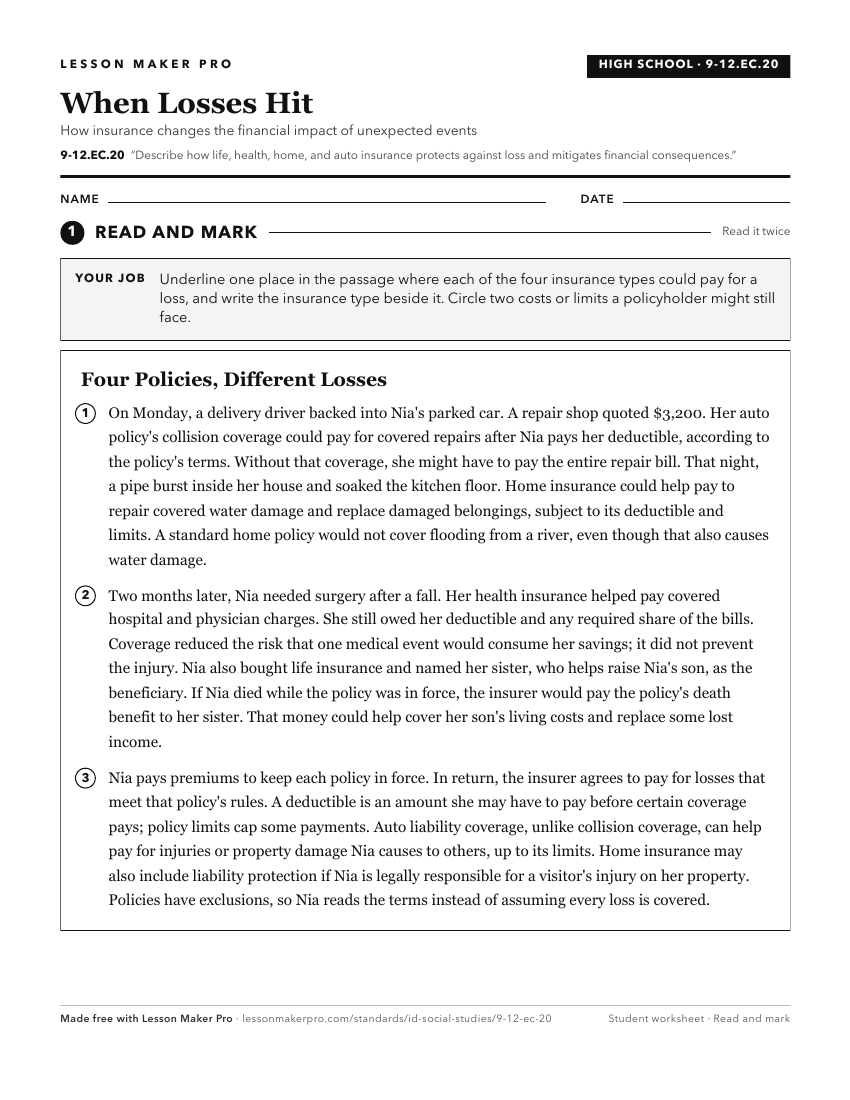
A ready-to-print activity worksheet aligned to 9-12.EC.20, with an answer key for the teacher on its own page. No account needed.
PDF, US Letter, prints cleanly in black and white.
Download the worksheetKeep exploring
Related Standards
- K.SS.3.2
Explain the benefits of saving money and give examples of how people use money to make purchases.
- 1.SS.3.3
Identify ways to save money for future needs and wants
- 4.SS.4.2
Explain that rules and laws can be used to protect rights, provide benefits, and assign responsibilities.
- 3.SS.4.1
Explain the benefits of following the laws and the consequences of breaking the rules and laws of our local and national communities.
Turn this exact standard into a lesson
Grade, subject, topic, and the complete standard are prefilled. Create one free, no account needed.
Also for this standard:Make a WorksheetMake a QuizMake a Sub Lesson