Idaho Social Studies 6-9.WG.6.1
The Standard
Explain how and why events may be interpreted differently according to the points of view of participants and observers.
Idaho Content Standards: K-12 Social Studies
Teacher's field guide
What This Standard Means
What Students Need to Do
- Students compare accounts of the same event from people who took part and people who watched. They look for differences in what each person saw, knew, and cared about. They explain why the accounts differ using details from both sources.
What Mastery Looks Like
- Given two accounts of a flood, a student can name where they agree and differ. They can point to details that show how each person's location or role shaped their account.
Common Misconceptions
- Students may assume a firsthand account is always more accurate than a reporter's account. They may also treat different descriptions as proof that someone is lying, rather than asking what each person could see.
How to Assess It
- Exit ticket: Give students these lines about a flood: a resident says, 'The river reached our front steps,' and a reporter says, 'The east road was closed.' Ask how both accounts could be accurate and why each focuses on a different detail.
Lesson moves
Ways to Teach It
Place resident, reporter, and rescue worker cards on a paper flood map; mark what each could see from that location.
Read two accounts of a flooded street, then write: What does each person notice that the other misses, and why?
Match six flood quotes to resident, rescue worker, or reporter cards; defend each match with a clue from the quote.
Compare a road crew's street-closure notice with a bus rider's account, then explain how their roles shape what they report.
Free download
Printable 6-9.WG.6.1 Worksheet
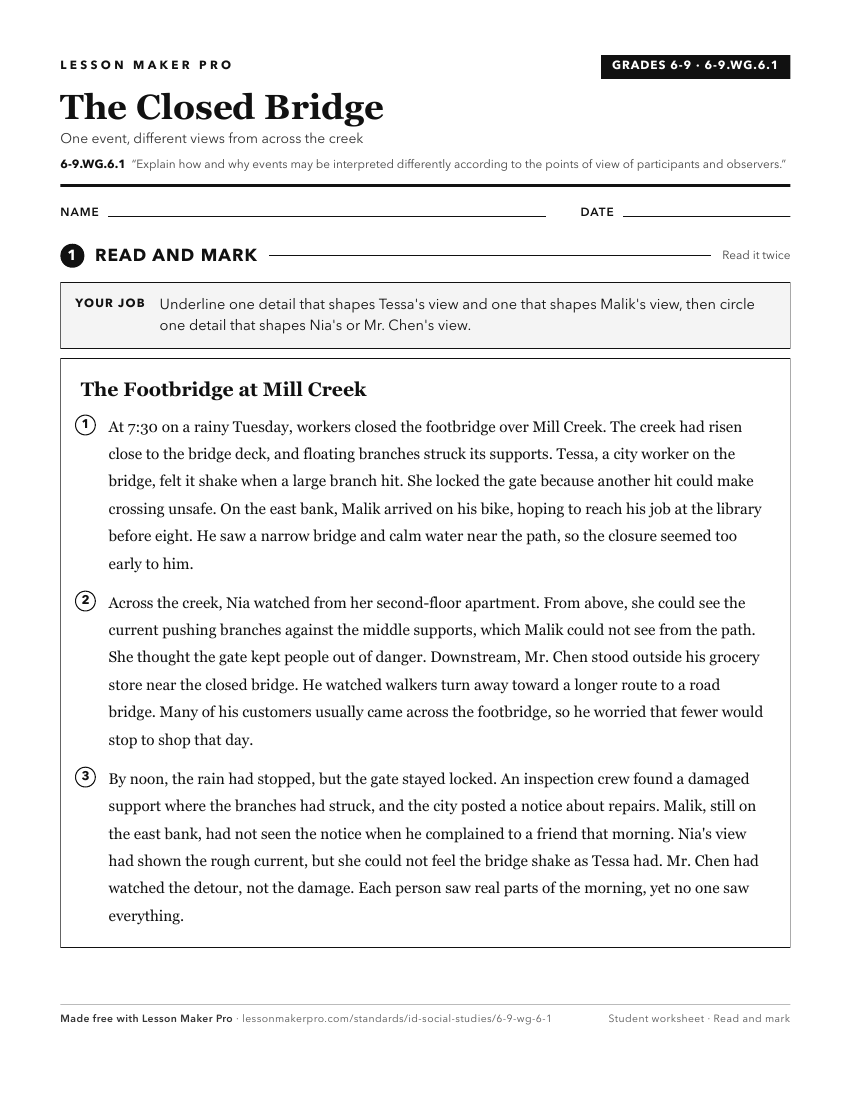
A ready-to-print activity worksheet aligned to 6-9.WG.6.1, with an answer key for the teacher on its own page. No account needed.
PDF, US Letter, prints cleanly in black and white.
Download the worksheetKeep exploring
Related Standards
- 6-9.WG.5.3
Analyze how miscommunication or misunderstandings of different cultures can lead to conflict.
- 6-12.HT2.5
Analyze how current interpretations of the past are limited by the extent to which available historical sources represent the perspectives of people at the time...
- 6-12.HT1.8
Analyze how current interpretations of the past are limited by the extent to which available historical sources represent the perspectives of people at the time...
- 6-9.WH.6.3
Explain how and why events may be interpreted differently according to the points of view of participants and observers.
Turn this exact standard into a lesson
Grade, subject, topic, and the complete standard are prefilled. Create one free, no account needed.
Also for this standard:Make a WorksheetMake a QuizMake a Sub Lesson