Idaho Social Studies 6-12.US1.3
The Standard
Analyze the development of the New England, Mid-Atlantic, and Southern Colonies, including the reasons for the establishment, the economic, political, and social development, and the relationships with American Indians.
Idaho Content Standards: K-12 Social Studies · American Indian Cultures and Colonization Cultures and Colonization 1491-1754
Teacher's field guide
What This Standard Means
What Students Need to Do
- Students compare why colonists settled in three regions and how they made a living, governed, and organized social life. They explain how settlers and Indigenous nations traded, negotiated, and fought over land, and how those relationships changed.
What Mastery Looks Like
- A student can compare Puritan towns in Massachusetts Bay, Pennsylvania's mixed farming and religious diversity, and Virginia's tobacco plantations and forced labor. They can explain why each colony began, who held power, and how relations with a named Indigenous nation changed.
Common Misconceptions
- Students may assume every New England colony was founded for religious freedom or every Southern colonist owned a plantation. They may describe Indigenous relations as only warfare, or assume colonial assemblies gave everyone a vote.
How to Assess It
- Exit ticket: Compare Pennsylvania and Virginia. Why was each founded, how was work or political power organized, and how did relations with Lenape or Powhatan peoples change?
Lesson moves
Ways to Teach It
Have groups place Massachusetts Bay, Pennsylvania, and Virginia fact cards on a map, then sort the cards by founding goal, work, government, and Indigenous relations.
Ask students to write: How did Penn's early land agreements with Lenape leaders differ from Virginia settlers' conflicts with Powhatan peoples?
Read clues such as 'town meetings,' 'grain exports,' and 'tobacco plantations'; pairs point to a region on a map and explain each choice.
Compare a map of Powhatan towns near Jamestown with a current Virginia map; trace the James River and identify which place names remain.
Free download
Printable 6-12.US1.3 Worksheet
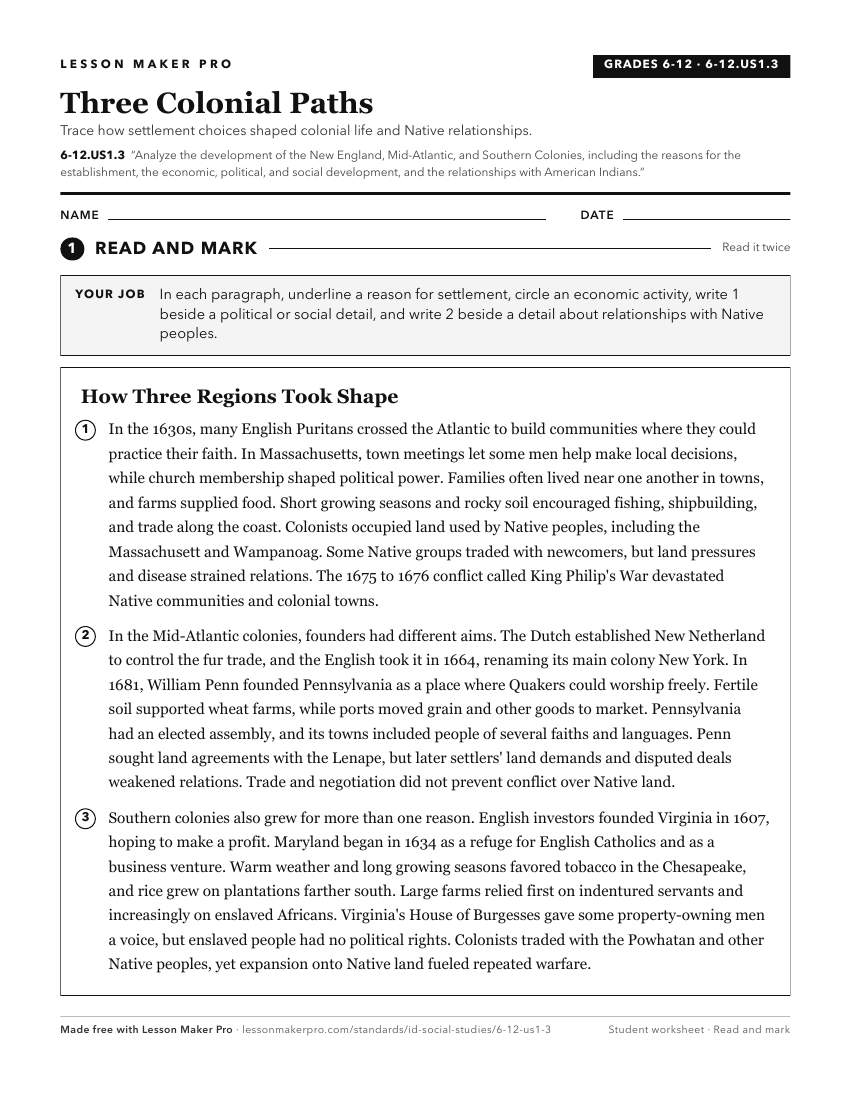
A ready-to-print activity worksheet aligned to 6-12.US1.3, with an answer key for the teacher on its own page. No account needed.
PDF, US Letter, prints cleanly in black and white.
Download the worksheetKeep exploring
Related Standards
- 6-12.US1.5
Compare the settlement motivations and impacts of the Spanish, Dutch, French, and English in North America.
- 6-12.US1.6
Compare the settlement motivations and impacts of the Spanish, Dutch, French, and English in North America.
- 6-12.US1.4
Explain the differences with economic systems between New England, and the Mid-Atlantic and Southern colonies, including indentured servitude and slavery as lab...
- 6-12.US1.7
Trace and analyze the colonial social, religious, political, and economic developments that provided context for the American Revolution, including, but not lim...
Turn this exact standard into a lesson
Grade, subject, topic, and the complete standard are prefilled. Create one free, no account needed.
Also for this standard:Make a WorksheetMake a QuizMake a Sub Lesson