Idaho Social Studies 6-12.US1.1
The Standard
Compare and contrast the culture of various American Indian communities that were established in North America prior to European settlement, including but not limited to: • Arctic (Inuit, Aleut) • Subarctic (Cree, Ojibwa) • Northeast (Iroquois, Ottawa) • Southeast (Creek, Seminole, Chickasaw, Choctaw, Cherokee) • Great Plains (Dakota, Blackfoot, Comanche) • Great Basin (Shoshone, Bannock, Ute) • Plateau (Nez Perce, Salish) • Southwest (Pueblo, Apache, Navajo) • Pacific Coast (Mohave, Chinook, Tillamook) • Other Idaho tribes (Coeur d’Alene, Kootenai, Paiute)
Idaho Content Standards: K-12 Social Studies · American Indian Cultures and Colonization Cultures and Colonization 1491-1754
Teacher's field guide
What This Standard Means
What Students Need to Do
- Students locate distinct Native nations across North America before European settlement. They compare how communities got food, built homes, and made decisions, using evidence rather than treating a whole region as one culture.
What Mastery Looks Like
- A student can use a map and source details to compare two nations. They can name a specific similarity and difference without claiming everyone in either region lived alike.
Common Misconceptions
- Students may call every community nomadic or assume everyone in one region lived the same way. They may treat regional map lines as fixed tribal borders or speak of living nations only in the past.
How to Assess It
- Exit ticket: Using the class source cards, compare how Inuit and Nez Perce communities got food before European settlement. Give one similarity and one difference, with a fact for each.
Lesson moves
Ways to Teach It
Pairs pin source cards about Inuit seal hunting, Haudenosaunee corn farming, and Nez Perce salmon fishing to a North America map.
Ask: What did Inuit seal hunting and Nez Perce salmon fishing have in common, and how did the places and methods differ?
Play a card sort matching each named nation to its region and a food source, then have partners explain two matches using the map.
Read a local tribal nation's official website for a present-day food or language program, then compare it with a historical account of that nation.
Free download
Printable 6-12.US1.1 Worksheet
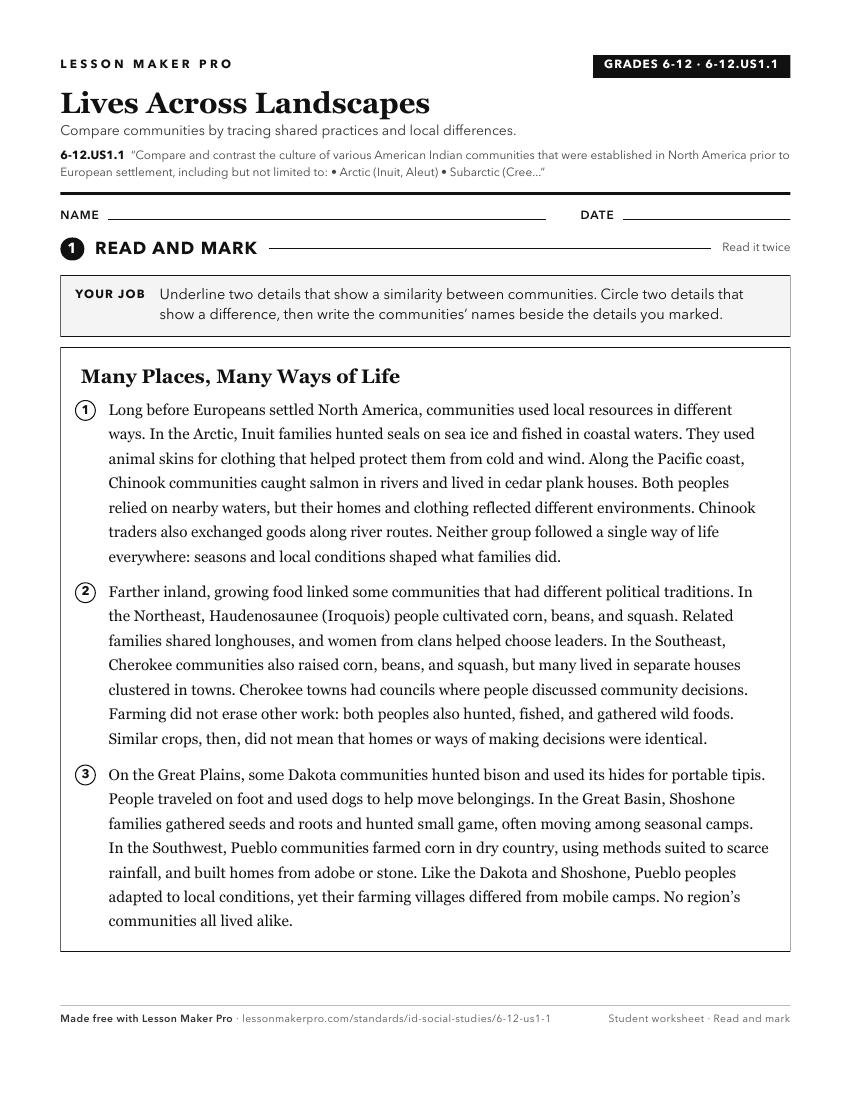
A ready-to-print activity worksheet aligned to 6-12.US1.1, with an answer key for the teacher on its own page. No account needed.
PDF, US Letter, prints cleanly in black and white.
Download the worksheetKeep exploring
Related Standards
- 6-12.US1.5
Compare the settlement motivations and impacts of the Spanish, Dutch, French, and English in North America.
- 4.SS.5.4
Compare the distinct histories, cultures, and ways of life of American Indian tribes in Idaho with those of indigenous peoples around the world.
- 6-12.US1.6
Compare the settlement motivations and impacts of the Spanish, Dutch, French, and English in North America.
- 5.SS.1.10
Review that American Indians were the first inhabitants of the United States and analyze the impact of westward expansion on North American tribes.
Turn this exact standard into a lesson
Grade, subject, topic, and the complete standard are prefilled. Create one free, no account needed.
Also for this standard:Make a WorksheetMake a QuizMake a Sub Lesson