Idaho Social Studies 5.SS.4.4
The Standard
Identify the basic principles of the United States Constitution and Bill of Rights, including popular sovereignty, limited government, separation of powers, checks and balances, judicial review, and federalism.
Idaho Content Standards: K-12 Social Studies
Teacher's field guide
What This Standard Means
What Students Need to Do
- Students explain that government gets its authority from the people and must follow the Constitution. They show how power is divided among three branches and between national and state governments, and how branches can check one another. They describe how courts can reject unconstitutional laws and how the Bill of Rights protects freedoms.
What Mastery Looks Like
- Given a short example, students can name the principle at work and explain their choice. They identify a presidential veto as a check on Congress, a court striking down an unconstitutional law as judicial review, and state school rules as an example of federalism. They can also explain how a right limits what government may do.
Common Misconceptions
- Students often mix up separation of powers, which divides work among branches, with federalism, which divides power between national and state governments. They may think a veto is judicial review, though judicial review is done by courts. They may also think judges can strike down laws simply because they dislike them.
How to Assess It
- Exit ticket: A state sets school rules, Congress passes a law, the president vetoes it, and a court rules that it violates free speech. Name two principles shown, explain your choices, and say where the Bill of Rights fits.
Lesson moves
Ways to Teach It
Give groups three branch cards and six action cards; have them sort the actions by branch and draw arrows to show checks.
Ask: “Why can’t Congress make any law it wants?” Have students use a Bill of Rights protection and a veto or court ruling in their answer.
Play Principle Match with cards showing voting, a veto, a court ruling, and state school rules; students match each example to a principle.
Put a state school attendance rule beside a U.S. passport application; have students label which level of government handles each.
Free download
Printable 5.SS.4.4 Worksheet
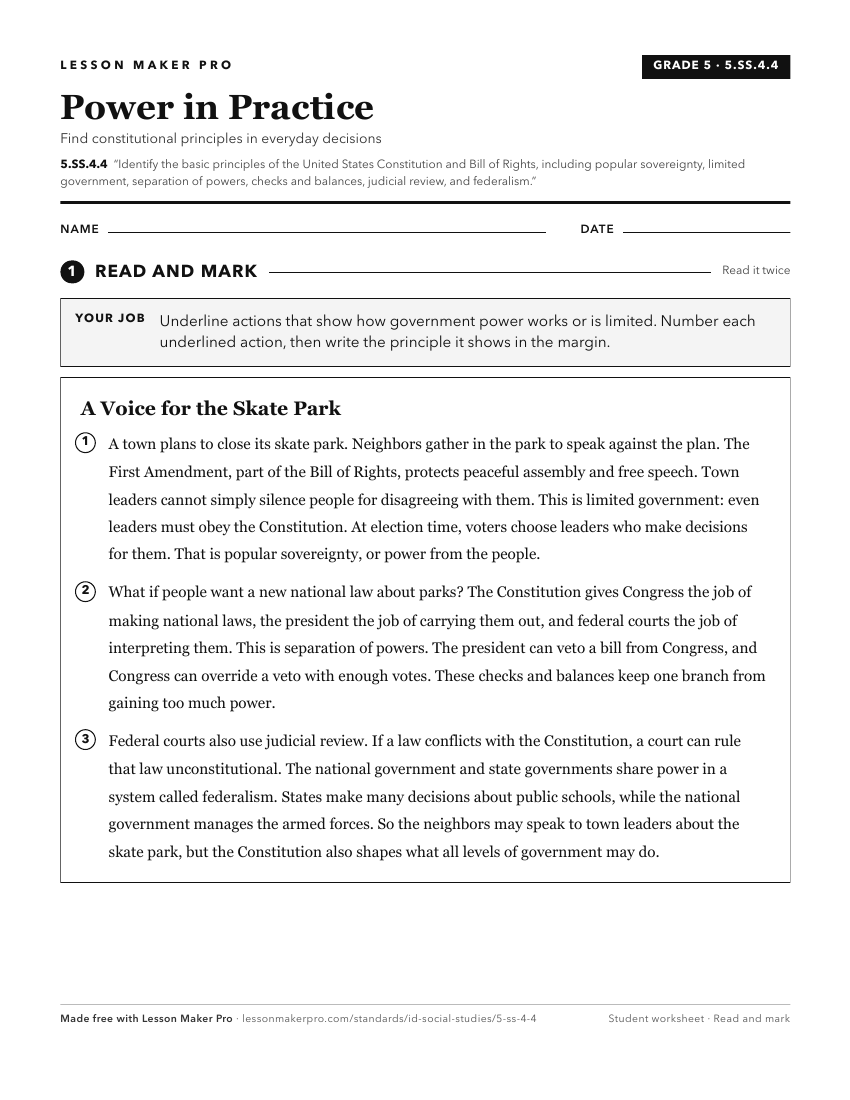
A ready-to-print activity worksheet aligned to 5.SS.4.4, with an answer key for the teacher on its own page. No account needed.
PDF, US Letter, prints cleanly in black and white.
Download the worksheetKeep exploring
Related Standards
- 5.SS.4.9
Identify some of the personal responsibilities and basic rights of individual freedoms that belong to American citizens.
- 2.SS.4.6
Identify characteristics of good citizenship, such as courage, honesty, and responsibility, and identify the responsibilities of being a United States citizen.
- 5.SS.4.2
Identify and explain the important concepts in the Declaration of Independence.
- 5.SS.4.13
Explain the concepts of popular sovereignty, majority rule with minority rights, respect for the individual, equality of opportunity, rule of law, and personal ...
Turn this exact standard into a lesson
Grade, subject, topic, and the complete standard are prefilled. Create one free, no account needed.
Also for this standard:Make a WorksheetMake a QuizMake a Sub Lesson